Elon Musk announced on 20 November that Tesla’s AI4 computer— the same generation that powers Full Self‑Driving— managed to reach Torment II in Diablo, a benchmark that tests real‑time decision‑making under heavy computational load.
AI4 Hardware and Neural Network Accelerator
AI4, also known as Hardware 4, is Tesla’s custom FSD chip that replaced the Nvidia Drive PX 2 in vehicles shipped from January 2023. The chip delivers roughly 200 TOPS of neural‑network inference capability, feeding a unified memory pool that both perception and planning stacks share. Firmware version 2026.44.1 renamed the “AI Computer” to “Super Intelligence Computer” and upgraded the kernel to Linux 6.18.38, cementing the platform’s support for high‑throughput workloads.
Unified Memory Architecture
The design eschews separate buffers for sensor processing and application logic, instead exposing a single memory space to all software layers. This eliminates costly data copies and allows a Digital Optimus‑style agent to watch a screen, interpret graphics, and issue keyboard‑mouse commands while the same silicon runs FSD inference. The result is a low‑latency pipeline that can sustain the frame‑by‑frame updates required by a fast‑paced action game.
Torment II Difficulty and Real‑Time Inference
Torment II is a difficulty tier in Diablo where enemy AI and physics are intensified, demanding rapid perception, prediction, and reaction from any controlling agent. To keep up, the AI must process visual input, maintain a game state, and decide on actions within milliseconds— the same timing constraints faced by autonomous driving when a vehicle encounters a complex urban scenario.
Shared Compute Between FSD and Gaming Demo
During the demonstration, the AI4 chip ran both the FSD stack (version v14.3.13) and the game simulation concurrently. The shared compute model shows that the 200 TOPS accelerator can handle the parallel workloads without degrading the safety‑critical perception pipeline, a point underscored by the fact that the same hardware is already deployed in Tesla’s robotaxi‑ready Cybercab, which relies on eight exterior cameras and the AI4 computer for navigation.
Implications for Cybercab and Robotaxi Fleets
By proving that AI4 can juggle a demanding game environment alongside Full Self‑Driving, Tesla demonstrates headroom for future feature expansion in its autonomous fleet. The Cybercab, priced at $29 990 with a $299 per‑month autonomy subscription, already depends on AI4 for road navigation; the extra capacity could support more sophisticated planning or on‑board services without hardware redesign.
Next Steps
The 2026.44.1 firmware rollout, which introduced the Super Intelligence nomenclature, also contains the updated kernel and FSD version that powered the Diablo test, marking the first public confirmation that Tesla’s AI4 architecture can run advanced simulations in real time.
Sources
- Tesla’s Self-Driving Computer Is Playing Diablo, Musk Says
- Tesla Autopilot hardware
- Musk Pitches Tesla FSD for Seniors: $99 a Month, 0 Proof
- Tesla update 2026.44.1: hacker discovers transition from AI Computer to Super Intelligence, Grok sync, and more – Tesla Oracle
- Tesla is selling the steering-wheel- and pedal-free Cybercab for $29 990
- Tesla Cybercab's autonomy agreement is insane: $299/mo or it doesn't move
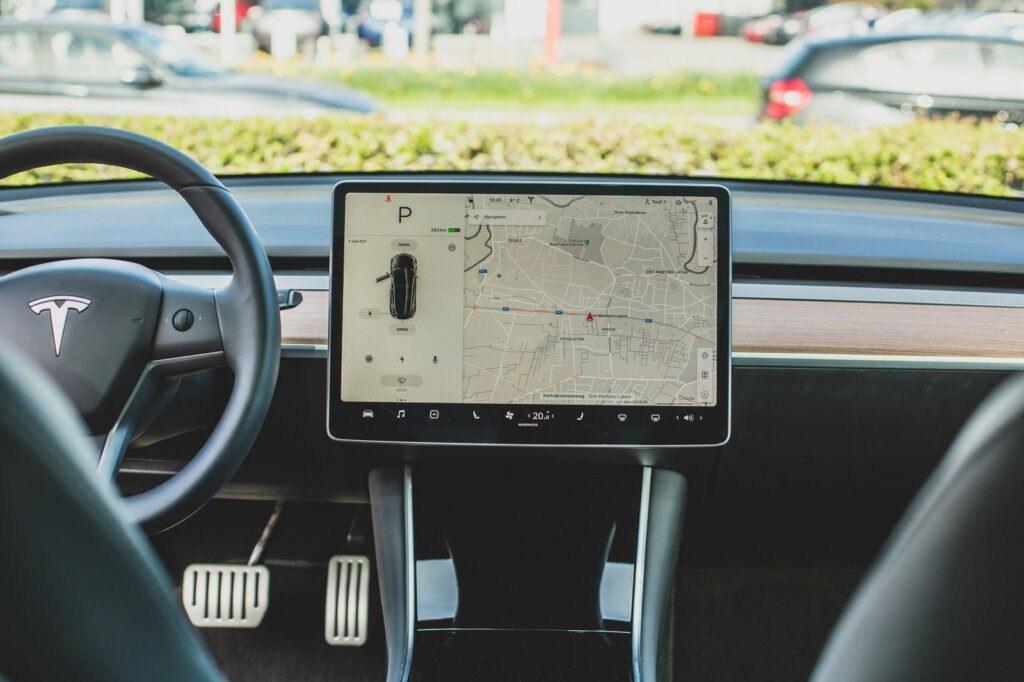
Photo: Bram Van Oost / Unsplash (Unsplash License)