The Royal Swedish Academy of Sciences has awarded the 2026 Nobel Prize in Physics for “decisive contributions to the IceCube Neutrino Observatory and the discovery of high-energy neutrinos of astrophysical origin.” The announcement was made on October 6. The citation names Francis Halzen, the project’s principal investigator and a professor at the University of Wisconsin-Madison.
Halzen was born in 1944 in Tienen, Belgium, and took his PhD at KU Leuven in 1969. According to the Academy, he first set out his plan for catching neutrinos at the South Pole in 1988. His reasoning was that a neutrino colliding with an atomic nucleus produces a flash of light, and that clear glacial ice could let sensors track it. The Pole offered other advantages: little interference, and ground that is geologically stable, with no earthquakes. Other researchers backed the idea, and within a few years sensors were being tested in ice.
Why so much ice
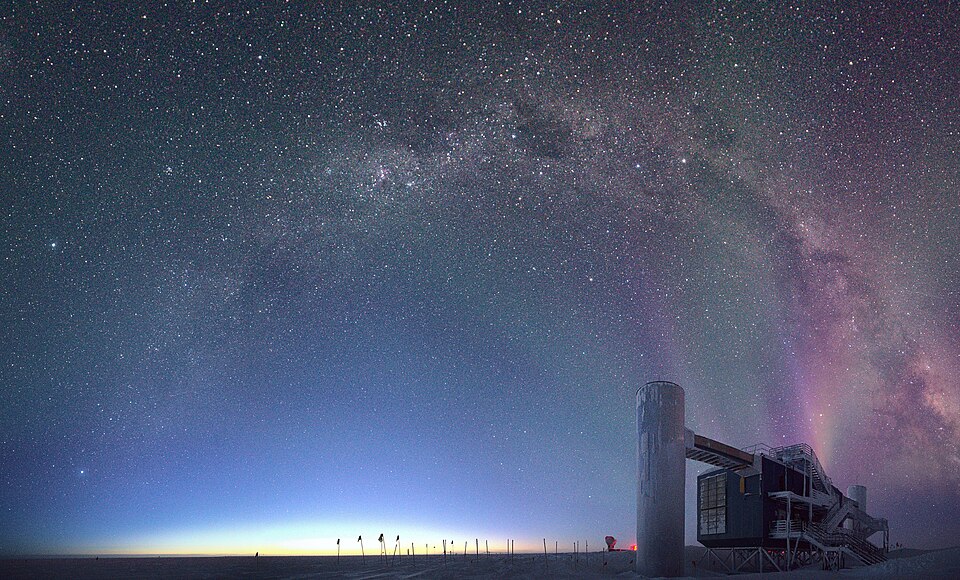
Neutrinos pass through the Earth and through human bodies without a trace. Only very rarely does one interact with a nucleus. Cosmic neutrinos with extreme energies are rarer still, so an enormous volume of material is needed to catch enough of them. IceCube covers a full cubic kilometre of ice and was completed on December 17, 2010, at a total cost of $279 million.
The payoff, the Academy said, is that neutrinos reach Earth without changing direction or losing energy. Natural particle accelerators in space fire out particles at energies up to a million times beyond what laboratories can produce. Much about those sources remains unknown. Neutrinos carry information about them that no other particle can.
The committee’s view
“Francis Halzen has led an international team of researchers and engineers who have provided us with a fantastic instrument,” said Mark Pearce, Chair of the Nobel Committee for Physics. “His tenacity and scientific vision has paved the way for a new kind of astronomy.”
The detector has not stood still. An upgrade approved in 2019 was announced as successfully deployed on February 12, 2026. It added five densely spaced strings of light sensors to the 86 already in the ice, along with more than 600 newer sensors and calibration instruments. The new sensors are two to three times more sensitive than the older ones, and two seismometers were placed beneath the ice, the deepest in the world. Plans for a further expansion, IceCube-Gen2, are in the federal approval process.