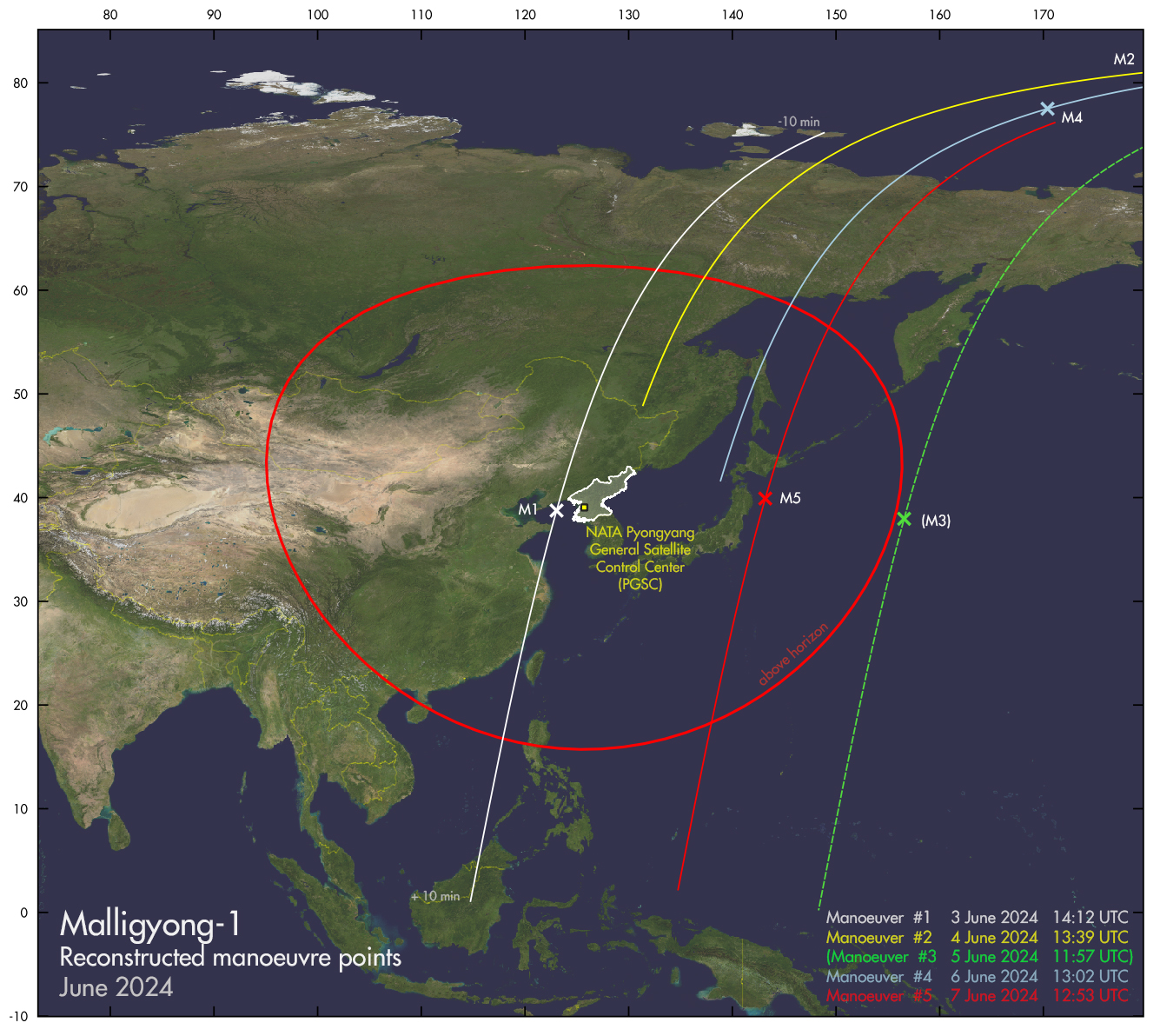
On February 19, 2024, North Korea’s Malligyong-1 satellite, launched in November 2023, performed orbital maneuvers that experts confirm show it is alive and communicating with Earth. Marco Langbroek, a satellite expert from Delft University of Technology, detected the changes using publicly available tracking data. The satellite raised its perigee to reach a more circular orbit at 303.2 miles above the surface. This development contradicts earlier assessments by South Korean officials who had dismissed the satellite as non-functional. The reemergence raises new questions about North Korea’s space capabilities and its potential for military surveillance.
What the orbital data shows
Langbroek’s analysis relies on orbital tracking data from the U.S. Space Force and other open sources. On February 19, the satellite executed a maneuver that lifted its lowest orbital point. This is not a passive drift. It requires an active propulsion system and ground commands.
“The satellite is alive. It performs orbital maneuvers, which proves it is functional,” Langbroek told reporters. He noted that the maneuver was small but deliberate. The perigee increase was about 1.2 miles. That may sound minor, but it confirms the satellite has onboard propulsion and is under active control.
The satellite now orbits at an altitude between 303 and 311 miles. That is a nearly circular orbit. Such orbits are more stable and better for imaging. Langbroek said the maneuver likely aimed to extend the satellite’s operational lifetime by countering atmospheric drag.
Conflicting assessments from South Korea
South Korean officials have taken a different view. Defense Minister Shin Won-sik previously stated that the satellite was not performing any meaningful reconnaissance. He said it showed no signs of active communication or imagery transmission.
“We assess that the satellite is not functioning as a spy platform,” Shin said in a January briefing. He added that North Korea lacked the technology to operate a military-grade reconnaissance satellite.
Langbroek’s findings challenge that assessment. However, no independent organization has detected any signals from Malligyong-1. The satellite has not been heard transmitting data. That does not mean it is dead. It could be operating in a passive mode, storing images for later download. Or it could be testing its systems before full activation.
The gap between what North Korea claims and what outsiders can verify remains wide. Pyongyang’s state media says the satellite is already spying on U.S. and South Korean military sites. Langbroek says it is functional, but he cannot confirm whether it is taking usable pictures.
Geopolitical fallout from the launch
The Malligyong-1 launch in November 2023 was North Korea’s third attempt at putting a satellite in orbit. The first two failed. The third succeeded, but it triggered strong reactions from neighbors.
Japan issued a missile attack warning during the launch. South Korea suspended a 2018 military agreement with North Korea that had reduced tensions along the border. The United Nations Security Council held an emergency meeting. North Korea’s satellite program uses ballistic missile technology, which is banned under multiple UN resolutions.
The United States condemned the launch. The White House called it a provocation and a violation of international law. President Trump’s administration has maintained a policy of maximum pressure on North Korea. The satellite’s apparent success complicates that strategy. It shows that North Korea can overcome technical hurdles despite sanctions.
What comes next
South Korean Minister Shin has predicted that North Korea will attempt a second satellite launch in the coming months. That would signal an accelerated space program. North Korea’s leader, Kim Jong Un, has made satellite development a priority. He wants a constellation of reconnaissance satellites to monitor U.S. forces in the region.
Langbroek said the orbital maneuver suggests North Korea is learning. “They are gaining experience in orbital operations,” he said. That experience could transfer to military applications. A satellite that can change its orbit can also evade tracking or adjust its coverage area.
The United States and South Korea are watching closely. They have the ability to track the satellite and monitor its signals. If it starts transmitting imagery, they will know. For now, the satellite remains a mystery. It is alive, but its mission is unclear.
The reemergence of Malligyong-1 shows that North Korea’s space program is not a dead end. It is a work in progress. The satellite may not be a sophisticated spy platform yet. But it is a step forward for Pyongyang. And it is a reminder that the regime is willing to break international rules to advance its military capabilities. The world will have to adapt to a North Korea that can put working satellites in orbit.