
Four paragraphs in a scientific journal. That was all it took. On 18 June 1908, the English electrical engineer A. A. Campbell Swinton wrote to Nature under the heading “Distant Electric Vision” and laid out how television might work with no moving parts at all.
The catch is that he could not build it, and neither could anyone else.
An electron beam at both ends
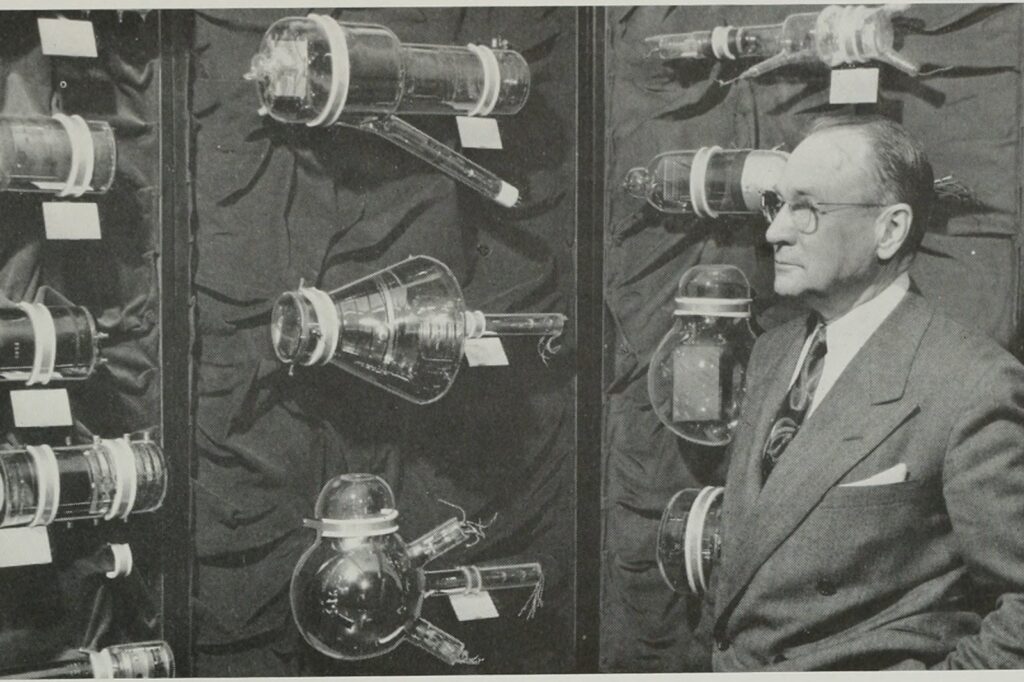
The cathode ray tube was not his invention. The German physicist Karl Ferdinand Braun had made the first one in 1897. Swinton’s idea was to aim an electron beam inside the camera as well as the receiver, and steer both electronically so they traced moving pictures. The letter was a reply to the inventor Shelford Bidwell, who had written in the 4 June issue about how photographic telegraphy might be done.
He kept refining the scheme. In a lecture to the Röntgen Society, he presented a diagram that was published in the society’s journal in 1912. It had flaws. The generators would have produced sine wave deflection where television needs a sawtooth, and there was no amplification. The proposed operating voltage of 100 kV looked less odd to a man used to X ray tubes. Paul Marshall, writing in a history of the subject, still judged that every basic ingredient of the later electronic systems was already on the page.
Timing was the real obstacle. In 1911 the thermionic valve was still new, and wireless relied on spark gaps and coherers. Nothing existed to oscillate, process or amplify signals electronically. Swinton himself saw that a large industrial laboratory would be needed to turn the idea into hardware. He never patented it.
A rival claim, and the race that followed
There is a competing claim to precedence. In St Petersburg in 1911, Boris Rosing got a display tube to scan four lines, linked to a mechanical image scanner. Observers at the time called the result “four luminous bands”. Rosing never took the leap of using a tube to capture images. Even Russian histories give Swinton credit for that.
The patents that followed looked a lot like his sketch. Vladimir Zworykin filed in 1923 and Kálmán Tihanyi in 1928. Only Philo Farnsworth’s scanned phototube image dissector, patented in 1929, differed, and even that shared common ground. By 1930 RCA, the Philco Storage Battery Company and Farnsworth’s company were all working on all-electronic television.
Swinton did not live to see the result. In the mid 1920s the field had fallen for mechanical television, built on an 1884 idea of Paul Nipkow and pushed by Baird in Britain and Charles F Jenkins in the United States. Swinton thought money was going into a blind alley. He died of pneumonia in 1930, aged 66, and the only television he ever saw was Baird’s mechanical kind.
His system was never built. Yet the cathode ray tube went on to display pictures in almost all television sets and computer monitors until the LCD panel arrived.
Sources
- Archibald Campbell-Swinton Describes "Distant Electric Vision," the Earliest Concept for Electronic or CRT Television (History of Information)
- One Hundred Years of All-Electronic Television (BECG, Paul Marshall)




