
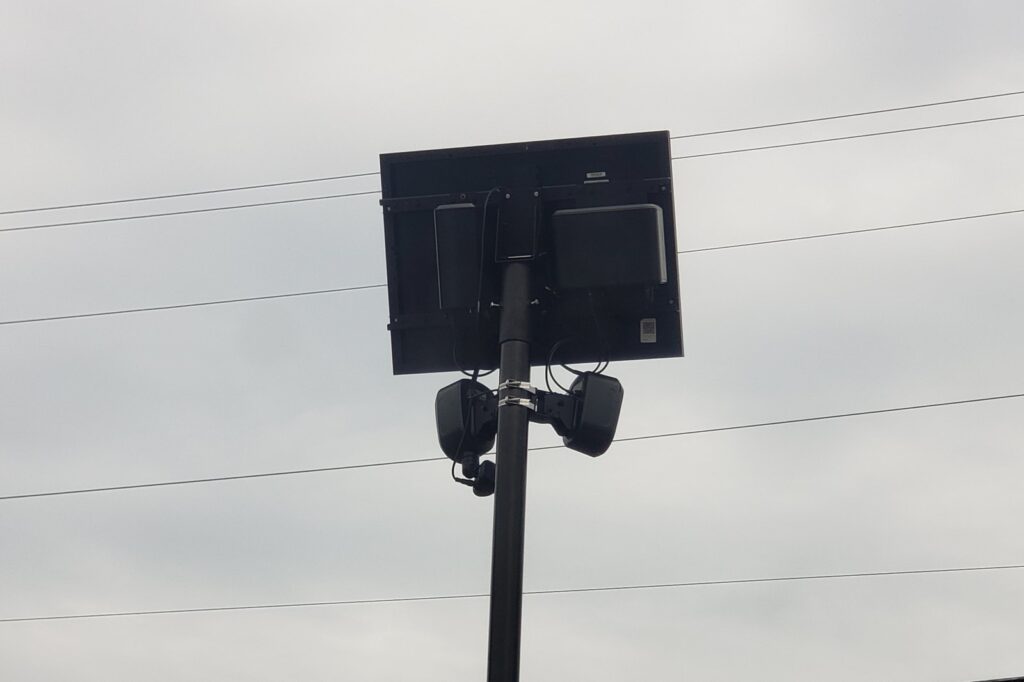
Deputy Sheriff Freddie Alaniz was parked beside a highway in Oklahoma in May when a Mazda SUV with California plates went by. According to the court opinion, he pulled out to follow it for no apparent reason other than those plates, and ran the number through Flock’s license plate reader system. Months later, a federal judge has ruled that search was unconstitutional.
Judge Sara Hill, in an opinion 404 Media reported on October 2, found that Alaniz’s use of the system “was an Unconstitutional Warrantless Search” that “was not supported by probable cause, and it was done without a warrant.” It is one of the first times a federal judge has decided that Flock searches can violate the Fourth Amendment.
The stop
Alaniz stopped the driver, Melisa Kyle, supposedly for changing lanes without a signal. He questioned her about her recent travels while continuing to review the license plate reader data, made her recount several days of activity and compared it with what Flock showed. Because she had spent only a short time in California, he suspected drug trafficking. He used her travel history from the system as part of his justification to search the car, and found 91 pounds of meth. Hill ordered all Flock evidence and everything from the car search thrown out.
The reader search alone gave Alaniz more than 50 individual records of Kyle’s whereabouts across the country over a month. “The only reason Alaniz conducted that search was because he saw her license plate was from California,” Hill wrote. The factors the government cited, she added, are what everyday Americans meet on long road trips for many legitimate reasons.
A dragnet, in the judge’s words
Hill acknowledged that people broadly have no reasonable expectation of privacy on public roads. But officers using the system, she wrote, can see a continuously updated location history for every vehicle caught by cameras in the network. “This is a type of indiscriminate mass surveillance,” she wrote. It collects information on all vehicles passing any connected camera and serves it to law enforcement on demand.
She said earlier rulings that Flock searches are not Fourth Amendment violations leaned on United States v Knotts, a 1983 case about a tracking device placed in a chemical container, and missed the difference between that and a large-scale, dragnet-type system. The decision follows the Supreme Court’s Chatrie v United States ruling that police access to a person’s digital data, including phone location data, is a search.
Michael Soyfer, a lawyer at the Institute for Justice, called the opinion “pretty amazing” for recognising the sheer breadth of such systems. His group won a separate jury verdict earlier the same week finding that a Border Patrol traffic stop scheme built on license plate reader scans was unconstitutional. 404 Media’s audit log review shows more than a hundred thousand warrantless searches of Flock every month.
Flock told 404 Media it was not a party to the case, that the ruling “goes against the overwhelming weight of authority,” and that it expects an appeal. The company said the decision does not set controlling precedent. Hill’s ruling will not bind other courts, and several cases elsewhere are weighing the same question.




