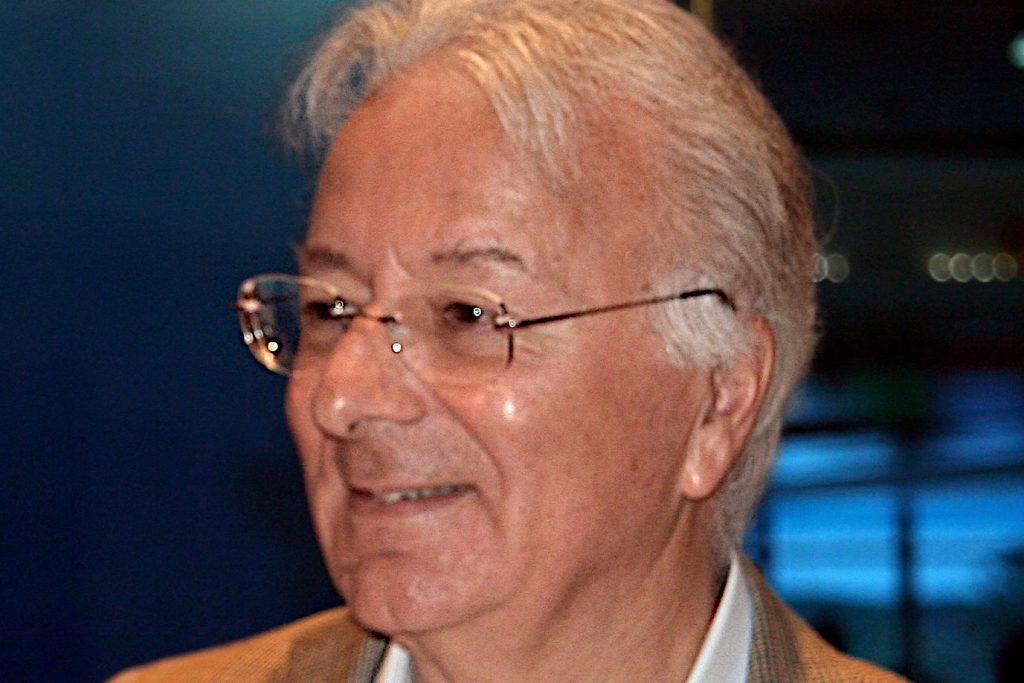
The Intel 4004 had 2,300 transistors on one die. It was the first microprocessor, a complete general-purpose CPU on a single chip, and it reached the market in March 1971. The engineer who turned a stalled project into working silicon was Federico Faggin.
A project stuck at Intel
Faggin was born in Vicenza, Italy, and studied physics at the University of Padua. He began at Olivetti at 19, where he co-designed a small transistor computer. In 1967 he moved to SGS-Fairchild, and in February 1968 the company sent him to Palo Alto, California. There he built the silicon-gate technology that Intel’s chips would later depend on.
By early 1970 the 4004 was going nowhere. Ted Hoff and Stanley Mazor had drawn up the architecture for a Busicom calculator, but neither was a chip designer, and nobody else at Intel was either. The company was busy with memory chips. Faggin accepted an Intel offer in April 1970.
On his first day, Mazor showed him the schedule. “My jaw dropped,” Faggin later wrote. “I had less than six months to design four chips, one of which, the CPU, was at the boundary of what was possible.”
It got worse. He had no support staff and none of the design and test tools other companies had. When Busicom’s Masatoshi Shima flew in a few days later for a progress check and learned that no logic design existed after five months, he was furious. “It took almost one week for Shima to calm down,” Faggin wrote.
Faggin set a new schedule, and Shima stayed on for six months to check the logic. Faggin worked 70- to 80-hour weeks and took the chips in order: the 4001 ROM, the 4003 interface chip, the 4002 RAM, then the 4004 CPU. The design was finished at the end of 1970. He etched his initials, “F.F.”, along the edge of the CPU layout, so they appear on every 4004 made.
Two refinements to silicon-gate technology, buried contacts and bootstrap loads, let the 4004 fit on one chip. Faggin also built a 4004-based tester to show Intel management that customers other than Busicom could use the chip. That helped persuade Bob Noyce to renegotiate Busicom’s exclusivity clause.
After the 4004
Faggin went on to lead the 8008 and 8080 projects. He conceived and architected the 8080, which Shima designed under his supervision. At the end of 1974 he left Intel and founded Zilog with Ralph Ungermann. Faggin served as president and CEO until the end of 1980.
The company’s first product was the Z80, which he conceived and designed. It ran faster than the 8080, kept software compatibility with it, and turned up in early personal computers and in game systems such as ColecoVision and the Master System. Production stopped in 2024. Later he co-founded Cygnet Technologies and then Synaptics, serving as CEO of both.
In 2010 Faggin received the 2009 National Medal of Technology and Innovation, the highest honor the United States gives for technological achievement. He started the Federico and Elvia Faggin Foundation in 2011 to support scientific study of consciousness at US universities. In 2015 the foundation helped set up a $1 million endowment for a chair in the physics of information at UC Santa Cruz.