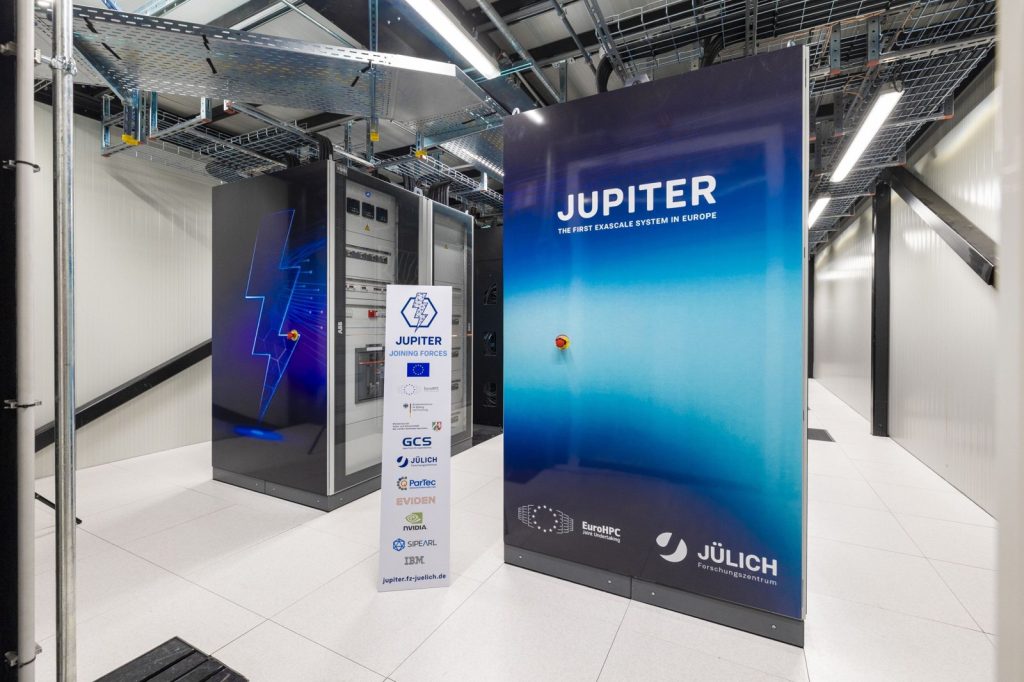
Nearly 24,000 NVIDIA GH200 Grace Hopper chips sit inside JUPITER, the machine Europe switched on Friday at the Jülich Supercomputing Centre in western Germany. It is the continent’s first exascale supercomputer, able to run one quintillion calculations per second.
It is now the fastest and most energy-efficient system in Europe and ranks among the top five worldwide. Eviden, a subsidiary of Atos, led the European consortium that built it. The project cost 500 million euros, paid jointly by the European Union and the German federal government through the EuroHPC Joint Undertaking.
Chancellor Friedrich Merz presided over the inauguration and called the system a historic achievement for European science and technology. He said it matters because it cuts dependence on outside technology suppliers.
Built for AI
JUPITER runs on Eviden’s liquid-cooled BullSequana XH3000 system and NVIDIA’s Quantum-2 InfiniBand networking. Together they give it more than 90 exaflops of AI performance. It delivers 60 gigaflops per watt, and heat reuse is built in. In early Linpack benchmark tests it ran at twice the speed of Europe’s next-fastest system, for both AI and traditional high-performance computing.
Thomas Lippert, co-director of the Jülich centre, said the machine is 20 times more powerful than any other system in Germany. He called it Europe’s first platform able to compete with U.S. and Chinese systems in training foundation AI models.
The planned uses are broad. Climate and weather modeling comes first, through the Earth Virtualization Engines project, which aims to build digital twins of Earth. Researchers also plan quantum work on CUDA-Q and cuQuantum, and AI-driven drug discovery with BioNeMo. Kristel Michielsen, the other co-director, said JUPITER will be central to hybrid quantum-classical computing, and that its quantum software tools will let researchers take on problems of unprecedented complexity.
Access is open to researchers, institutions and companies across Europe.
Aleksandra Przegalinska, vice-rector for innovation at Kozminski University and a senior research associate at Harvard University, said Europe has often been criticised for not being an AI superpower. With a machine this size, she said, “we can actually think seriously about the rise of European artificial intelligence.”
European officials point out that the system was developed and deployed in under nine months.
Sources
- Germany unveils Europe’s fastest supercomputer JUPITER
- The new JUPITER supercomputer, inaugurated by Commissioner Ekaterina Zaharieva and German Chancellor Friedrich Merz at Forschungszentrum Jülich in Germany, has officially become the first European… | TVP WORLD