
Jack Kilby was alone in the lab. It was the summer of 1958, his coworkers at Texas Instruments were away for a corporate shutdown, and he had a problem on his mind: electronics were built from piles of separate parts, and that made machines heavy, expensive and hard to scale.
Kilby used the empty weeks to try something else. Rather than wire individual components together, he asked whether everything a circuit needed could be built on one piece of semiconductor.
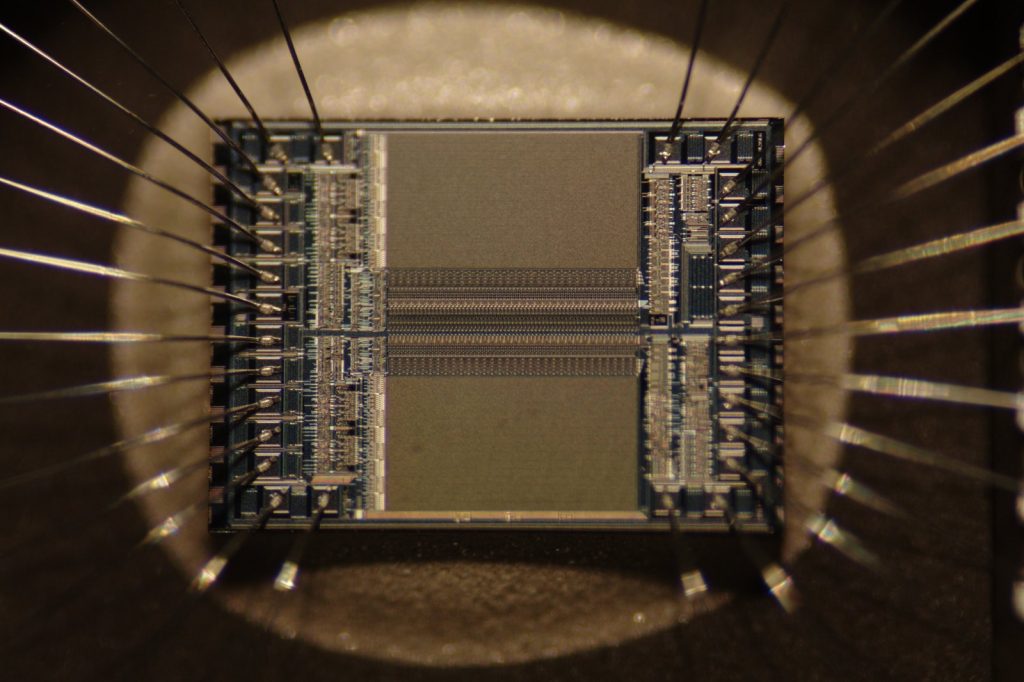
The answer was an early integrated-circuit prototype. One caption describes it as a single strip of germanium with hand-soldered wires.
One part instead of many
Until then, engineers had built circuits by connecting parts one after another. Kilby’s design merged diodes, transistors, resistors and capacitors into a single compact piece.
That changed how engineers thought about making circuits and checking their quality. Instead of a tangle of fragile, hand-wired joints, a circuit could be treated as one component, and one that others could copy and refine in later years.
What followed
Fitting several functions into a tiny area meant parts could shrink, speed up and get cheaper to make. The change reshaped manufacturing and helped make large computing systems commercially viable. Later work on the monolithic integrated circuit laid the groundwork for the microprocessor.
A research paper on the invention’s reach notes that integrated circuits soon became the core building block of modern electronic systems, in medical instruments and control systems as well as computers and consumer gadgets.
Historians treat 1958 as a turning point, less for the working device itself than for proof that the manufacturing idea held up in practice.




