
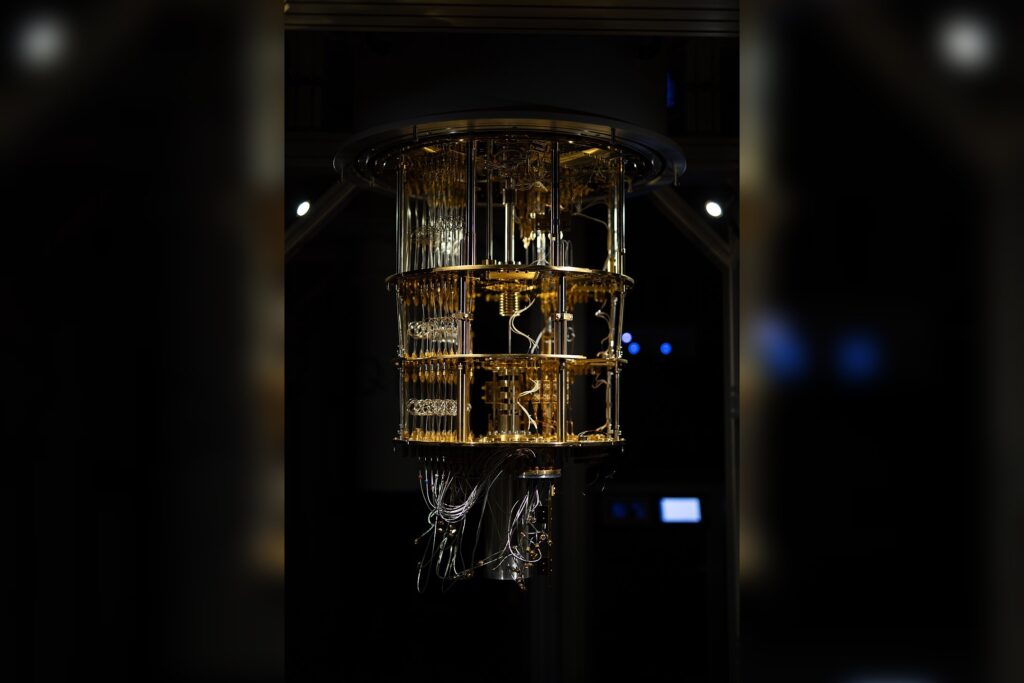
Three minutes and 20 seconds. That is how long Google’s team said its Sycamore chip needed to finish a calculation that, by the team’s own estimate, would tie up the world’s most powerful supercomputer for 10,000 years.
The result appeared in the journal Nature on 23 October 2019, after an early version surfaced briefly on a Nasa website the month before. John Martinis, who led the group, admitted the experiment “was kind of hard to do”. Colleagues, he said, took a while to see how it would work, and longer to make it work.
What the chip actually did
Sycamore is a superconducting processor built from a grid of 54 qubits. One of them failed, so the machine ran on 53. The paper says the device sampled a random quantum circuit a million times in about 200 seconds. Researchers chose the task precisely because it has no useful output. It checks whether a sequence of numbers is truly random, and random circuits are hard for ordinary machines to imitate.
The authors wrote that the work “marks the first computation that can be performed only on a quantum processor.” Google chief executive Sundar Pichai likened it to building the first rocket to reach space. A company spokesperson put it more bluntly: “We’ve already peeled away from classical computers, on to a totally different trajectory.”
IBM pushes back
Rival IBM wasted little time. In a blog post, its researchers argued that the Oak Ridge National Laboratory machine in Tennessee could solve the same problem in 2.5 days, perhaps less, depending on how it was programmed. Since quantum supremacy means beating what a classical computer can do, IBM said, Google’s claim did not hold. It called the experiment an excellent demonstration of progress in superconducting quantum computing, but not proof that quantum machines are “supreme”.
Sergio Boixo of the Google team shrugged off the objection, saying it was important to test such proposals on real supercomputers because results do not always go as expected. Martinis said the group looked forward to others checking its data.
Milestone or stunt?
Outside voices split. Christopher Monroe, a University of Maryland physicist and co-founder of the startup IonQ, called it an academic milestone and said the problem was unlikely to be useful for anything beyond showing a task that looks hard on normal computers. Steve Brierley, chief executive of the Cambridge quantum software firm Riverlane, took the opposite view, predicting people would look back on it as the moment the field changed. He also suggested dropping the word supremacy for “quantum advantage”, a term tied to real applications.
In an accompanying Nature article, MIT physicist William Oliver compared the result to the Wright brothers’ first flight. The Wright Flyer was not the first thing to fly and solved no pressing problem, he noted; what mattered was the possibility it showed.
The money was already moving. The Guardian put tech-company investment in the field at about $1bn to date. Hopes ran to drug discovery, better batteries, weather forecasting and financial modelling. Breaking today’s encryption is a different matter: that would take machines with 100m qubits, nearly two million times as many as Sycamore carries.
Sources
- Google claims it has achieved 'quantum supremacy' – but IBM disagrees | Google | The Guardian
- Quantum supremacy using a programmable superconducting processor | Nature




