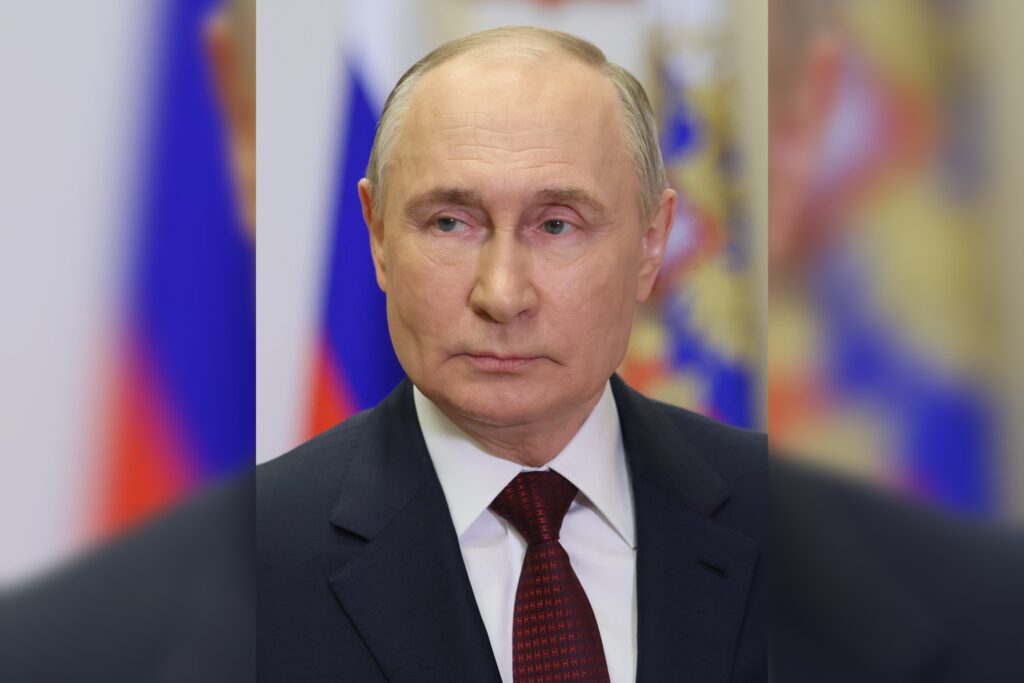
Exit polls put the number at nearly 88 per cent. That was Vladimir Putin’s share of the vote in the March 2024 presidential election, which hands him a fifth term and another six years in office. At 71, he was about to overtake Joseph Stalin as Russia’s longest-serving leader in more than 200 years.
Thousands of people turned out to protest at polling stations across Russia and at embassies abroad, in an action called “Midday Against Putin”. Several people were detained after throwing green liquid into ballot boxes, and some Russians set fires at polling stations. Yulia Navalnaya, the widow of Alexei Navalny, voted at the Russian embassy in Berlin. She wrote her husband’s name on the ballot. “It cannot be that a month before the elections, Putin’s main opponent, who is already in prison, was killed,” she said.
Navalny had died in a remote Arctic prison a month earlier. Putin raised it himself in his first speech after the result, saying talks had been under way to swap Navalny for Russians held in Western countries. His condition, he said, was that Navalny never come back. “But things happen, there’s nothing you can do about it.”
The United States called the vote “obviously not free or fair”. Ukrainian President Volodymyr Zelenskyy went further and called it a “simulation of an election”, adding: “This actor should be on trial in The Hague.” Putin had warned the West that any interference in the three-day vote would count as an act of aggression.
On the last day of voting, Russian authorities said 35 drones were launched at targets across Russia. One caused a brief fire at an oil refinery and some border areas lost electricity. Moscow accused Kyiv of election sabotage.
Communist candidate Nikolai Kharitonov came second with just under four per cent, ahead of Vladislav Davankov and Leonid Slutsky.
From the KGB to the Kremlin
Putin was born on 7 October 1952 in Leningrad, now Saint Petersburg. He studied law at Leningrad State University, graduating in 1975, and joined the KGB that year. He spent 16 years there as a foreign intelligence officer, including a posting in Dresden, East Germany, from 1985 to 1990. He resigned with the rank of lieutenant colonel on 20 August 1991, the second day of the coup attempt against Mikhail Gorbachev. “As soon as the coup began, I immediately decided which side I was on,” he has said.
In 1996 he moved to Moscow to join Boris Yeltsin’s administration, ran the Federal Security Service, and became prime minister in August 1999. When Yeltsin resigned, Putin became acting president. By March 2000 he had won his first term. He was reelected in 2004, then served as prime minister again from 2008 to 2012 under Dmitry Medvedev because of the limit on consecutive terms. He returned to the presidency in 2012, after an election marked by allegations of fraud and protests, and won again in 2018.
The record since then is one of war and sanctions. Russia annexed Crimea and backed a war in eastern Ukraine, which brought international sanctions. Putin also sent troops to Syria to back Bashar al-Assad. In April 2021, after a referendum, he signed constitutional amendments that let him run twice more, potentially extending his presidency to 2036. He launched the full-scale invasion of Ukraine in February 2022, announced a partial mobilization that September and annexed four Ukrainian oblasts. In March 2023 the International Criminal Court issued an arrest warrant over the alleged illegal abduction of children during the war.
Critics describe his rule as authoritarian, with imprisoned opponents, censored independent media and elections that are neither free nor fair. Russia scores very low on Transparency International’s Corruption Perceptions Index and on Freedom House’s Freedom in the World index.