
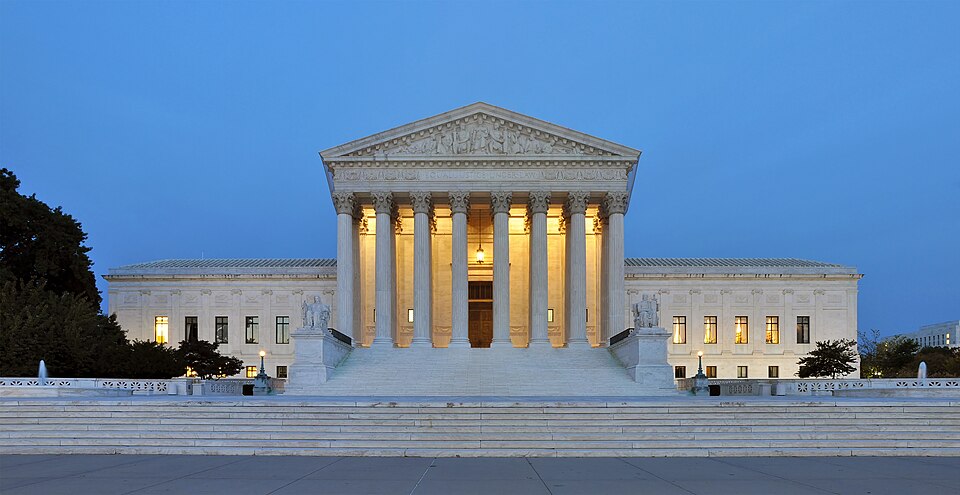
On June 30, 2022, the Supreme Court split 6 to 3 and struck down the idea behind the Obama-era Clean Power Plan. The ruling in West Virginia v. Environmental Protection Agency decided how far the EPA may go when it regulates carbon dioxide from power plants that already exist. It was also the first time the Court named the major questions doctrine as part of its reasoning.
The rule that never took effect
The EPA proposed the Clean Power Plan in June 2014. It aimed to cut carbon dioxide from electricity generation by 32% from 2005 levels by 2030, and it relied on Section 7411(d) of the Clean Air Act, a provision the agency had rarely used. States would write the implementation plans.
The plan had two layers. One required cleanup technology inside a plant’s own fence line. The other pushed “generation shifting” outside the fence line, moving output from coal toward gas, solar and wind. Opponents went after that second layer. In August 2015, 28 states and hundreds of companies sued in the D.C. Circuit. They argued, among other things, that the House and Senate versions of Section 7411(d) had never been reconciled in 1990, and that the plan handed states too much power over the grid and raised Tenth Amendment problems.
In February 2016 the Supreme Court stayed the plan. The order was unsigned, and Justices Ginsburg, Breyer, Sotomayor and Kagan said they would have denied the request. In 2026, The New York Times obtained memos from that period. They show Chief Justice John Roberts worried that companies would spend money to comply before a likely final decision in 2018, which would make the rule effectively irreversible. Alito and Kennedy echoed him.
The plan never came into force. The Trump administration’s EPA moved to repeal it in 2017, and in August 2018 proposed the Affordable Clean Energy rule, which kept controls inside the fence line and aimed for a cut of only 0.7% to 1.5% by 2030. EPA’s own analysis estimated that rule could mean 1,500 to 3,600 more premature deaths a year by 2030. Courts stayed that rule too. The case survived the arrival of the Biden administration in 2021, because the EPA said it still leaned toward outside-the-fence-line controls.
What the Court decided
The majority held that Congress had not given the EPA authority to regulate existing plants through generation shifting, at least without weighing the cost to those plants. That would have wiped out the Clean Power Plan. The agency can still cut emissions at existing plants through technology installed on site.
Earlier cases frame the ruling. In Massachusetts v. EPA in 2007, a 5 to 4 Court found that the agency must regulate greenhouse gases and can be sued for failing to do so. In Michigan v. EPA in 2015, another 5 to 4 decision, the Court held that the EPA had to consider costs before deciding that regulating fossil fuel plants was “necessary and appropriate.”
The 2022 case was also the first to be described as a product of the shadow docket, since the Court had blocked the Clean Power Plan before the lower courts finished their work.




