TOKYO, November 16, 2026 — Advantest is capitalizing on the global surge in AI-driven semiconductor demand with its AI-powered inspection platforms, but the company faces critical hurdles in scaling production to meet the market’s needs.
AI Inspection Platform Enhances Chip Testing Efficiency
Advantest supplies semiconductor testers used to verify that AI chips function as designed. The growth in this market is driven not only by increased production of AI semiconductors but also by a rise in inspection content due to higher speeds and greater functionality. The company’s strength lies in its technology for fast and accurate semiconductor inspection and a system that involves it in customers’ new product development from an early stage.
A key product is the V93000 SoC tester, with its new “Pin Scale 5000B” card, announced in April 2026. This card is designed to handle increased inspection requirements while maintaining compatibility with previous models, allowing customers to utilize existing inspection programs and equipment configurations efficiently.
Technical Challenges in Scaling Production
Despite strong demand, Advantest faces significant challenges in increasing production to meet the rise in semiconductor volumes. The company is expanding its SoC tester production capacity, with a current annual capacity of over 5,000 units. The next goal is to reach 10,000 units per year, a target that has been moved up from the original end of fiscal year 2028, though a specific timeline has not been provided.
Securing sufficient components is another critical challenge. The company’s forecast for the second half of fiscal 2027 assumes it will absorb rising component costs through improvements in the mix of high-specification products. As of the end of September 2026, inventories stood at 352.4 billion yen, a 52.1% increase from the previous year, reflecting the necessary preparations for production increases but also posing a risk if demand weakens.
Impact on the Semiconductor Test Market
The AI-driven demand for high-performance semiconductors is a primary driver of Advantest’s growth, particularly for its SoC testers, which are used for CPUs, GPUs, and AI-dedicated chips. This focus makes Advantest more vulnerable to fluctuations in equipment investment compared to its direct competitor, Teradyne. Teradyne has a more diversified business, including product inspection and robotics, which buffers it from downturns in semiconductor testing.
In contrast, Advantest’s high concentration on test systems means its overall performance is more strongly tied to the strength of its main testers. This concentration is a double-edged sword: it amplifies growth during upswings but also increases exposure when customer investment slows.
Financial Performance Driven by AI-Oriented SoC Testers
Advantest’s financial performance reflects the strong demand for its AI-oriented products. For the fiscal year ending March 2026, net sales reached 1.1286 trillion yen. In the first half of fiscal 2027 (April to September 2026), net sales grew 60.5% year-on-year to 845.2 billion yen, while operating profit surged 96.5% to 456.8 billion yen, resulting in an operating profit margin of 54.0%, up from 44.1% in the previous year.
The company revised its forecast for fiscal 2027 upward on October 28, 2026, projecting net sales of 1.863 trillion yen and operating profit of 967 billion yen. This forecast is supported by the increase in volume and complexity of high-performance semiconductors for AI, along with improvements in the sales mix. However, the high profit margins in the first half were also boosted by temporary factors, including reversals of inventory valuation losses and the utilization of DRAM secured before price increases.
Future Growth Prospects and Investment in R&D
Advantest’s future growth depends on its ability to connect the increase in inspection volume to its equipment supply and generate recurring revenue from services and consumables. The company is directing funds toward increasing production capacity and responding to the testing requirements of next-generation semiconductors. It plans to invest 114 billion yen in R&D and 60 billion yen in capital investment for the fiscal year ending March 2027.
The company’s ability to maintain its high profitability and growth sustainability will be key to its stock valuation. As of November 6, 2026, the stock traded at a PER of 27.3 times and a PBR of 17.7 times based on its forecast for fiscal 2027. Financially, the company is strong, with cash and cash equivalents of 401.8 billion yen and an equity ratio of 66.1% as of the end of September 2026. An interim dividend of 49 yen has been confirmed, with year-end and annual dividends still to be decided.
Sources
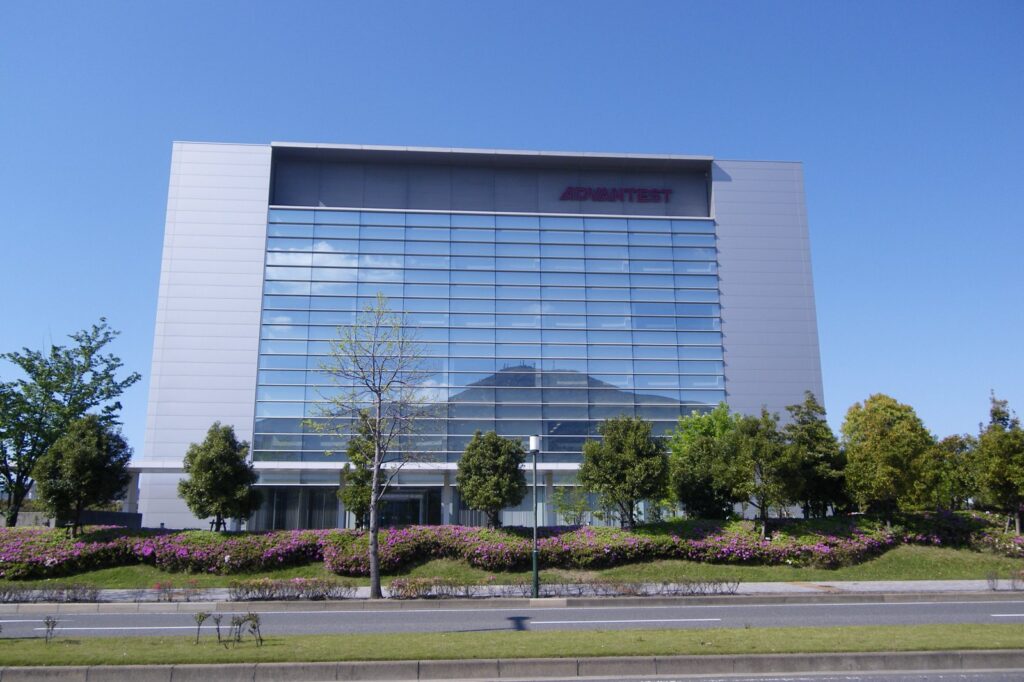
Photo: Kugel (Public domain)