CHICAGO, November 17, 2026 — Altera, Oxford Quantum Circuits and NVIDIA have unveiled a reference design that links a superconducting quantum processor directly to GPU compute via an FPGA controller. The system, demonstrated at SC26 on November 16, uses Altera’s Agilex 9 Direct RF FPGA and NVIDIA’s NVQLink to replace racks of analog gear with a low-latency, GPU-accelerated control loop.
The Technical Reality
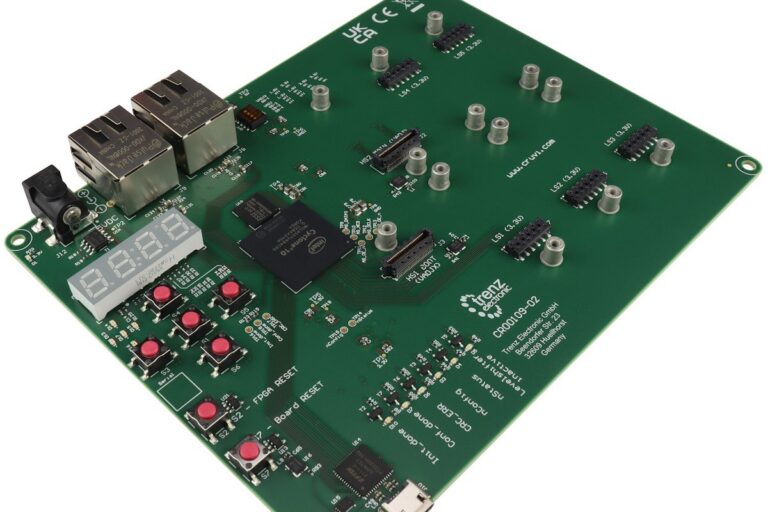
The architecture centers on the Agilex 9 Direct RF FPGA. Its integrated ADCs and DACs run at up to 64 gigasamples per second, synthesizing and digitizing microwave signals in the 4 GHz to 8 GHz band without external up-conversion or down-conversion stages. According to Altera, direct RF sampling cuts electrical drift, thermal load and component counts. Frequency multiplexing lets multiple readout channels share a single RF port, reducing coaxial cabling as qubit counts grow.
OQC’s RF signal-conditioning circuitry still sits between the quantum processor and the FPGA, so not all RF circuitry lives on the die. The FPGA handles time-critical pulse generation, synchronized gate scheduling and resonator spectroscopy under deterministic scheduling. NVQLink connects the FPGA to NVIDIA GPUs with sub-4-microsecond data-transfer latency across high-bandwidth switch channels. GPUs then take on calibration, state tomography and machine-learning readout classification via CUDA-Q libraries.
The Scaling Bottleneck
The collaboration addresses a physical constraint: traditional control electronics expand into multi-rack assemblies filled with discrete signal generators, mixers, filters and standalone converters as qubit counts increase. By consolidating converters and control functions in the FPGA and sharing RF ports through multiplexing, the reference design aims to shrink footprint, power draw and latency. Altera, the largest pure-play FPGA provider majority-owned by Silver Lake with Intel holding 49%, is demonstrating the full system at booth #2854.
Division of Labor
The stack enforces a strict split. The FPGA owns the real-time domain: pulse synthesis, gate scheduling, spectroscopy. The GPU owns the compute-heavy domain: calibration, tomography, ML classification. CUDA-Q kernels can dynamically steer FPGA registers during hybrid algorithm execution. The reference package includes validated functions for qubit and resonator spectroscopy, qubit initialization, and resonator readout and classification, plus a GPU-based ML readout classifier and example initialization routines. An emulation path lets developers bring up the controller and test algorithms before physical qubit hardware is available.
Broader Context
The announcement sits alongside a parallel NVIDIA-IBM effort detailed at SC26. That collaboration links IBM quantum computers to DGX systems, reporting a CUDA-Q decoding algorithm that cuts a quantum error-correction computation from 12 weeks to 45 minutes. NVIDIA also updated Slurm to let quantum processors be scheduled alongside CPUs and GPUs in standard supercomputing workflows, with IQM systems among early integrations.
Release Timeline
The reference design and software stack are scheduled for formal release in January 2027. OQC plans to integrate the Direct RF control architecture into upcoming commercial QPU deployments with native NVQLink connectivity to GPU clusters.
Sources
- Altera, NVIDIA and OQC Unveil Reference Design Linking Quantum Processors to GPUs
- Altera Demonstrates an FPGA-based Quantum System Controller Reference Design in Collaboration with OQC and NVIDIA
- NVIDIA and IBM link quantum processors to GPUs for error-correction gains
- Altera, OQC and NVIDIA FPGA Quantum Controller — CASRAI
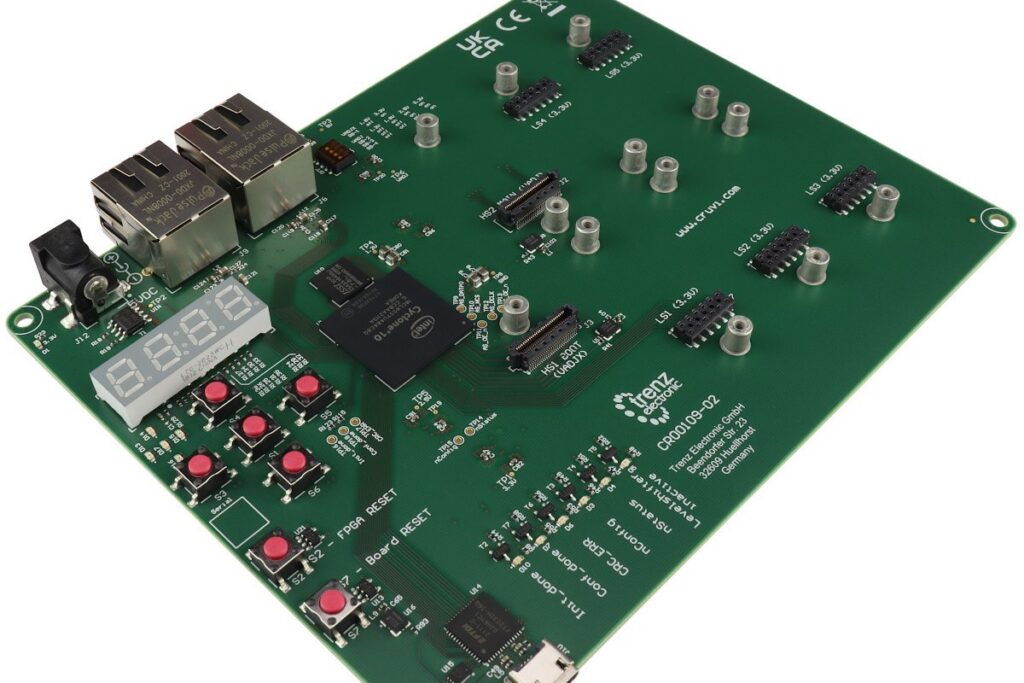
Photo: Antti Lukats (CC0)