
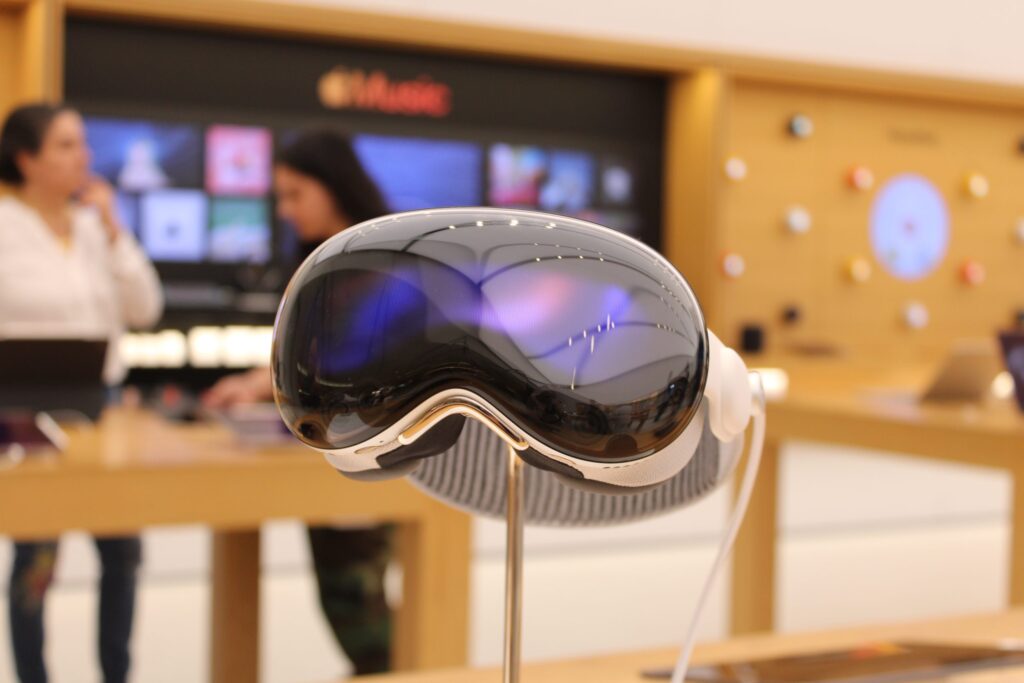
Apple put a computer on people’s faces on June 5, 2023. At its Worldwide Developers Conference, the company showed off Vision Pro, a head-worn device it calls a spatial computer, priced from $3,499 in the United States.
Apple said it would reach customers in the US early the following year, with more countries to follow later that year. It is the company’s first new major product category since the Apple Watch arrived in 2015.
Eyes, hands and voice
There is no controller. You look at an app to pick it, tap your fingers together to select, flick your wrist to scroll, or dictate by voice. The software, called visionOS, puts apps in windows that hang in the room around you, and they can sit side by side at any size.
Cameras let you see your actual surroundings through the headset. A Digital Crown dial lets you dial that view up or down, from a room with floating apps all the way to one that hides the real room entirely.
Apple chose its words with care. It has steered clear of calling the product a virtual reality headset.
“Today marks the beginning of a new era for computing,” CEO Tim Cook said. “Just as the Mac introduced us to personal computing, and iPhone introduced us to mobile computing, Apple Vision Pro introduces us to spatial computing.”
What people can do with it
Apple pitched the headset for work, movies, games and keeping in touch. Two displays pack 23 million pixels between them, and Apple said the setup can make a movie feel like it is playing on a screen 100 feet wide. Users can also pull a Mac into the headset wirelessly as a large private display.
Family moments get their own treatment. Vision Pro carries Apple’s first three-dimensional camera, so people can record spatial photos and videos and later watch them at life size, Apple said. On FaceTime, callers appear as life-size tiles in the room, and the person wearing the headset shows up as a Persona, a digital version of themselves that follows their face and hand movements.
A front screen called EyeSight shows the wearer’s eyes to people nearby, so the device does not cut them off from others in the room.
Under the hood
Two chips share the load. The M2 handles general computing, and a new R1 chip processes input from 12 cameras, five sensors and six microphones. Apple said R1 sends new images to the displays within 12 milliseconds.
Battery life is the catch. Apple said the headset can run all day when plugged in, but about two hours on its external battery pack.
Eye data gets special handling. Apple said where a user looks is not shared with Apple, third-party apps or websites, and that Optic ID, the iris-scanning unlock, keeps its data on the device.
“Creating our first spatial computer required invention across nearly every facet of the system,” said Mike Rockwell, Apple’s vice president of the Technology Development Group.
Apple later set the US release for February 2, 2024, after announcing the date on January 8 of that year.




