
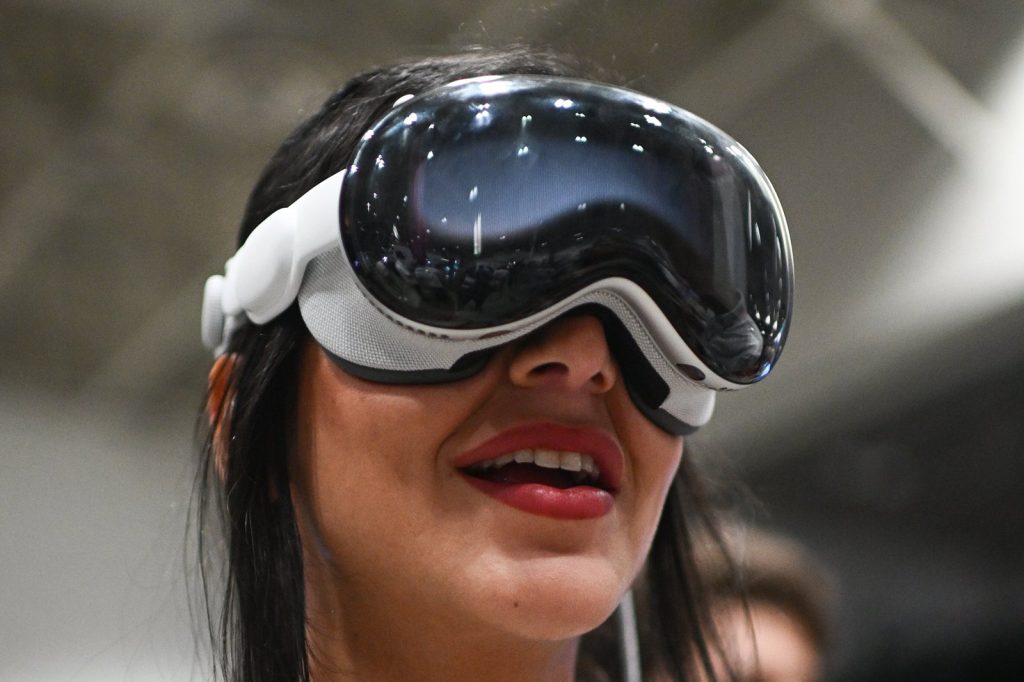
Apple calls the Vision Pro a spatial computer, not a VR headset, and the company has avoided the older label in its presentations. The software that carries that claim is visionOS, which Apple announced with the $3,499 device at its Worldwide Developers Conference on June 5, 2023.
“Today marks the beginning of a new era for computing,” Tim Cook, Apple’s CEO, said. “Just as the Mac introduced us to personal computing, and iPhone introduced us to mobile computing, Apple Vision Pro introduces us to spatial computing.”
How visionOS works
The headset uses 3D tracking and camera passthrough. Cameras built into the front show the user the room, and visionOS lays windows over that view so they appear to float in the space. Apps can sit side by side at any scale. Apple says the interface responds to natural light and casts shadows, which helps a wearer judge size and distance.
There is no controller. Users look at an item to pick it, tap their fingers together to select it, flick a wrist to scroll and dictate by voice. Apple says eye-tracking data is not shared with Apple, third-party apps or websites.
A Digital Crown on the headset sets how much of the real room the wearer sees. Twist it and a virtual environment covers the camera feed. Apple’s example is a dynamic landscape that can help a user focus or clear clutter from a busy space.
The operating system is built on iPadOS frameworks, along with decades of work in macOS and iOS. Apple says it was designed from the ground up for the low-latency demands of spatial computing. Developers can take advantage of the Vision Pro’s new capabilities, and Apple says hundreds of thousands of familiar iPhone and iPad apps will run on it. The App Store is new for the headset.
The hardware behind it
Two micro-OLED displays, each about the size of a postage stamp, pack 23 million pixels between them. An M2 chip handles general computing. A second chip, the R1, takes in data from 12 cameras, five sensors and six microphones, and Apple says it sends new images to the displays within 12 milliseconds.
Mike Rockwell, Apple’s vice president of the Technology Development Group, described it as “a standalone spatial computer in a compact wearable form factor.”
Apple says the battery lasts up to two hours, or all day when plugged in. Vision Pro is Apple’s first new major product category since the Apple Watch in 2015.
The headset also has EyeSight, an outward display that shows the wearer’s eyes to people nearby. Optic ID unlocks the device by scanning the iris. Apple says that data is encrypted and never leaves the device.
The Vision Pro was due in the US early in 2024, with other countries to follow later that year.




