
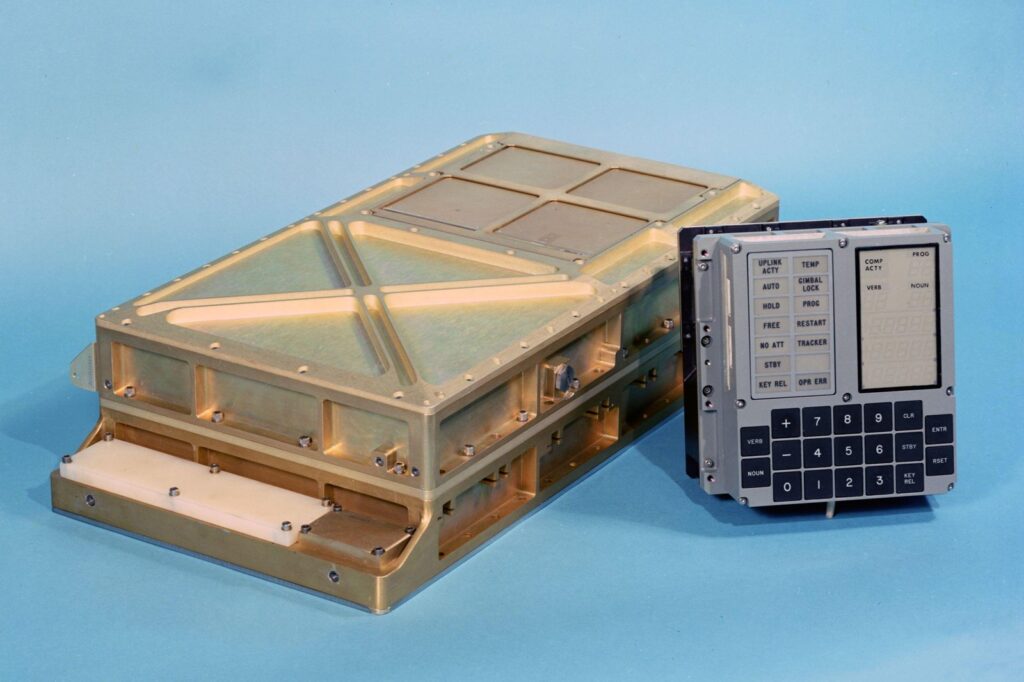
Two hundred thousand circuits. That is how many Fairchild Micrologic chips the Apollo Guidance Computer project needed, according to the Computer History Museum, which makes it the largest buyer of integrated circuits anywhere through 1965. A single government program was soaking up a technology that was barely out of the lab.
Two men, one idea
The idea arrived twice. By the late 1950s transistors were everywhere, in radios, telephones and computers, but they had hit a practical limit: each one still had to be wired to the others by hand, and steady hands with tweezers could only go so small. Engineers wanted to make the transistors, the wiring and everything else in one step.
In late July 1958 Jack Kilby was alone at Texas Instruments. He had joined only a couple of months earlier, so he had no holiday to take when nearly everyone else did, and the halls were empty. He realised that resistors and capacitors could be made of silicon as well, so an entire circuit could come from one crystal. His boss told him to get on with it. Kilby had a working model by September 12. Texas Instruments filed for a patent on February 6, and showed off a “Solid Circuit” the size of a pencil point in March.
In California, Robert Noyce at the young Fairchild Semiconductor had the same thought in January 1959. Kilby had worked out how to make the components; Noyce found a far better way to connect them. Knowing TI had already filed, Fairchild wrote an extremely detailed application. It paid off. On April 25, 1961, the patent office gave the first integrated circuit patent to Noyce while Kilby’s was still being examined. Both men are now credited with conceiving it independently. The companies later settled their dispute with a cross-licence, which InfoWorld noted let the semiconductor industry thrive. Kilby won the Nobel Prize in Physics in 2000 and died in Dallas at 81. His first chip was about half a paper clip in size; computers of that day, as InfoWorld put it, were 50 feet long, weighed eight tons and used more than 5,000 vacuum tubes.
Betting a moon landing on an untested chip
The MIT Instrumentation Laboratory chose chips for the Apollo computer when, in the National Air and Space Museum’s words, their reliability was “a large unknown”. Size, weight and power limits meant the Command Module and Lunar Module would carry only one computer each, and it had to work. Eldon Hall, the lead hardware designer, persuaded NASA that integrated circuits were the right call.
Not everyone agreed. In late 1962 Bellcomm recommended IBM instead. IBM’s computer for the Saturn V rocket used no integrated circuits. MIT won the argument and worked closely with Fairchild. Chips went through tests for temperature, vibration and contamination, and if one failed, the whole lot it came from was thrown away. MIT also picked just one chip type, so it could be tested more thoroughly. The payoff: no Apollo Guidance Computer, on either module, ever suffered a hardware failure during a mission. Every Apollo flight to the Moon carried two of them.
Obsolete by launch
There was an irony. In 1965 Gordon Moore of Fairchild wrote the essay that gave us Moore’s Law. By the time Apollo 7 flew in October 1968, the six-device circuit in the guidance computer was far behind, with Fairchild selling chips holding several hundred devices. Fairchild did not even end up building the Apollo chips; its design was licensed to Philco, which made the thousands used. By the end of the 1960s the area around Santa Clara County was being called Silicon Valley, and Apollo’s orders were a major factor.
Sources
- Integrated Circuit
- Jack Kilby’s momentous contribution | InfoWorld
- Apollo Guidance Computer and the First Silicon Chips | National Air and Space Museum
- ICs Rocket to Success – CHM Revolution | Computer History Museum




