
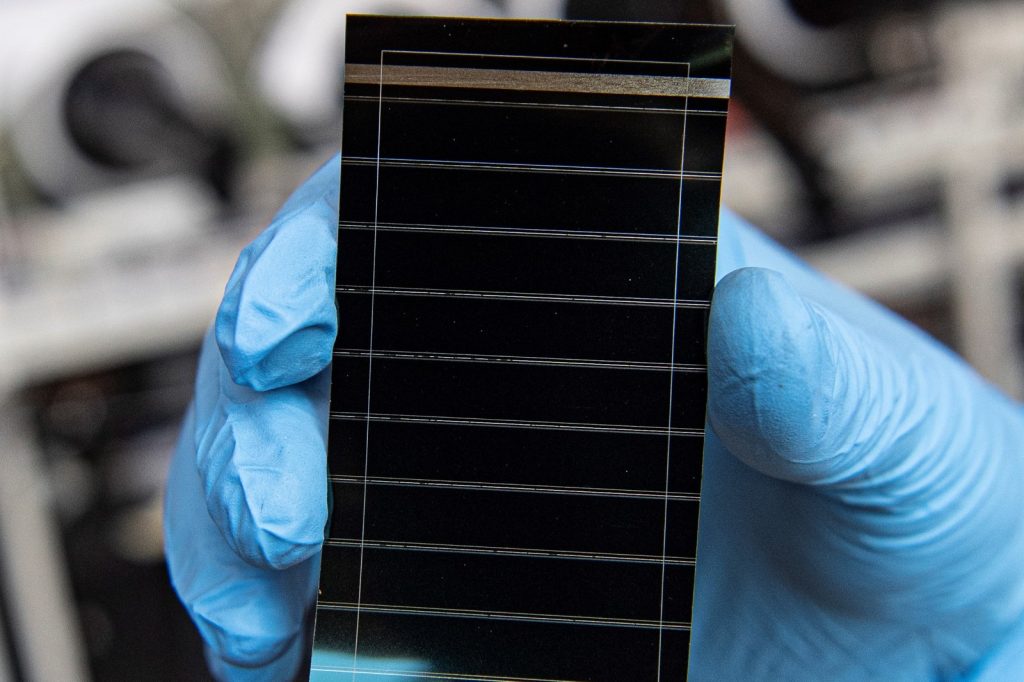
Perovskite solar films are usually made from liquid inks. A team from Georgia Tech and Albany State University wants to try heat and vapor instead, and the National Science Foundation has put $1.3 million behind the attempt.
Georgia Tech’s Research News Center announced the award on Oct. 13, 2026. The money comes through the NSF’s Historically Black Colleges and Universities Excellence in Research program and covers a three-year project called Close-Space Sublimation for Scalable Perovskite Optoelectronics Manufacturing. Liqiu Zheng, an assistant professor of physics at Albany State, and Juan-Pablo Correa-Baena lead it. Correa-Baena is an associate professor and Goizueta Junior Faculty Chair in Georgia Tech’s School of Materials Science and Engineering and School of Chemistry and Biochemistry.
What close-space sublimation does
Perovskites are a class of semiconductors with potential uses in solar energy, photonics, electronics and quantum technologies, according to Georgia Tech. Close-space sublimation moves material as vapor across a short gap, using heat. The team will test whether that approach can be adapted to perovskites. If it works, Georgia Tech said, production could become faster, use material more efficiently and scale up more easily.
In plain terms: swapping a wet process for a dry one could change how many devices a lab or factory can turn out from the same amount of starting material.
Equipment and training at Albany State
Part of the award pays for new thin-film manufacturing and characterization equipment at Albany State. Georgia Tech researchers will help the Albany State group get the tools running, sharing know-how on operation, data collection and analysis. The two schools will jointly study how thin films grow, how they are structured and how finished devices perform.
Students at both campuses are part of the plan. They will get hands-on training in thin-film deposition, X-ray characterization, solar-cell fabrication and data analysis, and exchanges between the schools will open each other’s facilities to them.
“This award elevates the research footprint of Southwest Georgia and recognizes Albany State’s ability to contribute to nationally relevant scientific research,” Zheng said. She added that it gives students experience with advanced semiconductor technologies and helps feed the pipeline of talent into the semiconductor workforce.
From seed grant to federal award
The project grew out of Georgia Tech’s Research Collaboration Forum, which the university launched in 2023 to connect its researchers with faculty at historically Black colleges and universities, industry, federal agencies and national laboratories. Its Seed Grant Program has handed out awards of $10,000 to $50,000. The Georgia Tech and Albany State pair was funded in the forum’s first cycle, and the Southeastern Nanotechnology Infrastructure Corridor Catalyst Program also gave early support.
“The RCF seed funding allowed us to establish the collaboration, generate preliminary data, and demonstrate that our teams could work effectively together,” Correa-Baena said. “That initial year helped us identify the key scientific questions and provided the foundation for the new three-year, $1.3 million NSF award.”
George White, Georgia Tech’s director of strategic partnerships, described the forum’s aim as building research capacity and long-term collaborations, and creating paths to larger funding.




