
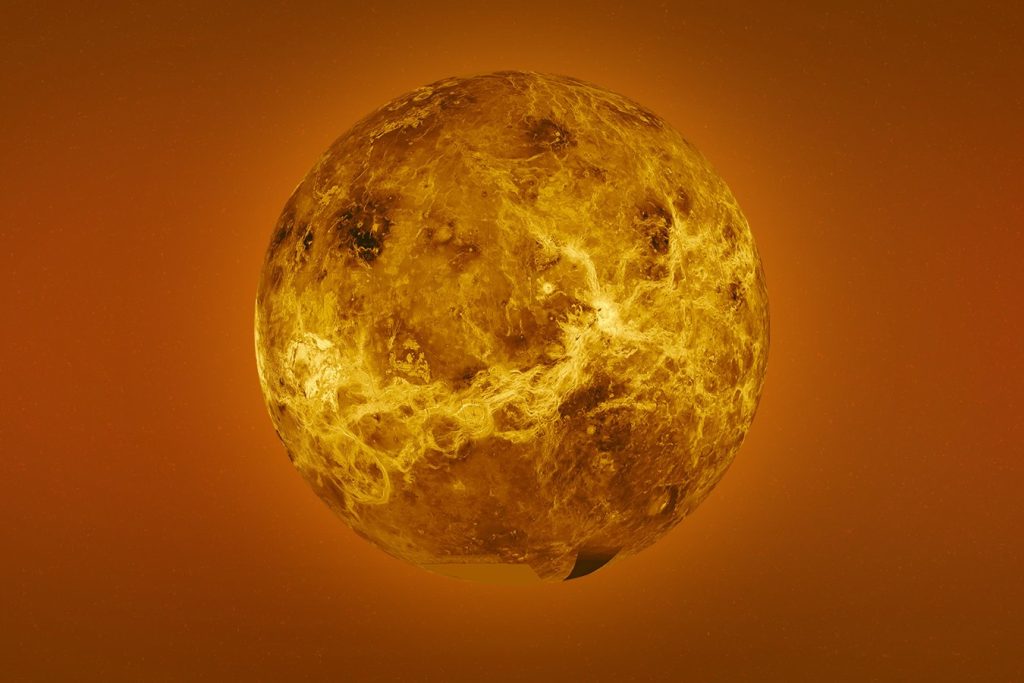
For decades Venus has been the planet everyone flew past on the way to somewhere more photogenic. On June 2, 2021, NASA changed that, picking two Venus missions from four finalists for its Discovery Program. Both would be the first American trips there in more than 30 years.
The two missions
DAVINCI+ stands for Deep Atmosphere Venus Investigation of Noble gases, Chemistry, and Imaging. VERITAS is Venus Emissivity, Radio Science, InSAR, Topography, and Spectroscopy. They beat Io Volcano Observer and TRIDENT, the latter bound for Neptune’s moon Triton. Each was awarded $500 million for development, and each was expected to launch between 2028 and 2030.
DAVINCI+ goes after the atmosphere. A sphere-shaped probe will descend through it, taking measurements and images, to work out how the atmosphere formed and evolved, and whether Venus ever had oceans. Some tentative evidence points that way, though it is not conclusive. The probe will also take the first high-resolution images of the “tesserae” on the surface, terrain scientists think resembles Earth’s continents and may hint at plate tectonics. James Garvin of NASA’s Goddard Space Flight Center is principal investigator.
VERITAS looks down from orbit. Using synthetic aperture radar, it will map the planet in more detail than ever before and build 3D reconstructions of the surface. Infrared measurements will chart rock types, still largely unknown although basalt is thought to dominate, and could detect water vapor released by any active volcanoes. Suzanne Smrekar of NASA’s Jet Propulsion Laboratory leads it.
Loose ends in the clouds
The timing was not lost on researchers. Only months earlier, in September 2020, came the announcement of possible phosphine in Venus’s atmosphere. On Earth microbes produce it, and the upper Venusian atmosphere is temperate. Studies of the signal were still under way, with mixed results.
The new instruments carry their own puzzles. DAVINCI+ includes the Compact Ultraviolet to Visible Imaging Spectrometer, built on freeform optics, which will probe the “unknown absorbers”, dark patches of particles that soak up as much as half of the Sun’s incoming ultraviolet light. Some scientists have suggested they could be microbes. VERITAS will carry the Deep Space Atomic Clock-2, an ultra-precise timing device meant to support autonomous maneuvers and radio science.
“It is astounding how little we know about Venus,” said Tom Wagner, NASA’s Discovery Program scientist, adding that the missions together would cover the planet from its clouds to its core. NASA’s Thomas Zurbuchen said the agency was ushering in a new decade of Venus.




