
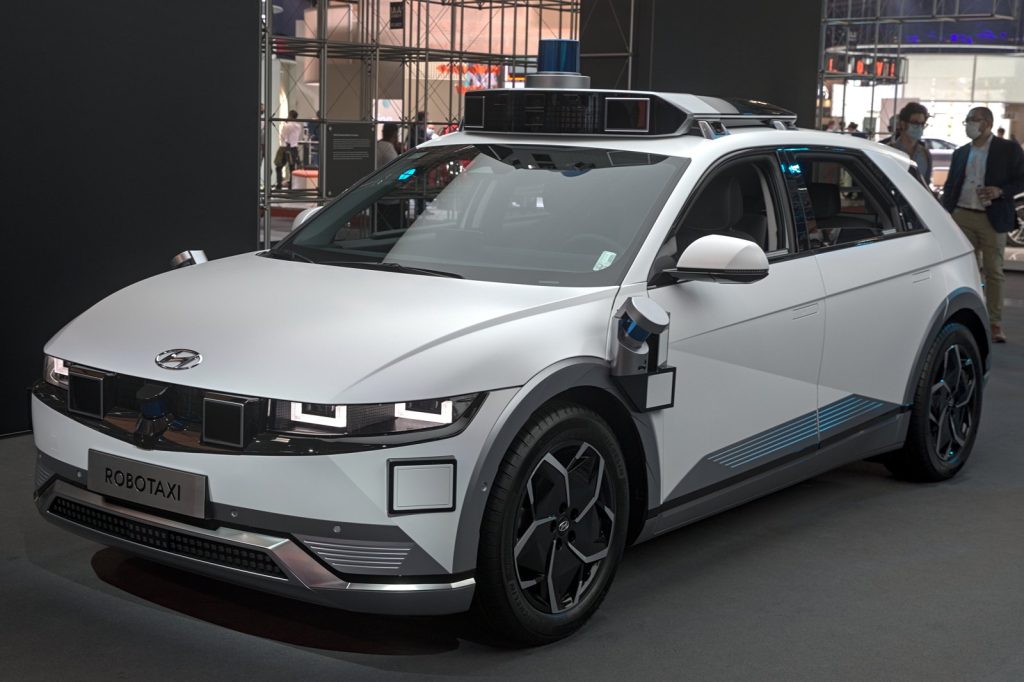
“We imagine that someday, a billion cars on the road will all be autonomous,” Nvidia CEO Jensen Huang said at the company’s CES launch event in Las Vegas in January. Nvidia does not build robotaxis. It wants to be the brain inside them.
CNBC reported that the chipmaker is working with robotaxi operators in hopes they will run their fleets on Nvidia’s AI chips and its Drive AV software as soon as 2027. Around then, Nvidia hopes to power partner deployments of “Level 4” robotaxis, meaning vehicles that can drive without human intervention inside pre-defined regions. Xinzhou Wu, the company’s vice president of automotive, told CNBC at a San Francisco demonstration that the start would be modest. “We will probably start with a limited availability but work with the partner for us to get our footing,” he said.
A small business with a big role
Nvidia has sold chips and other technology for cars under the Drive name since 2015, but it is still small beside the AI business. Automotive and robotics chips brought in $592 million in the quarter ended in October, about 1% of total revenue, CNBC said. Huang has called robotics, self-driving cars included, the company’s second most important growth category after AI.
The company announced a robotaxi partnership with Uber in October. Robotaxis, meanwhile, have caught on over the past year. CNBC noted that Alphabet’s Waymo runs a driverless commercial taxi service in five U.S. markets, San Francisco among them.
What carmakers buy
Nvidia sells more than silicon. Carmakers can also pay for access to its AI chips and simulation software to train self-driving models. Its Drive AGX Thor automotive computer costs about $3,500 per chip, and Nvidia says it lets manufacturers cut development costs and bring driver-assist features to market faster. It also tunes its technology for specific vehicles, such as how hard a car should accelerate. Ali Kani, general manager of Nvidia’s automotive platform, said some customers ask for help training software on the chip while handling simulation themselves.
The CNBC reporter rode in one result in December: a 2026 Mercedes-Benz CLA through San Francisco. A Mercedes safety driver sat behind the wheel and said the car drove itself for 90% of the hour-long ride. It stumbled once, when two buses and a Waymo met on a narrow street lined with parked and unloading trucks, and the driver backed the car up. Nvidia called the drive “Level 2 Plus Plus,” and the driver remains responsible at all times.
Mercedes models due late in 2026 are to use Nvidia’s technology to navigate cities like San Francisco, with hands-free highway driving, urban driving and park-to-park features arriving this year. Nvidia says it runs two AI systems for safety. An end-to-end model reads the sensors and plots a path, while a second, rule-based stack, covering things like stopping at a stop sign, takes over when the AI is unsure. The company is aiming for point-to-point self-driving in consumer cars by 2028.




