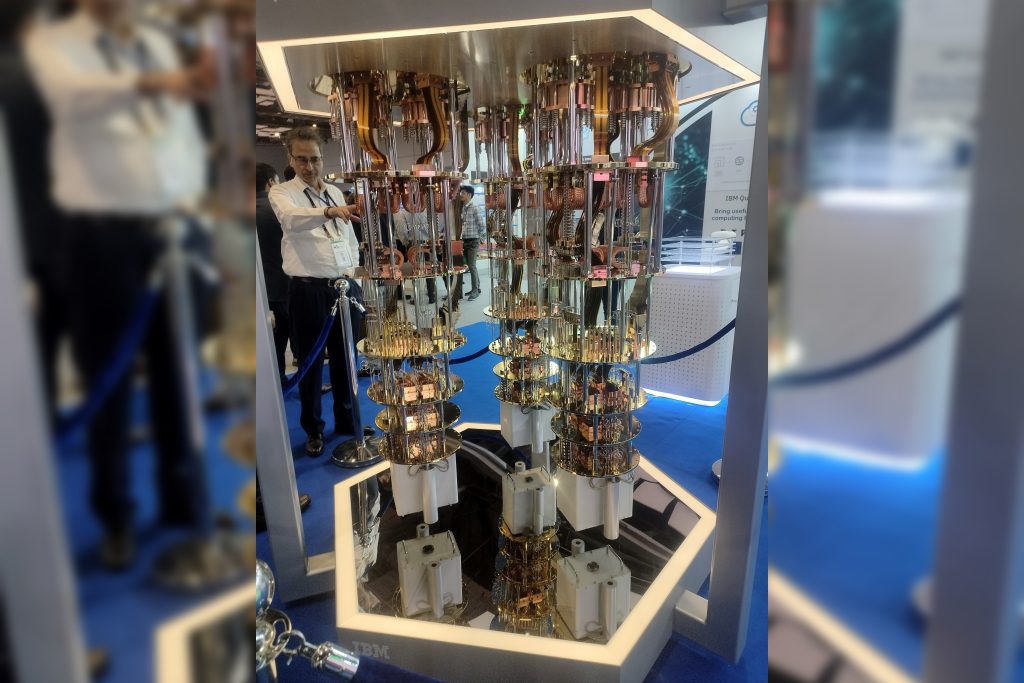
IBM said in September 2019 that it would add its 14th quantum computer to its fleet the following month, a 53-qubit machine the company described as the largest universal quantum system open to outside users.
The same week, a research paper from Google briefly appeared on a NASA website and then vanished.
Google’s vanishing paper
The Financial Times reported that the paper claimed “quantum supremacy,” meaning a quantum chip had solved a problem no conventional supercomputer can. The chip, described as Google’s 72-qubit Bristlecone, introduced in March 2018, was said to have finished a calculation in just over three minutes that would take IBM’s Summit machine 10,000 years. The paper called the result “the first computation that can only be performed on a quantum processor.”
Then it came down. Google’s PR and marketing staff declined to discuss it afterward.
IBM’s open-door approach
IBM has gone the other way. In 2016 it put a 5-qubit prototype on the cloud as the IBM Q Experience, open to anyone. Dario Gil, director of IBM Research, said the aim was to move quantum computing “beyond isolated lab experiments conducted by a handful of organizations, into the hands of tens of thousands of users.”
The numbers IBM gave in 2019: more than 150,000 registered users, nearly 80 commercial clients, universities and research labs, over 14 million experiments run through the cloud, and more than 200 scientific papers published. The company also opened its first Quantum Computation Center in Poughkeepsie, New York. That brought the number of IBM systems online to 10, with four more due within a month.
Gil said the new 53-qubit system offers “a larger lattice” for more complex entanglement and connectivity experiments. The goal, he said, is what IBM calls Quantum Advantage: machines that can solve real client problems classical methods cannot.
Still years away
Qubits are typically subatomic particles such as electrons or photons, and a connected group of them can hold far more combinations of 1 and 0 than the same number of ordinary bits. Making and managing them is hard. IBM uses superconducting circuits cooled to temperatures colder than deep space.
Backers point to possible gains in drug discovery, new materials, supply chain optimization and financial modeling. Most experts, the reporting said, still put a machine that delivers on those promises at least a decade away, even as IBM, Microsoft, Google and AT&T press on.