The first Tesla Megacharger stations have opened at Pilot Travel Centers, bringing high-voltage charging to bear on the commercial trucking sector. This new infrastructure represents a significant shift in power delivery architecture for heavy-duty electric transport.
Power Output Metrics
The initial Megacharger sites demonstrate a peak output range of 1.2 to 1.25 megawatts. The Georgia location, situated near Savannah, delivers 1.2 megawatts across six stalls equipped with Megawatt Charging System connectors. The California site, located in Tulare, achieves 1.25 megawatts across four stalls. According to the partnership announcement, each site is powered by Tesla’s V4 cabinets. These cabinets represent the latest generation of Tesla’s charging hardware, capable of supporting up to 1000 volts and up to 1000 amps. This voltage and amperage ceiling enables the high power figures observed at the pilot sites. While the V4 cabinets peak at 1.2 megawatts, the slight variation between sites—1.2 MW versus 1.25 MW—suggests operational tuning within the hardware’s capabilities. The Megacharger network is intended to support the Tesla Semi, which Tesla confirmed can charge at over 1.2 megawatts, specifically reaching 1,206 kilowatts during live testing.
Connector Architecture
The Megacharger dispensers are fitted with Megawatt Charging System (MCS) connectors. This standard is distinct from the connectors used in Tesla’s light-duty Supercharger network. The MCS connector is designed specifically for the high-current, high-voltage demands of commercial vehicle charging. Its introduction alongside the V4 cabinets signifies a coordinated hardware rollout. Tesla has listed 64 additional Megacharger locations as “coming soon,” indicating a planned expansion of this connector standard across major freight corridors. The deployment of MCS connectors at these sites marks the physical interface through which the high power output is transferred to vehicles such as the Tesla Semi.
Thermal Management and Cable Engineering
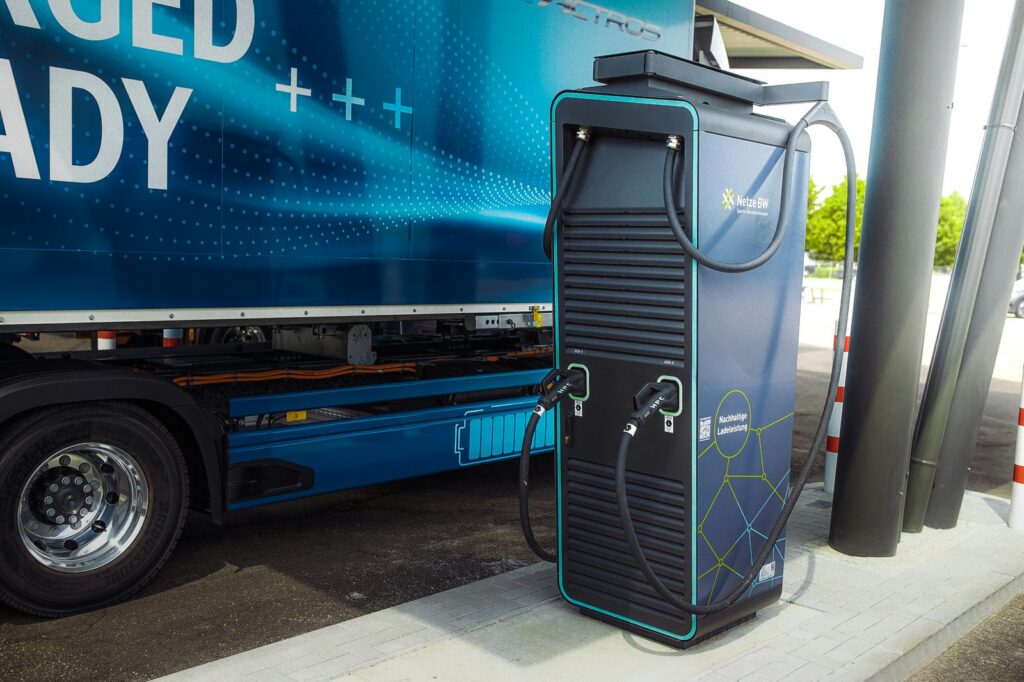
A technical feature of the V4 charging posts is the use of liquid-cooled cables. This engineering approach allows for the delivery of higher power levels while keeping the physical cable profile thinner and lighter than previous generations. The Tesla Supercharger network’s evolution, from the original V1 stations to the current V3 and V4 posts, has consistently involved refinements to cable thermal management. V3 stations introduced liquid-cooled cables to facilitate higher power delivery. The V4 posts continue this trend, utilizing the technology to manage the heat generated by 1000-ampere flows. Effective thermal management is a prerequisite for sustaining the high power outputs—up to 1.25 megawatts—without compromising cable integrity or safety.
Fleet Charging Implications
The rollout of the Tesla Megacharger network addresses the operational needs of long-haul electric transport. Tesla’s Semi, available in Standard Range and Long Range configurations, features battery capacities estimated around 550 kilowatt-hours and 875 kilowatt-hours. Both configurations are capable of charging to 60% in approximately 30 minutes when connected to a Megacharger. This charging speed is a critical factor for fleet operators seeking to minimize downtime on major freight corridors. Pilot, describing itself as North America’s largest travel center network, is installing these stations along routes such as I-5, I-10, and others across several states. The goal is to create viable routes for heavy-duty electric trucks, pairing charging infrastructure with the services and amenities drivers rely on. The expansion of the network, with dozens of new sites under construction, aims to move the technology from a small pilot program toward a national infrastructure for commercial electric trucking.
Charging Speed and Energy Capacity
The Tesla Semi is engineered for rapid recharging during long-haul operations. According to Tesla, both the Standard Range and Long Range configurations can accept a charge of up to 1.2 megawatts, with live testing confirming a peak of 1,206 kilowatts. Tesla estimates the battery capacity at approximately 550 kilowatt-hours for the Standard Range model and 875 kilowatt-hours for the Long Range model. This architecture allows both versions to charge to 60% in roughly 30 minutes when connected to a Megacharger. This capability is designed to minimize downtime for fleet operators, enabling drivers to restore significant energy levels within a standard break period.
Pilot Travel Centers, identifying itself as North America’s largest travel center network, is integrating these high-speed stations along critical freight corridors. Shannon Sturgil, senior vice president of alternative fuels at Pilot, stated that the initiative aims to “make fleet electrification a more accessible option for long-haul transportation.” By pairing the Megacharger network with travel center amenities, the partnership seeks to support the operational demands of commercial electric trucking. With dozens of additional sites listed as “coming soon” and active construction underway, the infrastructure is transitioning from a pilot program toward a national network intended to facilitate viable long-distance routes for heavy-duty electric vehicles.
Expansion Timeline and Regional Rollout
Tesla has listed 64 new U.S. Megacharger locations as “coming soon,” with a targeted rollout intended to establish viable freight corridors across the country. According to InsideEVs, California and Texas will host over 50% of these new sites, with 18 and 17 locations respectively. Important hubs are also scheduled for Washington state, Georgia, Florida, and Chicago, which has four locations planned. Tesla’s Q4 shareholder report indicated that 37 of these locations would enter service in 2026, following earlier statements from the Semi program boss aiming for 46 Megachargers online by early 2027. The expansion strategy focuses on connecting corridors rather than scattering individual pins, creating a backbone for long-haul electric truck operations.
Pilot and Tesla opened the first Megacharger sites in October 2026, with the Georgia location near Savannah delivering 1.2 megawatts and the California site in Tulare achieving 1.25 megawatts. Pilot describes itself as North America’s largest travel center network and plans to install Megachargers along I-5, I-10, and other major freight corridors across several states. Shannon Sturgil, senior vice president of alternative fuels at Pilot, stated the initiative aims to “make fleet electrification a more accessible option for long-haul transportation.” With dozens of additional sites under construction and the network transitioning from a pilot program toward a national infrastructure, the partnership seeks to support the operational demands of commercial electric trucking by pairing high-power charging with travel center amenities and services.
Sources
- Pilot and Tesla Open First Megacharger Sites
- Tesla Supercharger
- Tesla's Megawatt Chargers Are Coming Soon. Here's Where The First Ones Will Go
Photo: Netze BW / Unsplash (Unsplash License)