
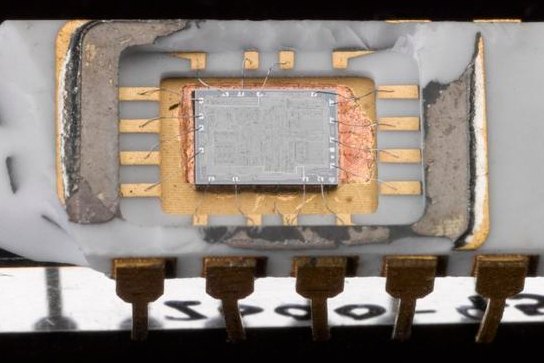
Tucked into a corner of the Intel 4004 are two letters you cannot see without serious magnification: F.F. They are the initials of Federico Faggin, who led the chip’s design and slipped them into the circuitry while finishing the physical layout.
The mark was never meant for customers. Some chip designers saw their work as craft as much as engineering, and a tiny signature was a quiet way to leave a trace on something the naked eye cannot examine. Decades later, high-resolution photographs of the 4004 die showed the initials to technology historians and collectors. They are now among the best-known hidden details in semiconductor history.
From Vicenza to Silicon Valley
Faggin was born in Vicenza, Italy, in 1941. As a boy he built model airplanes, and that led him to electronics. After a technical high school he joined Olivetti, where he ran an experimental computer project early in his career, then took a physics degree at the University of Padua.
California came next. At Fairchild Semiconductor he worked on MOS silicon-gate technology, a manufacturing advance that allowed smaller, faster and more reliable chips.
In 1970 he moved to Intel and became project leader on what turned into the 4004. With Intel engineers Marcian Hoff and Stan Mazor, he turned the processor’s architecture into a working silicon chip that could be made in volume. It reached the market in November 1971 as the first commercially available single-chip microprocessor.
Modest numbers, large idea
By today’s standards the 4004 was slow, at about 92,000 instructions per second. But a complete central processing unit now fit on one piece of silicon instead of several circuit boards packed with separate parts. Computers got smaller, cheaper and easier to build. Products that had been impractical because of their size or cost became possible.
More than 50 years later, processors carry billions of transistors where the 4004 had thousands, and they perform trillions of calculations every second. They run phones, laptops, electric vehicles, cloud computing, medical equipment and space missions. All of them follow the basic design the 4004 introduced: a programmable processor on a single chip. Faggin’s silicon-gate work remains a cornerstone of how those chips are made.




