
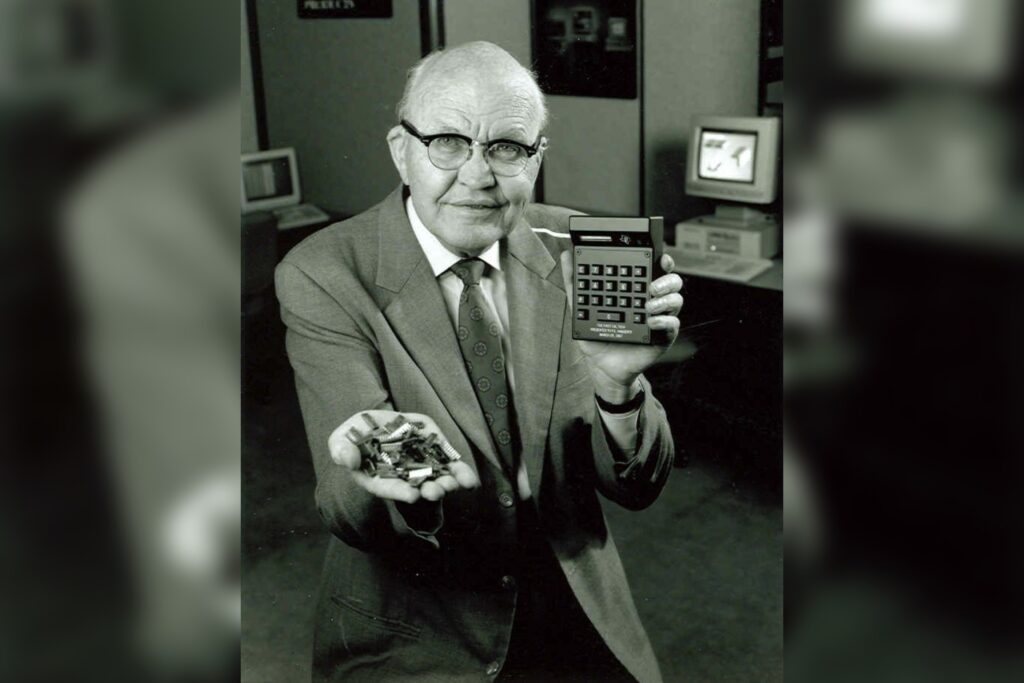
WASHINGTON, July 8 — The integrated circuit, the tiny silicon slab that reshaped the modern world, emerged from a moment of independent invention in the late 1950s, a strategic breakthrough that set the stage for the digital age. Two engineers, working on separate coasts with different approaches, solved the same fundamental problem: how to pack multiple electronic components onto a single piece of semiconductor material. The broader stakes of their work were not immediately obvious, but the calculus of computing power, cost, and size was about to be rewritten.
Jack Kilby of Texas Instruments demonstrated the first working integrated circuit on September 12, 1958. His prototype used a single piece of germanium, with components connected by gold wires.
It was a proof of concept, a crude but functional device that proved the idea could work. Kilby’s Nobel Prize in Physics, awarded in 2000, recognized the magnitude of that single step. Robert Noyce of Fairchild Semiconductor took a different path.
In early 1959, he developed a more practical version using silicon and planar technology. This approach allowed components to be interconnected on the chip’s surface, a manufacturing innovation that made mass production feasible.
Noyce later co-founded Intel in 1968, a company that would become synonymous with the microprocessor revolution. What this signals is that the integrated circuit was not a single eureka moment but a convergence of two distinct engineering traditions, each solving a piece of the puzzle.
From Military Hardware to the Moon
The first commercial integrated circuits appeared in 1961, and their earliest customers were not consumers but the military and aerospace sectors. These were applications where reliability, size, and weight mattered more than cost. By 1964, Fairchild’s ICs were used in the Apollo Guidance Computer, the machine that would navigate astronauts to the lunar surface.
Strategically, this government-backed demand provided the production volume and reliability testing that the fledgling industry needed to mature. The integrated circuit allowed the miniaturization of electronics, reducing size, cost, and power consumption in ways that had been unimaginable a decade earlier.
Handheld calculators and digital watches became possible not because of any single invention, but because the IC made it economically viable to pack complex circuitry into a small package. The broader stakes of this miniaturization were profound: electronics were no longer confined to rooms full of vacuum tubes and wiring.
The Transistor Count Revolution
The trajectory of the integrated circuit is best measured in the sheer density of components it now contains. In 2023, a typical central processing unit holds billions of transistors on a chip the size of a fingernail. That figure, staggering in its scale, represents a continuous arc of engineering refinement stretching back to Kilby’s germanium slab and Noyce’s silicon interconnect.
The microprocessor, the direct descendant of those early ICs, now powers everything from smartphones to supercomputers. The geopolitical chessboard of semiconductor manufacturing has shifted dramatically in the decades since those first chips.
What began as an American innovation, driven by Texas Instruments and Fairchild Semiconductor, has become a global industry with strategic implications for national security and economic competitiveness. The calculus of chip production now involves billions of dollars in fabrication plants, complex supply chains spanning multiple continents, and government policies designed to secure domestic manufacturing capacity. Looking ahead, the integrated circuit continues to evolve.
The fundamental physics of silicon transistors is approaching its limits, but researchers are exploring new materials and architectures to sustain the pace of miniaturization. The broader stakes of this next phase are clear: whoever masters the next generation of chip technology will hold a decisive advantage in computing, communications, and defense.
The integrated circuit, born in a Texas laboratory and refined in a California startup, remains the strategic terrain on which the future will be built.
{“@context”: “https://schema.org”, “@type”: “NewsArticle”, “headline”: “Engineers Kilby And Noyce Develop Integrated Circuit Technology Independently”, “description”: “WASHINGTON, July 8 — The integrated circuit, the tiny silicon slab that reshaped the modern world, emerged from a moment of independent invention in the…”, “datePublished”: “2026-07-08T09:30:00+00:00”, “author”: {“@type”: “Person”, “name”: “Noah King”}, “publisher”: {“@type”: “Organization”, “name”: “InfoPulse Today”, “url”: “https://newsfeed.infopulsetoday.com/”}}




