
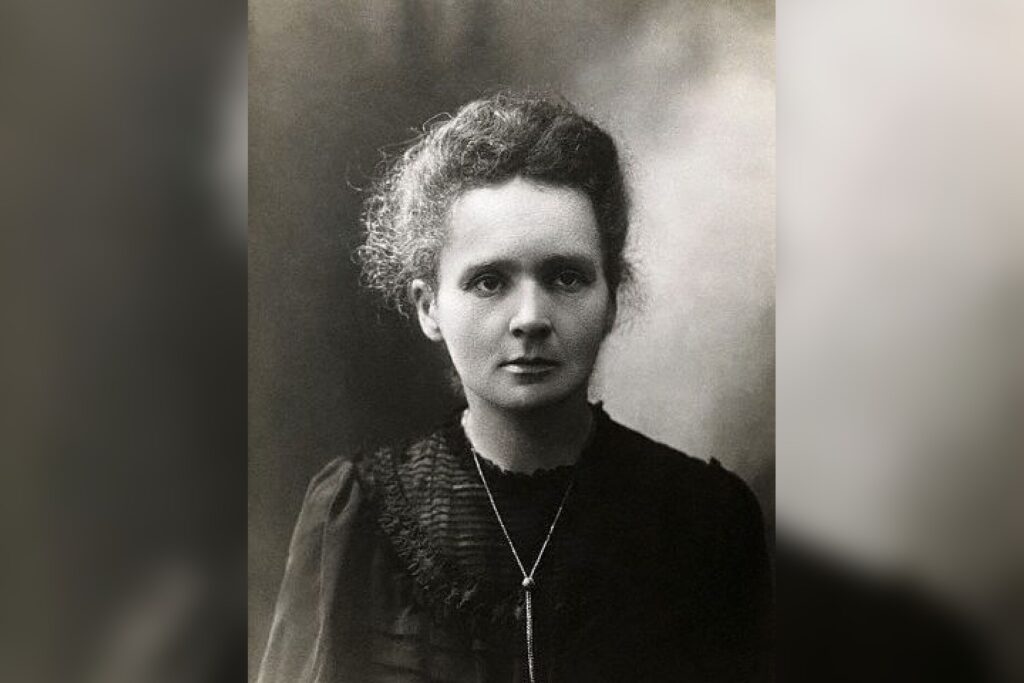
Every technology culture builds its patron saints, and few fit the role better than Marie Sklodowska Curie. Two Nobel Prizes, a word she coined that reshaped physics, elements pulled from ore by hand — and a death caused by the very thing she discovered. Her career, more than a century on, reads as both the business case for deep research and its warning label.
The record itself: born in Warsaw on November 7, 1867, the daughter of impoverished Polish schoolteachers, she worked as a governess to support an older sister studying in Paris before joining her there. At the Sorbonne she took advanced scientific degrees and met Pierre Curie, a physicist already known for the piezoelectric effect. When a 2009 New Scientist poll named her the most inspiring woman scientist of all time, it was measuring a myth a century in the making.
The Discovery Years
Her thesis topic was brand new: Wilhelm Roentgen’s X-rays and Henri Becquerel’s observation that uranium salts could expose photographic film. Using instruments Pierre had designed to measure faint electrical effects, she coated metal pieces with thin layers of uranium salt and began quantifying the rays. In 1898, after successive chemical reactions and crystallizations, the Curies announced polonium, and then radium salts weighing about 0.1 gram — distilled from tons of uranium ore, with each batch tested for its power to ionize air.
The prizes followed the work. In 1903, the year she also became the first woman in France to earn a doctorate in an advanced science field, she shared the Nobel Prize in Physics with Pierre and Becquerel. In 1911 she took the chemistry prize alone, for discovering polonium and radium — the first person ever to win two.
The Cost Side Of The Ledger
Pierre died in 1906, struck by a horse-drawn wagon, and Marie pressed on to their shared objective: a pure specimen of radium. Radium institutes were built for her in France and Poland; during World War I she assembled a front-line fleet of portable X-ray units for wounded French soldiers. She raised two daughters, and the elder, Irene Joliot-Curie, became a Nobel-winning chemist alongside her own husband, Frederic Joliot.
Then the invoice came due. Both women eventually died of leukemia brought on by long exposure to radioactive materials — the field’s pioneers taken by the phenomenon they named. The word “radioactive” was Curie’s own coinage, and in her hands it was a discovery; in her body, over decades of handling, it was a dose nobody yet knew to measure.
What Innovators Take From It
The inspiration half of the legacy is real and documented: she has inspired generations of women scientists, and the public imagination has held her for more than 100 years. The caution half is equally concrete. Her method — isolate, test, scale up from a fraction of a gram to tons of ore — is the innovation playbook still used today, and so is her blind spot: the hazard inside the breakthrough was invisible to the instruments of the era.
That is the dual inheritance any technical field claims from her story. Push the frontier with everything you have; assume the frontier pushes back in ways you cannot yet detect. Curie’s notebooks from those years are still stored in lead-lined boxes. The woman who coined the word did not live to learn what it fully meant — and every generation that builds a new technology since has had to relearn her ending.
Sources
- Marie Sklodowska Curie | Science History Institute
- Marie Curie neyi buldu ya da icat etti? Marie Curie buluşları ve bilime katkıları – Haberler




