A reviewer who spent a week with the Mercedes-Benz CLA 350 Electric came back with a number that stuck. Over mostly highway driving in Sport mode, in fall weather, he saw 4.2 miles per kilowatt-hour. The car has 85 kilowatt-hours of usable battery, so that works out to roughly 357 miles on a charge, about 45 miles beyond the 312-mile EPA estimate for the all-wheel-drive 350. He did not run a full range test, and one driver’s week is not a lab, but the gap is large enough to notice.
What is under the floor
Mercedes says the new cells use a silicon-oxide and graphite blend in the anode, the electrode that holds lithium ions during charging. The automaker says energy density is up 20 percent and cobalt content is down. There is a supply-chain angle too. China dominates graphite processing, and mining the stuff is dirty and expensive, so carmakers want to lean on it less.
The chemistry explains the appeal. Graphite tops out at a theoretical 372 mAh/g. Pristine silicon manages 3,600 mAh/g, roughly ten times as much, because each silicon atom can bind up to 3.75 lithium atoms against one for every six carbon atoms in graphite.
Why it took fifty years
Lithium-silicon experiments date to the early to mid-1970s, and the problem has always been swelling. Silicon expands by roughly 400 percent on crystallographic densities when lithium goes in, which cracks the material and pulls it off the current collector. Charged silicon is also highly reactive with the electrolyte. Early prototypes lost most of their capacity in as few as 10 cycles.
Cell makers have found workarounds. Silicon-carbon composites were first reported in 2002. In 2016, Stanford researchers wrapped silicon microparticles in graphene, reaching 3,300 mAh/g. Group14 Technologies patented a composite called SCC55, which gives 50 percent more volumetric energy density than graphite when fully lithiated. StoreDot found it could reach 80 percent charge in ten minutes, and Porsche announced plans in 2022 to build cells with it in Germany. Enovix was the first to ship finished silicon-anode batteries to customers, and Sila said in September 2021 that it had shipped its first product, in the Whoop 4.0. Tesla has said it will raise silicon content gradually, coating the particles in an elastic layer.
Composites have a catch of their own. In silicon-graphite electrodes, capacity starts as a weighted average of the two materials, but cycling can electrically isolate silicon particles, and capacity then drifts down toward graphite’s alone. As of 2018, commercial anodes held at most 10 percent silicon.
On the road, and at the charger
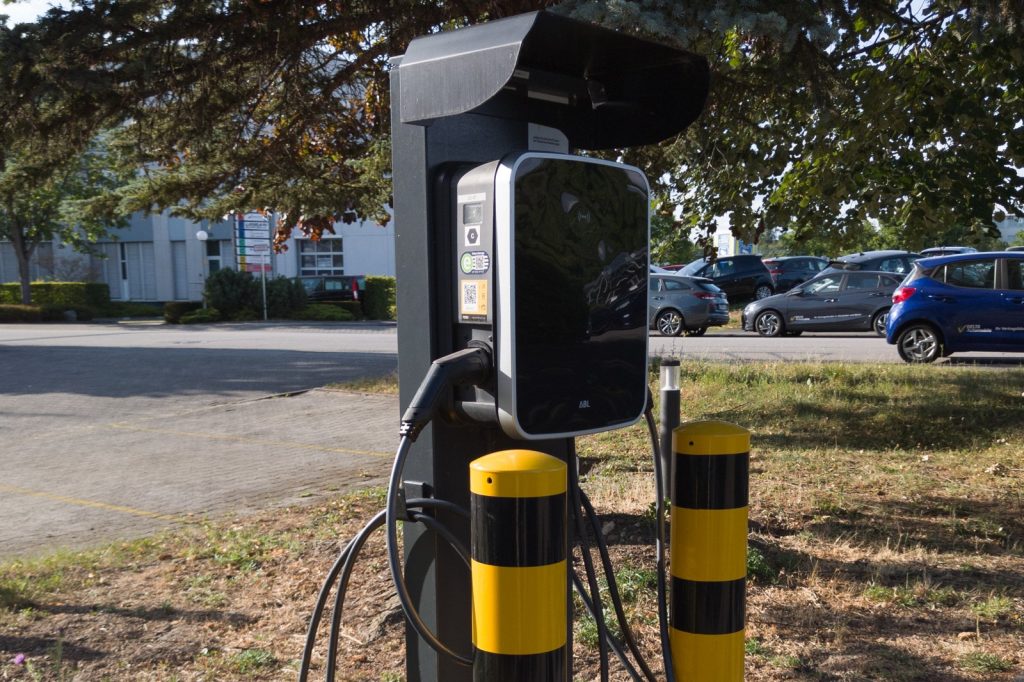
The reviewer tested charging at a 400-kilowatt Mercedes-Benz station in Livingston, New Jersey. The CLA hit a peak of 280 kW within seconds, added 100 miles of indicated range in five minutes and 200 miles in 14. It reached 80 percent in exactly 20 minutes and 90 percent in 26. He called the charging stops astonishingly quick and credited the new cells, as Mercedes does, though he did not isolate the silicon from other factors.
The car is not flawless. He found the software unremarkable and some interior choices questionable. The rear bench is cramped, and the Superscreen comes only with a nearly $6,000 package. The CLA starts at $51,850 with destination fees, about $2,500 above a Model 3 Premium all-wheel drive. Several sedans, including the Lucid Air and Audi A6 e-tron, offer more range. Demand, meanwhile, is firm: Transport & Environment data shows European EV sales up 45 percent year on year, to 22 percent of the market.
Sources
- Lithium–silicon battery
- Silicon Batteries: The Key To Unlocking EV Confidence
- I Drove Mercedes’ New EV With A Silicon Anode Battery. The Future Is Here
Photo: Matti Blume (CC BY-SA 4.0)