
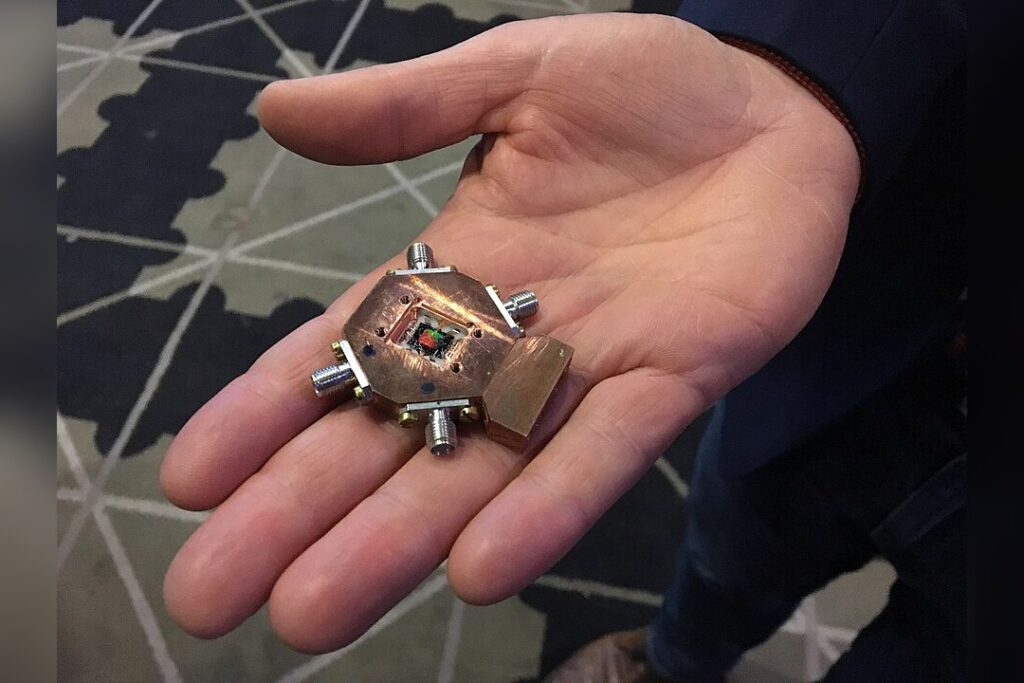
WASHINGTON, July 8 — A 1982 lecture at a physics conference in Pasadena first planted the seed. Physicist Richard Feynman proposed that a computer built on quantum mechanics, not classical transistors, might simulate nature in ways a conventional machine never could. Three years later, David Deutsch formalised the concept into a universal quantum computer.
That theoretical foundation, laid more than four decades ago, is now the basis of a global industry valued at $866 million in 2023 and projected to reach $6.5 billion by 2030, according to MarketsandMarkets. The technology works differently from every computer that came before.
Classical machines process information as bits — each bit is either a 0 or a 1. Quantum computers use qubits, which can exist in multiple states at once through a phenomenon called superposition. A second quantum property, entanglement, links qubits so that a change to one instantly affects its partner, even across distance.
Together, these mechanics allow quantum computers to explore many possible solutions simultaneously. The record shows a steady march from theory to laboratory demonstration.
In 1998, Isaac Chuang and colleagues at IBM ran the first experimental quantum algorithm. That milestone proved the concept could work outside a thought experiment. Two decades later, in 2019, Google’s Sycamore processor achieved what the company called quantum supremacy.
It solved a specific problem in 200 seconds — a calculation that, according to Google’s estimates, would have taken a classical supercomputer 10,000 years. As of 2024, quantum processors have reached roughly 1,000 qubits. But the number of qubits tells only part of the story.
Error rates remain high. Researchers across the field are working on error correction, a challenge that many consider the central engineering hurdle.
The potential applications span several industries. Cryptography stands to be transformed: quantum computers could break widely used encryption methods, but they also enable new, theoretically unbreakable quantum encryption. Drug discovery and materials science could benefit from quantum simulations of molecular interactions that classical computers cannot model accurately.
Optimization problems — from supply chain logistics to financial portfolio management — are another natural fit. Artificial intelligence, too, may see advances as quantum algorithms accelerate machine learning tasks.
The competitive landscape has taken shape. Major technology firms — IBM, Google, Microsoft, Intel — have all invested heavily in quantum research. They are joined by startups such as Rigetti and IonQ, which pursue different qubit architectures.
On the timeline, the next few years will be critical. The projected market growth from $866 million to $6.5 billion by 2030 implies a compound annual growth rate that would require both technical breakthroughs and commercial adoption. Error correction must improve.
Qubit counts must rise while error rates fall. And developers must build quantum algorithms that solve real-world problems faster than classical alternatives.
What to watch next: whether the major players can demonstrate a practical advantage — sometimes called quantum utility — on a commercially relevant problem. The 2019 Sycamore result was a proof of principle on an esoteric benchmark. The next milestone will be a quantum computer doing something useful that a classical computer cannot, at any cost, replicate in reasonable time.
{“@context”: “https://schema.org”, “@type”: “NewsArticle”, “headline”: “Quantum Computing Industry Valued at $866 Million in 2023”, “description”: “WASHINGTON, July 8 — A 1982 lecture at a physics conference in Pasadena first planted the seed. Physicist Richard Feynman proposed that a computer built…”, “datePublished”: “2026-07-08T09:30:00+00:00”, “author”: {“@type”: “Person”, “name”: “Ariel Antonio”}, “publisher”: {“@type”: “Organization”, “name”: “InfoPulse Today”, “url”: “https://newsfeed.infopulsetoday.com/”}}




