
In 2019, Google said its Sycamore processor finished a calculation in 200 seconds. The company’s estimate for the world’s fastest supercomputer was 10,000 years. Google called it quantum supremacy, and it remains the best-known marketing line the field has.
The trick behind it is the qubit. A classical bit is a switch, either off (0) or on (1). A qubit can sit in superposition, counting as both at once until someone measures it. Think of a coin spinning in the air rather than lying flat. Entanglement adds a second oddity: when two qubits are entangled, the state of one is tied to the state of the other, however far apart they are.
For the people who will eventually feel the effects, the physics matters less than what it does for them. A patient waiting on a new medicine, an engineer chasing a better electric-vehicle battery.
Where it came from
The ideas date to early 20th-century physics, when Einstein, Bohr and Schrödinger found that electrons and photons can occupy several states at once and affect each other across distance. In the 1980s Richard Feynman suggested that classical machines struggle to simulate quantum systems, so a quantum machine might do the job. David Deutsch went further and described a universal quantum computer, one able to do anything a classical computer can, and in some cases exponentially faster.
IBM has put real quantum hardware online through its cloud-based Quantum Experience, so researchers can run circuits on actual devices. Canadian firm D-Wave Systems sells quantum annealing, a narrower approach suited to optimization. Volkswagen and some pharmaceutical firms already use D-Wave systems, and the VW work on traffic flow in Beijing is the example usually cited.
What it could change
Medicine is the case people lean on. Quantum simulation could model how molecules interact with proteins far more accurately than classical machines manage, which might speed up the search for new drugs. Materials work follows the same logic: lighter, stronger construction materials, and more efficient batteries.
Cryptography cuts both ways. Shor’s algorithm can factor large numbers efficiently, and that threatens encryption built on the difficulty of factoring. Quantum key distribution, though, offers a communication method resistant to hacking. Beyond that, supply chains, financial portfolios and traffic systems all involve optimization problems with too many variables for classical machines, and climate simulation and machine learning are on the list too.
The catch
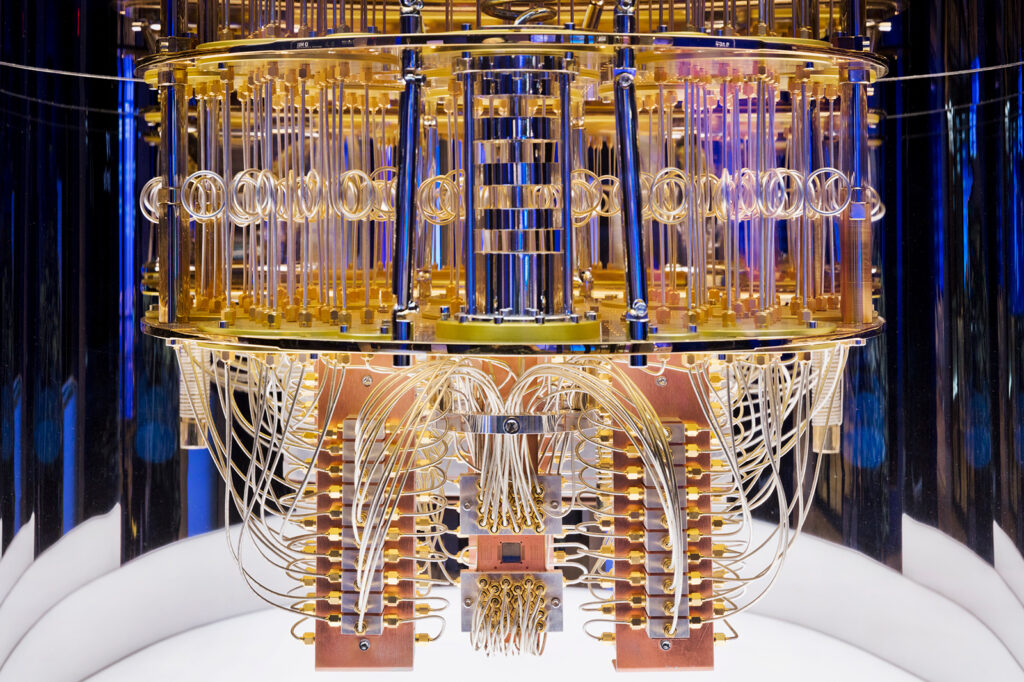
Qubits are delicate. Slight noise from the environment disrupts a computation, so they are held close to absolute zero, about -273.15°C, inside large dilution refrigerators that cool helium isotopes. Three problems keep coming up: building stable systems with more qubits, correcting errors caused by fragile qubits, and making the machines practical enough for wide use.
IBM, Google and D-Wave are all still investing. Classical computers will not go away, and the expectation is that quantum machines will sit alongside them.




