
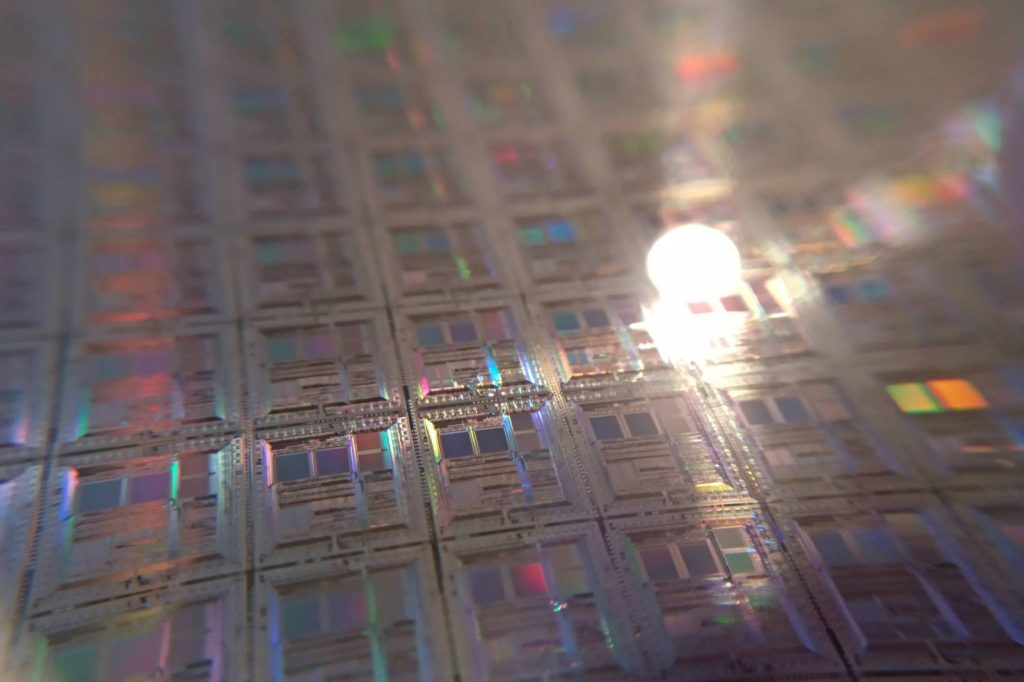
Since 1960, computing power has grown roughly 2 billion times over. Think of a shop that doubled its floor space every couple of years for six decades and you get the idea. Behind that curve sits a 1965 observation by Gordon Moore, Intel’s co-founder.
Moore first predicted that the number of transistors on a chip would double every year while manufacturing costs fell by half. Ten years later he revised the pace to a doubling every two years. It is an empirical pattern, not a law of physics, but the industry used it to plan its long-term work, and it turned into something of a self-fulfilling prophecy.
What the doubling bought
The practical upshot is cheaper, stronger chips. Modern processors hold tens of billions of transistors on a sliver of silicon the size of a fingernail, with the largest reaching 50 billion. The semiconductor industry is now worth about $600 billion, and analysts expect it to reach $1 trillion by 2030. The world produces nearly 270,000 petabytes of data a day, and chips like these have to handle it.
The economic reach is large. Moore’s Law has added about $3 trillion in direct value to global GDP, plus roughly $9 trillion in indirect value over the past two decades. Each new semiconductor job creates five more in other industries.
The pace has slipped
Progress has slowed since 2010 and now runs slightly below Moore’s curve. The smallest commercial transistors measure 3 nanometers, and engineers are closing in on atomic scale. TSMC and Samsung say they have kept pace through the 10, 7 and 5 nanometer nodes.
AI is the hardest test. AI models double in size every six months, and AI computing power doubles every 3.4 months, far faster than a two-year cycle. Traditional CPUs cannot train these models efficiently, so the industry is turning to other tricks. Custom AI chips can raise performance and energy efficiency by as much as 100 times. Processing-in-memory designs cut the energy spent shuttling data around. Advanced packaging is about 8% of the chip market today, and forecasters expect it to double to $96 billion by 2030. Stacking memory on top of logic shortens the data path. Memory makers already build 3D NAND with 176 layers and plan 600 by 2030.
The bill
Each new fabrication plant costs about $10 billion to build and equip. Wafer fabrication capacity alone will need $2.3 trillion in investment between 2024 and 2032, and the industry already puts more than 40% of sales into R&D and capital spending. Environmental costs are real: heavy water use, chemicals, greenhouse gases, and some plants produce up to 15,000 tons of waste in three months.
Quantum computing is sometimes pitched as the successor. It shines at molecular simulation and cryptography but struggles with everyday tasks. Photonics, neuromorphic chips and carbon nanotube transistors are the other candidates.




