
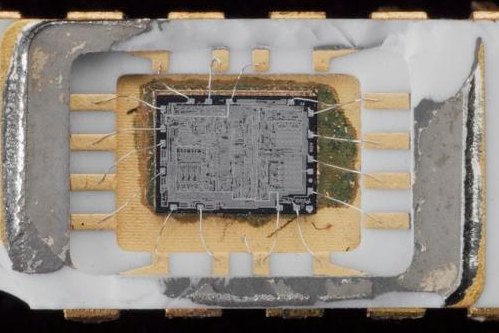
A customer wanted custom chips for a new calculator. Ted Hoff, an engineer at Intel, thought there was a better way to do it.
Hoff had come to Intel from Stanford in 1968 and led the architectural work on the company’s first microprocessor products. Instead of building a different circuit for each job, he proposed a small general-purpose 4-bit computer spread across four chips.
Squeezing a computer onto silicon
The job of making it fit fell to Federico Faggin. Born and schooled in Italy, he joined Intel in 1970 and became the principal designer and project leader for the chip set. He reworked Intel’s MOS memory technology until all 2,300 transistors of the 4004 microprocessor sat on a single chip.
Masatoshi Shima, who worked for Busicom Corporation in Japan, was assigned in 1970 to help Faggin with the 4004 design. When an engineering prototype was ready, Busicom president Yoshio Kojima presented it to Faggin. It showed all four members of the family, and it served as the test bed for the first commercial use of the 4004.
The chip itself was modest on paper. It was made on 2-inch wafers using p-channel silicon gate MOS technology. The die measured 12 square millimeters, and the smallest line width was 10 microns.
Intel saw that other customers might want the same thing and secured marketing rights. In 1971 the company introduced the family as the MCS-4 Micro Computer Set.
The company behind the chip
Robert Noyce and Gordon Moore, both Fairchild Semiconductor alumni, founded Intel (the name is short for Integrated Electronics) in 1968. It started out making semiconductor memory chips. Japanese companies later overtook it in memories, and Intel turned its attention to microprocessors.
Most buyers never think about who made the parts inside a product. In 1991 Intel set out to change that with its “Intel Inside” campaign, which made the name familiar in homes that had never seen one of its chips.
Not every chip made the company look good. Intel rejected a batch of Pentium processors because of a subtle design error known as the FDIV bug, and the defect drew wide criticism. A keychain made from one of those chips carries a line from Intel CEO Andy Grove on the back: “Bad companies are destroyed by crises; Good companies survive them; Great companies are improved by them.”




