
A Watch, a Filament, and a Glancing Blow
The technical reality of late September 2026 space weather came down to one question: how much of a September 28 solar eruption would actually reach Earth? NOAA’s Space Weather Prediction Center answered cautiously, issuing a G1, or Minor, geomagnetic storm watch covering October 2, 2026, after a large filament eruption and its accompanying coronal mass ejection. SWPC expected glancing effects at most, while NASA models put arrival close to the top of October 2, give or take several hours.
The mechanics under the hood were well documented. A sizable solar filament, stretching roughly from S10W50 to N45W50, began lifting off the Sun around 13:51 UTC that September 28. Coronagraphs caught the aftermath: the CME showed up in LASCO C2 coronagraph imagery from the SOHO observatory, west of the Sun, at 14:36 UTC the same day.
Reading the Forecast Dials
The watch went out from SWPC at 13:01 UTC on September 29, ruling out storm-level geomagnetic activity for September 30 and October 1, with G1 conditions expected only on October 2. Its three-day forecast, published at 00:30 UTC on September 30, carried the detail that matters: the highest forecast three-hour Kp sat at 4.67, equivalent to Kp 5 minus, the G1 threshold, during the 15:00 to 18:00 UTC window. For perspective, the greatest observed three-hour Kp across the preceding 24 hours was 2, below anything on the NOAA scale.
Independent readers agreed on the geometry. The Solar Influences Data Analysis Center at Belgium’s Royal Observatory described it as a partial-halo CME with angular width near 200 degrees and a speed close to 500 km/s, or 311 miles per second. Most of the ejecta headed westward off the Sun-Earth line, which is why a glancing encounter, rather than a direct hit, was the working scenario.
What the Models Said
As ever, the models diverged in instructive ways. A deterministic NASA WSA-ENLIL+Cone run placed shock arrival near 03:15 UTC on October 2, give or take 7 hours, and allowed a peak geomagnetic response spanning Kp 3 to Kp 5. NASA’s 27-member ensemble told a milder story: an ensemble-average arrival at 00:05 UTC on October 2; its leading edge, per the simulations, reached missions near Earth spanning 16:25 UTC on October 1 to 06:42 UTC on October 2, for 96% of simulation runs, and a 95% chance maximum Kp would hold at 2 to 4, beneath the G1 threshold.
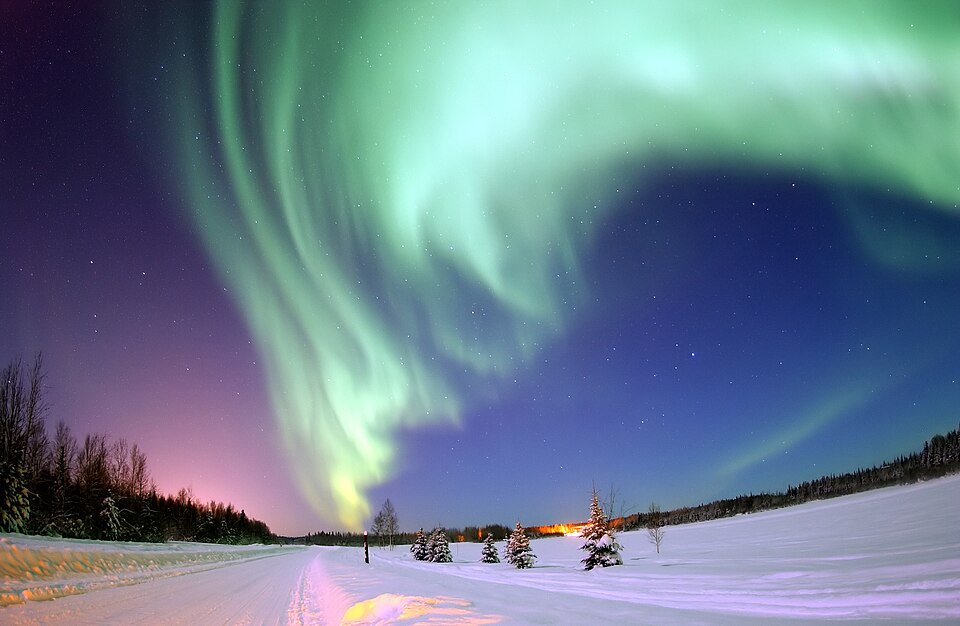
G1 is the lowest rung on NOAA’s five-level geomagnetic scale, mapped to Kp 5. Expect weak power-grid fluctuations, possible minor effects on satellite operations, and aurora visible at high latitudes, including the northern U.S. tier around northern Michigan and Maine. A show, in short, rather than a crisis, and a textbook case of forecasters hedging honestly around a blow that never aimed straight at us.




