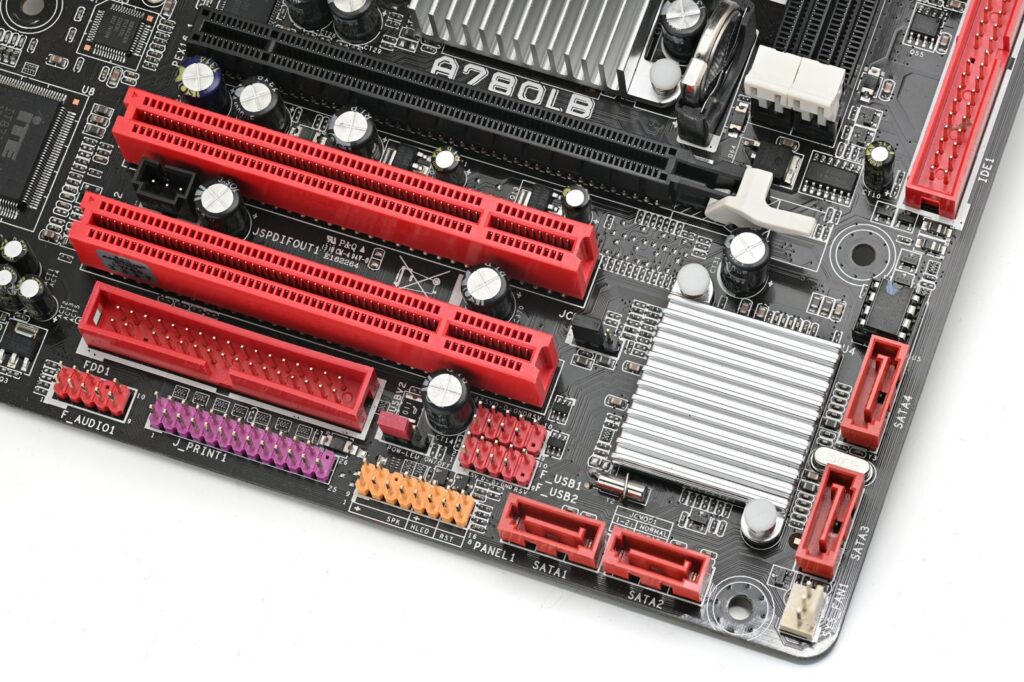
Flip over a modern motherboard and you will often find pin headers for Serial (COM), Parallel (LPT) and PS/2, ports that most people last used in the 1990s. It is easy to assume the board makers are being lazy. XDA-Developers makes the case that something else is going on, and here’s what it means in plain terms: the old ports are leftovers of a deal Intel struck three decades ago, and getting rid of them would cost more than keeping them.
Intel’s pitch: fewer pins, no fees
In the 1990s Intel announced the Low Pin Count (LPC) interface, aimed at retiring the Industry Standard Architecture (ISA) bus, which needed far more pins. The name says it all. Intel’s problem was persuading manufacturers to switch.
Jan Camps, marketing manager for Intel’s Platform Component Division, laid out the thinking at the time. As the industry moved to faster, higher-bandwidth parts, he said, carrying older technologies had become a burden because of the extra pins, space, cost and testing. Intel’s research had found a way to ease the migration, and he promised lower costs and better efficiency for hardware makers. His last line is the one that matters: “Intel has opened the specification so the industry can quickly adopt the technology and integrate it into motherboard legacy I/O peripheral development.”
Open meant royalty-free. Nobody had to pay to use LPC, and the quick uptake let Intel move the market off ISA much faster.
A home for the Super I/O chip
Nuvoton, ITE and Winbond found LPC a very efficient bus for their existing Super I/O chips. Those chips are still in our computers, and they still support Serial, Parallel, PS/2 and floppy drives. They also do housekeeping: reading thermal sensors to see how hot the hardware is running, and controlling fan speed.
By the early 2000s the bus was mostly forgotten outside legacy peripherals. It survived because it cost almost nothing to include. Then the Trusted Computing Group spotted a use for it. Its new TPM 1.2 chip, a cryptographic coprocessor, did not need much bandwidth, every motherboard already had the bus, and with no licensing to worry about, connecting the two was an easy call. TPM 1.2 later fell out of favour after it emerged that it sent everything in unencrypted text, so anyone with physical access to a PC could grab decryption keys with a logic analyzer as they travelled.
Why the headers stay
Think of it like a back door nobody uses: it costs more to brick it over than to leave it. Every modern PC still relies on a Super I/O chip for fan control, temperature monitoring and voltage upkeep. The logic behind the supposedly useless headers already lives inside that chip, and working out how to strip it out would cost more than soldering on a plastic pin header. Makers also avoid trouble with legacy tools that depend on the ports.
So the practical upshot is simple. Keeping the headers costs the manufacturer nothing extra, and nobody has a reason to remove them just because few people still plug anything into them.
Sources
- Your motherboard still has “useless” headers from the 1990s, and licensing agreements are to blame
- Motherboard
- COLORFUL Launches iGame X870E ULTRA-S V14 Motherboard in India | Loktej Business News
Photo: Phiarc (CC BY-SA 4.0)