
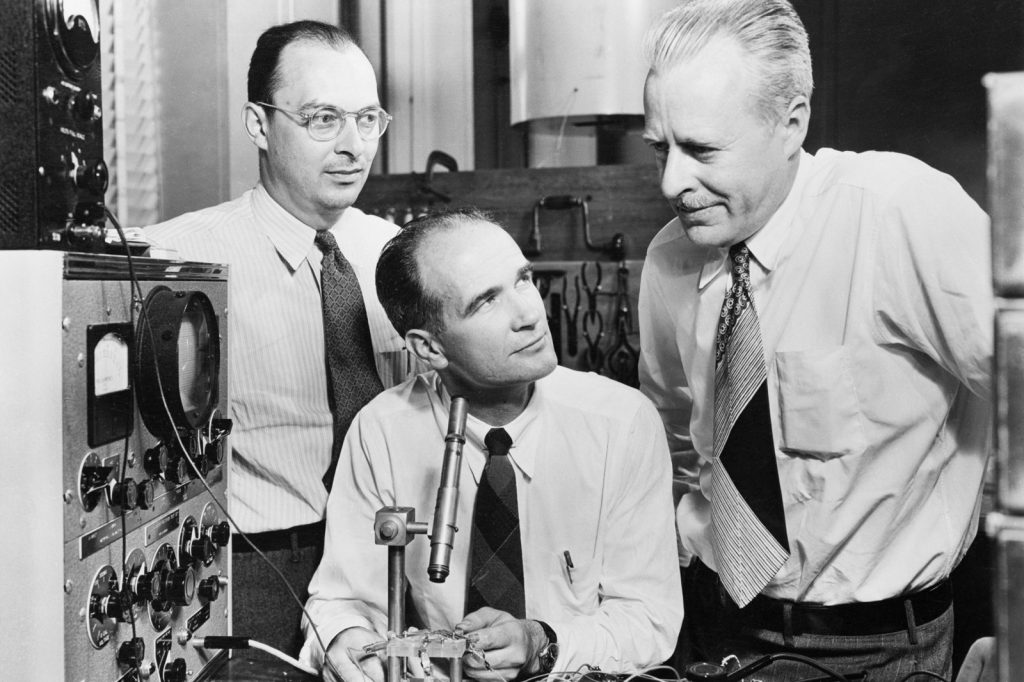
On December 16, 1947, on the fourth floor of Building 1 at Bell Labs in Murray Hill, New Jersey, John Bardeen and Walter Brattain pushed a pair of gold contacts, set close together on a spring, onto a small block of germanium. They were not out to rewrite history. They wanted a smaller device that drew less power than the vacuum tubes used in telephone calls.
What they got was the point-contact transistor, a circuit that worked as both a switch and an amplifier. William Shockley supervised the work. The three men shared the 1956 Nobel Prize in Physics for the discovery of the transistor effect. Bardeen later won a second physics prize, in 1972, for a theory of superconductivity, and remains the only person to take the award twice.
Ed Eckert, the corporate archivist at Nokia Bell Labs, puts the appeal plainly. “The vacuum tube had its limitations: its size, it used lots of power, it was fragile, it created lots of heat. So, the transistor was the answer to all these problems.”
First jobs
The early uses were modest. A card translator helped extend long-distance phone calls. A phone amplifier served noisy places and hearing-impaired users. Then came hearing aids and, famously, the transistor radio. Researchers soon saw the device could reach into automobiles, health care, construction, space exploration and above all computers.
The number of transistors on a silicon chip roughly doubled every two years for decades, an observation known as Moore’s Law. Today some 30 million transistors fit on the head of a pin. A human hair is 90,000 nanometers wide; transistors are measured in nanometers. The average smartphone holds about 460 billion of them.
Eckert offers a comparison: with vacuum tubes in their place, “this cell phone would be ten times the size of the Empire State Building.”
Bill Gates once joked that his first stop on any time-travel trip would be Bell Labs in December 1947.
The lab went on to collect nine Nobel Prizes and five Turing Awards. The original transistor still sits behind glass in the lobby of the Murray Hill campus.




