ENIAC weighed more than 30 short tons and ran on 18,000 vacuum tubes. When the University of Pennsylvania formally dedicated it on February 15, 1946, the press called it a “Giant Brain.” The bill came to about $487,000.
John Mauchly and J. Presper Eckert designed the machine to work out artillery firing tables for the Army’s Ballistic Research Laboratory. Its first program, though, was a study of whether a thermonuclear weapon was feasible. It went to practical work on December 10, 1945, was accepted by the Army Ordnance Corps in July 1946, and moved to Aberdeen Proving Ground in Maryland in 1947. It ran there without a break until 1955.
How it started
In June 1941, graduate students were computing firing tables with Friden calculators under Mauchly’s supervision. He began to wonder whether electronics could speed the job up. He was no electronics expert, so he brought in research associate Eckert. In August 1942 Mauchly proposed an all-electronic calculating machine, and the Army gave Penn a six-month research contract worth $61,700. The construction contract was signed on June 5, 1943, and secret work began at the Moore School of Electrical Engineering under the code name Project PX.
The machine
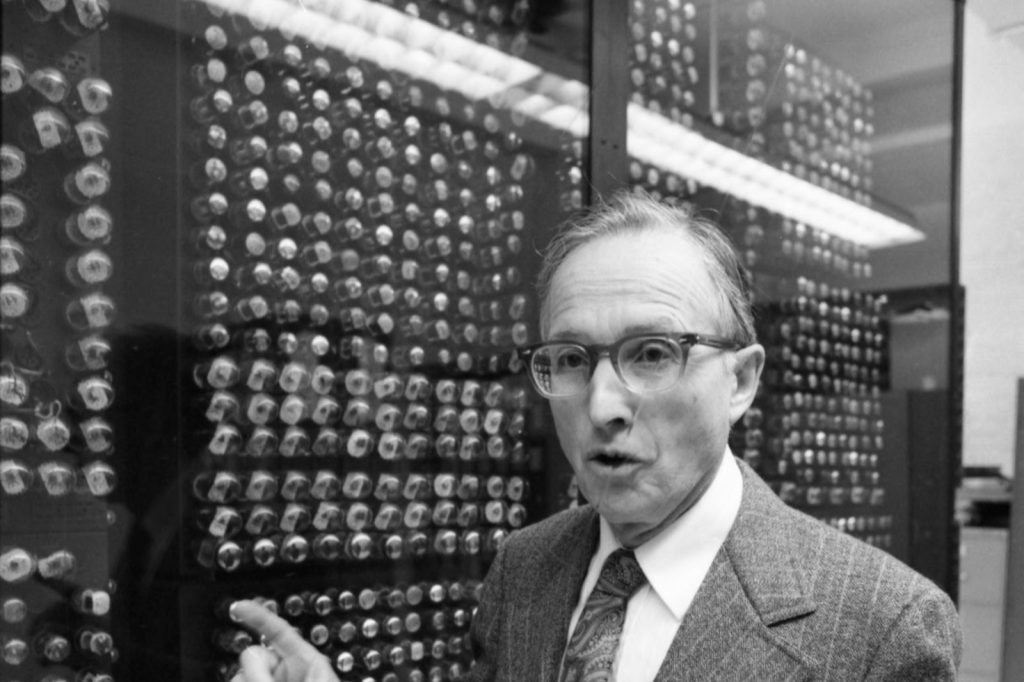
By the end of its working life, ENIAC held 18,000 tubes, 7,200 crystal diodes, 6,000 relays, 70,000 resistors, 10,000 capacitors and roughly 5,000,000 hand-soldered joints. It stood about 10 feet tall and 100 feet long, took up 300 square feet and drew 150 kW. Twenty accumulators did the adding, each holding a ten-digit decimal number, at 5,000 additions or subtractions a second. The press was right about its speed: it ran on the order of a thousand times faster than electromechanical machines.
Reliability was the price. Several tubes burned out almost every day, and the machine sat idle about half the time. Most failures came while the tubes warmed up or cooled down. Engineers eventually brought the rate to about one tube every two days. “We had a tube fail about every two days and we could locate the problem within 15 minutes,” Eckert said in a 1989 interview. In 1954 the longest stretch without a failure was 116 hours.
Programming by cable
ENIAC could run loops, branches and subroutines, but it was not a stored-program computer. Programs were set with plugboard wiring and three portable function tables. Working out how to map a problem onto the machine usually took weeks, and setting the switches and cables afterward could take days.
Six women did that work: Kay McNulty, Betty Jennings, Betty Snyder, Marlyn Wescoff, Fran Bilas and Ruth Lichterman. Herman Goldstine picked them from a pool of at least 200 women the Moore School had hired as human “computers.” No programming languages existed, so they studied ENIAC’s blueprints and logic to learn how to set it. They also learned the machine well enough to narrow a bug down to a single failed tube. Snyder, later known as Betty Holberton, went on to write the first generative programming system, SORT/MERGE, and helped design the UNIVAC and the BINAC.