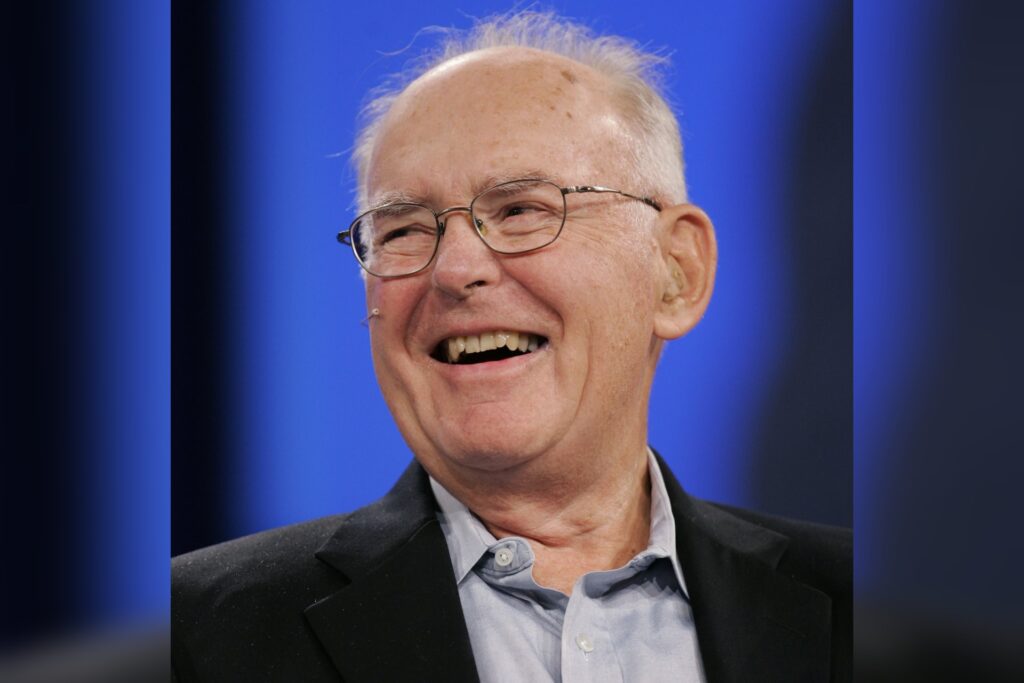
In April 1965, Electronics magazine asked Gordon Moore for a guess about the next ten years of the semiconductor business. Moore, then director of research and development at Fairchild Semiconductor, wrote a short article saying the number of components in a dense integrated circuit had been doubling roughly every year and would probably keep doing so. Decades later he described it plainly: “I just did a wild extrapolation.”
The guess stuck. In 1975 he revised the pace to a doubling about every two years, and Caltech professor Carver Mead gave it the name Moore’s law.
A law that was really a target
It was never physics. It is an empirical observation about cost and density, and the industry came to treat it as a schedule. Chipmakers cited it as they raced to add processing power, and some historians call it a self-fulfilling prophecy. Moore himself saw it as a pleasant surprise: “Moore’s law is a violation of Murphy’s law. Everything gets better and better.”
One footnote that gets garbled constantly: the 18-month figure people quote belongs to Intel executive David House, who worked out in 1975 that two-year transistor doubling implied chip performance doubling about every 18 months.
From chemistry to Intel
Moore was born in 1929 and earned a chemistry PhD at Caltech in 1954. He left Shockley Semiconductor with the “traitorous eight” when Sherman Fairchild agreed to back them. In July 1968 he and Robert Noyce founded NM Electronics, which became Intel.
He was executive vice president until 1975, then president. In April 1979 he took over as chairman and chief executive, and held both jobs until April 1987, when he stayed on as chairman. Intel named him chairman emeritus in 1997.
The curve flattens
Microprocessor architects report that progress has run below Moore’s pace since around 2010. Dennard scaling, which kept power use in line as transistors shrank, had already ended in the mid-2000s. Brian Krzanich, a former Intel chief executive, pointed to Moore’s own 1975 revision as a precedent and called the slowdown “a natural part of the history of Moore’s law.”
Nobody agrees on what comes next. In September 2022, Nvidia chief executive Jensen Huang called Moore’s law dead, while Intel’s Pat Gelsinger took the opposite view.
The money went elsewhere
In 2000, Moore and his wife Betty set up the Gordon and Betty Moore Foundation with a gift worth about $5 billion, aimed first at environmental conservation, science and the San Francisco Bay Area. In 2001 they gave Caltech $600 million, then the largest gift ever to a higher-education institution. Moore received the National Medal of Technology and Innovation in 1990 and the IEEE Medal of Honor in 2008.
He died at his home in Waimea, Hawaii, on March 24, 2023, aged 94. Gelsinger, then Intel’s chief executive, said Moore “defined the technology industry through his insight and vision.”