Flip a coin and it lands heads or tails. Hold that picture, because it is the simplest way into how a quantum computer differs from the laptop on your desk. A classical bit is the landed coin: 0 or 1, nothing else. A qubit is the coin still in the air, described by a mix of both outcomes until someone measures it.
Physicists call this superposition. In a qubit, the mix has weights attached. Two numbers, called probability amplitudes, set the odds of getting a 0 or a 1 when the measurement happens, and at that moment the qubit collapses to one answer. Nobody ever sees a qubit as “both.”
The numbers add up fast. Three classical bits hold one of eight values at a time. Three qubits can sit in a superposition of all eight. With 10 qubits the count is 1,024 states, and 50 qubits can represent more than one quadrillion.
Why more states do not equal more speed
It is tempting to say a quantum machine simply tries every answer at once. It does not work that way. Superposition alone gives no speedup. What matters is interference: the algorithm is built so that the amplitudes of wrong answers cancel each other out while those of right answers reinforce, and a measurement then returns the correct result far more often than a guess would.
Grover’s search and Shor’s factoring algorithm both lean on this trick. Shor’s is the one that worries security people, since a large, fault-tolerant quantum computer running it could break RSA and elliptic-curve encryption, which protect much of today’s web traffic.
Entanglement
The second ingredient links qubits together. When two qubits are entangled, their joint state cannot be split into two independent ones. Measure one and you learn something about the other, however far apart they sit. In the textbook example, the pair always reads 00 or 11 with equal odds. If the first is 0, so is the second.
Einstein called it “spooky action at a distance.” Experiments have since confirmed it is real. It cannot carry a message faster than light, though. Each result is random, and the correlation only shows up once the two sides compare notes by ordinary means.
Gates such as controlled-NOT and controlled-Z create entanglement from qubits that start out separate.
Where the hardware stands
Today’s machines belong to what researchers call the NISQ era, short for Noisy Intermediate-Scale Quantum. They have tens to hundreds of qubits, and some platforms report devices approaching or passing 1,000. Raw qubit count is not the measure, though. Errors are. Two-qubit gate error rates on leading platforms often sit between 10^-3 and 10^-2, which limits how many steps a program can run before noise takes over. Qubit states also decay, so there is a ceiling on how long any computation can last.
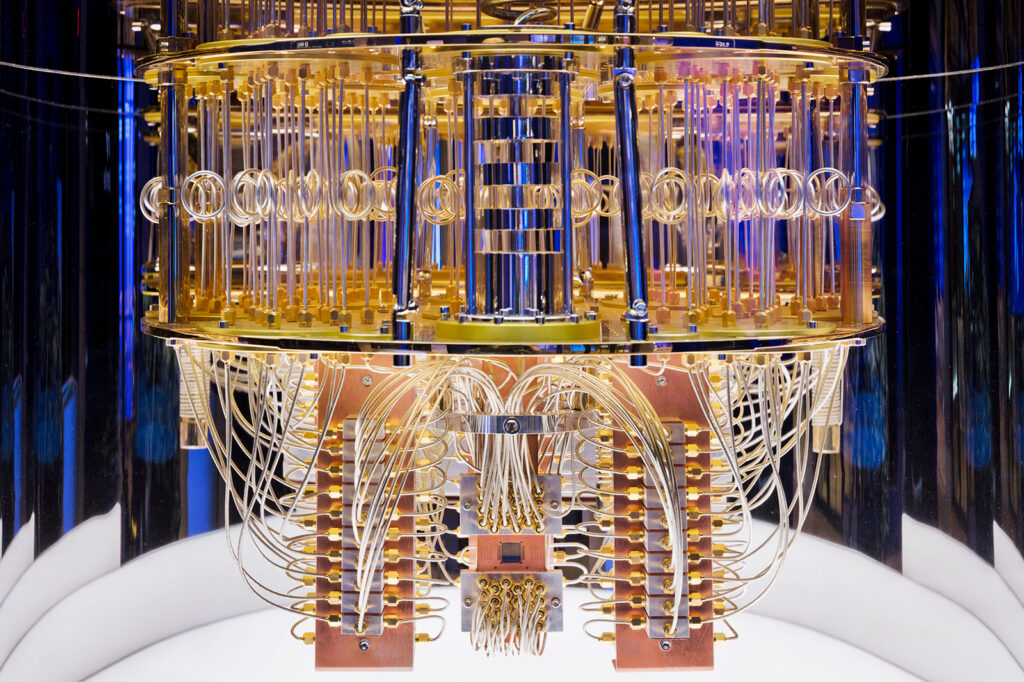
Several designs compete: superconducting circuits, trapped ions, neutral atoms, photons and semiconductor spin qubits. Superconducting chips have fast gates but are sensitive to noise. Trapped ions are more accurate and slower.
The fix is error correction, which spreads one dependable logical qubit across many physical ones. Cryptographically relevant factoring is expected to need many such logical qubits.
Most people who work with the technology reach it through cloud platforms and toolkits such as Qiskit, Cirq, Q# and AWS Braket. Most current uses are experiments: small-molecule chemistry, portfolio and routing optimization, early machine learning. For optimization, the evidence for a consistent quantum edge is still preliminary, since classical methods are already well tuned. On encryption, NIST has led standardization of post-quantum algorithms, including CRYSTALS-Kyber and CRYSTALS-Dilithium, and companies with long-lived sensitive data are drawing up migration plans to guard against “harvest now, decrypt later” attacks.
A fully fault-tolerant machine may be years to decades away.
Sources
- Quantum Superposition: Science Fiction Meets Reality
- Quantum Computing Explained: Qubits and Entanglement