When Robert Noyce was a student at Grinnell College, he stole a 25-pound pig from the mayor’s farm and roasted it at a school luau. The mayor wrote to Noyce’s parents that in Iowa, taking a domestic animal was a felony carrying “a minimum penalty of a year in prison and a fine of one dollar.” Noyce faced expulsion. The college president, who taught his physics course and did not want to lose him, struck a deal instead: the college paid for the pig, and Noyce sat out a semester. He came back in February 1949 and graduated Phi Beta Kappa.
The same professor, Grant Gale, got hold of two of the first transistors Bell Labs ever produced and showed them to his class. Noyce was hooked. Gale pointed him at MIT, where his speed earned him the nickname “Rapid Robert”, and he took his physics doctorate in 1953.
From Shockley to Fairchild
After a spell as a research engineer at Philco in Philadelphia, Noyce left in 1956 to join William Shockley, co-inventor of the transistor, at his laboratory in Mountain View, California. It lasted a year. Noyce and seven colleagues, later known as the “traitorous eight”, walked out over Shockley’s management style and started Fairchild Semiconductor. Sherman Fairchild said later that Noyce’s impassioned pitch was what persuaded him to set up the semiconductor division.
The chip
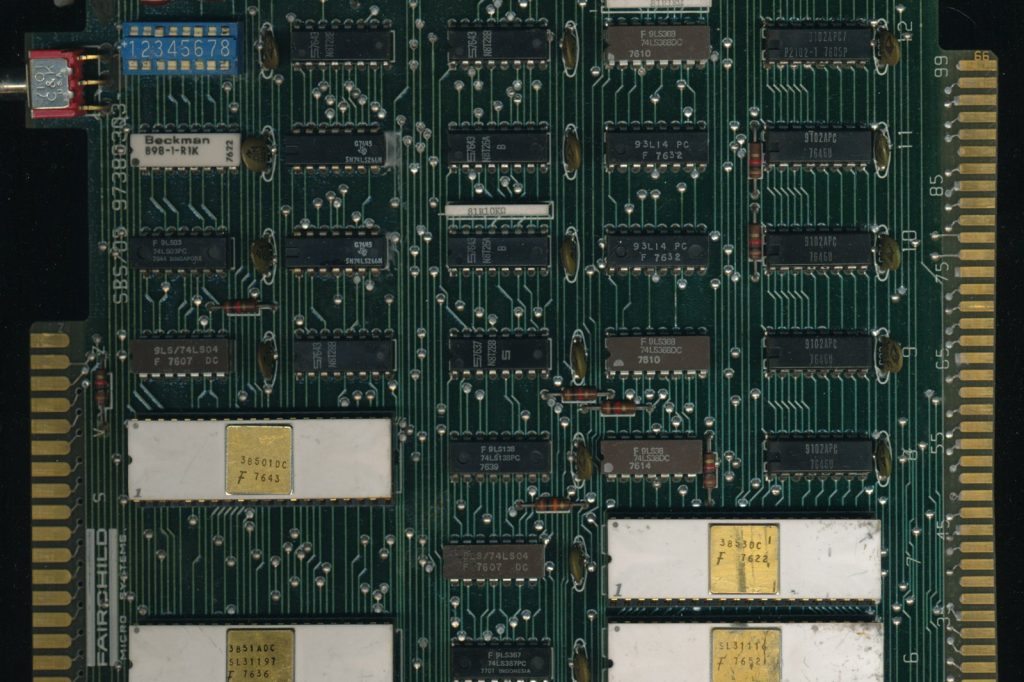
Jack Kilby had built the first hybrid integrated circuit in 1958 at Texas Instruments, on germanium. In 1959 Noyce independently came up with a different design, the monolithic integrated circuit, and the difference is the detail that matters. Kilby’s chip relied on external wire connections and could not be mass-produced. Noyce put every component on one piece of silicon and joined them with aluminium lines. His design rested on the planar process Jean Hoerni developed in early 1959, which in turn built on surface passivation and thermal oxidation methods from Mohamed Atalla. In July 1959 Noyce filed U.S. patent 2,981,877, “Semiconductor Device and Lead Structure”.
Three American presidents honoured him for it.
Intel
Noyce and Gordon Moore left Fairchild and founded Intel in 1968. Arthur Rock, the board chairman and a major investor, said the company needed Noyce, Moore and Andrew Grove, and in that order: Noyce the visionary, Moore the virtuoso of technology, Grove the technologist turned management scientist. Noyce served as the first CEO until Moore took over in 1975.
Under his oversight, Ted Hoff developed the microprocessor as a concept and Federico Faggin designed the first commercial one, the Intel 4004. Noyce called it his second revolution.
His management style was “roll up your sleeves”. He skipped the fancy company cars, reserved parking spaces, private jets and grand offices, and treated employees as family. Later Intel chief executives were measured against that example.
Honours
The list is long. The Franklin Institute gave him its Stuart Ballantine Medal in 1966, the IEEE its Medal of Honor in 1978 “for his contributions to the silicon integrated circuit, a cornerstone of modern electronics”, and in 1979 he received the National Medal of Science and the Faraday Medal. President Ronald Reagan presented the National Medal of Technology in 1987. In 1989 he went into the U.S. Business Hall of Fame, with President George H. W. Bush giving the keynote, and the National Academy of Engineering gave him its Charles Stark Draper Prize.
Noyce suffered a heart attack at his home on June 3, 1990, aged 62, and died at the Seton Medical Center in Austin, Texas. In his last interview, asked what he would do as “emperor” of the United States, he said he would make sure the country was “preparing our next generation to flourish in a high-tech age.”