
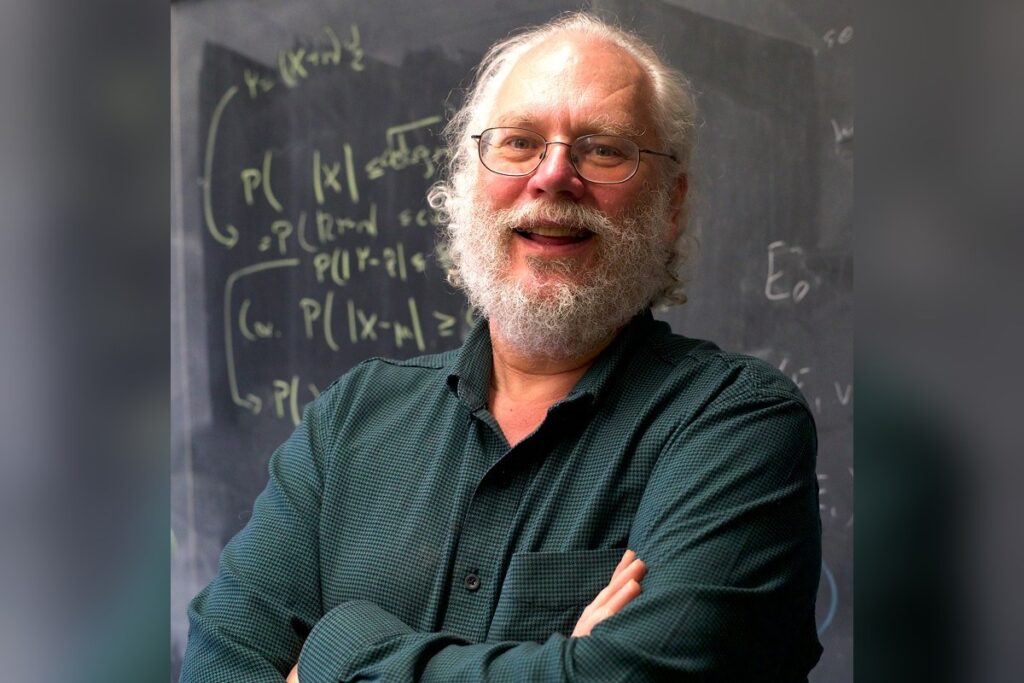
A talk at Bell Labs in 1994 went wrong in a way that changed cryptography. Peter Shor stood up to describe a problem where a quantum computer beat any conventional machine. Somewhere between the room and the rumour mill, listeners came away believing he had cracked integer factoring. He hadn’t. A few days later, ABC News (Australia) reported, he had.
New Scientist tells the same story from the researcher’s side. Shor, then working at Bell Labs in New Jersey, had wandered into quantum computing almost by accident, after a seminar by Umesh Vazirani. The problem Vazirani described struck him as contrived. Over roughly six months, ending in the spring of 1994, he went looking for something more practical and found it: factoring very large numbers, plus a recipe a quantum computer could follow to do it.
Why factoring matters
Take 77. Anyone can see it is seven times 11. Now imagine a number thousands of digits long. ABC News quoted Henry Everitt, chief scientist with the United States Army, on what that means for public-key encryption: “It would take roughly the age of the universe for our current computers to find those factors.” Multiplying is easy, and splitting the product back apart is not. That gap protects bank transactions, log-ins, messages, health records and government communications.
Shor’s method, on a big enough quantum machine, would close the gap. ABC put the classical timescale at 13.8 billion years and said his discovery got a quantum computer well under it.
A reason to build the machine
The algorithm gave researchers an urgent reason to try, New Scientist wrote. Everitt had been planning a small workshop on quantum technology when Shor’s result appeared, and he added a second day on quantum computing. The workshop produced a road map for building such a computer and financial backing from the US Army.
The hardware crept forward. In 1995, scientists at the US National Institute of Standards and Technology built the first quantum logic gate. In 2001, IBM ran Shor’s algorithm for the first time and factored the number 15. By 2016, NIST had launched a contest for replacement encryption. Of the dozens of entries, it picked 69 with potential, and by 2022 it had cut the field to three winners.
The man behind it
MIT’s mathematics department lists Shor as Morss Professor of Applied Mathematics, a post he has held since 2003. He took a Caltech degree in 1981 and an MIT doctorate in 1985, then spent 1986 to 2003 on AT&T’s research staff. In 1999 he received both the ACM’s Gödel Prize and a MacArthur Foundation Fellowship. The Breakthrough Prize in Fundamental Physics followed in 2023. MIT’s Killian award citation says “quantum computing exists today, in practice, because of Peter Shor.”
Shor himself sounds calm about it. New Scientist caught him at the Quantum.Tech World conference in Boston, where attendees queued for selfies and badge signatures. “We have good methods for post-quantum cryptography, we just have to implement [them],” he said, then added: “This will be incredibly hard.” Banks and hospital systems may need years just to audit their networks, the magazine noted, and as many again to update devices and software.
Today’s quantum computers cannot run his algorithm yet. “[Quantum computers] are still toys, but they’ll stop being toys very soon,” Shor told the magazine. ABC cited the latest Quantum Threat Timeline Report, which calls a code-breaking machine “quite possible” within the next 10 years and “likely” in the next 15.
Sources
- Peter Shor's algorithm could break the internet – but he's not worried | New Scientist
- Q-Day and the race to protect your data from quantum attack | ABC News (Australia)
- Peter Shor, MIT Department of Mathematics faculty profile




