
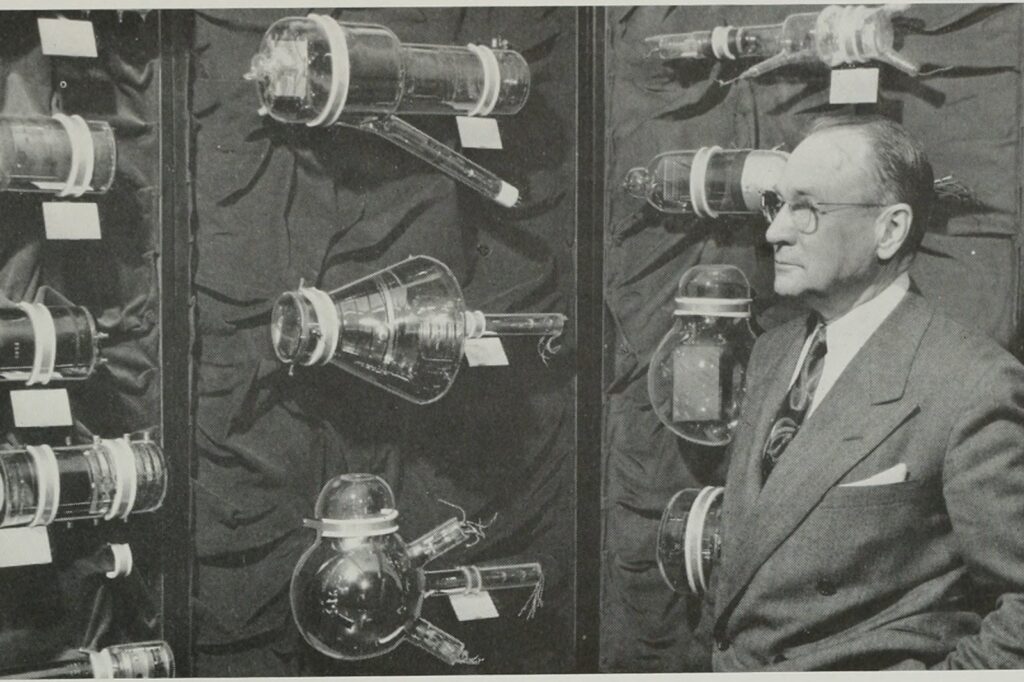
LONDON, July 19 — The cathode-ray tube is usually remembered as the chunky glass display that sat on desks for decades. But the mechanics here tell a different story: the CRT was also the engine of television’s first eyes. Before the charge-coupled device sensor arrived in the 1980s, video camera tubes—devices based directly on the CRT—were what captured images from the early 1930s right through the 1990s.
The principle is elegant and deceptively simple. An electron beam scans across a target onto which the scene’s image has been focused.
The beam’s size is tiny relative to that target, and its current shifts with brightness at each scan point. The result? In the NTSC format, that meant 480 to 486 horizontal scan lines per image; PAL delivered 576 lines; the high-definition Hi-Vision system pushed as high as 1,035 lines.
The beam’s precision made the resolution possible. The claim of origin, however, belongs to a Scottish electrical engineer.
In June 1908, Alan Archibald Campbell-Swinton published a letter in the scientific journal Nature outlining a fully electronic television system that would use CRTs for both imaging and display. But on closer reading, he noted the “real difficulties lie in devising an efficient transmitter” and that “no photoelectric phenomenon at present known will provide what is required.” A CRT display had already been demonstrated by Max Dieckmann in 1906—results printed in Scientific American in 1909—but the transmitter side remained the bottleneck.
The Long Road from Rubidium to Selenium
Campbell-Swinton expanded his vision in a November 1911 presidential address to the Röntgen Society. His proposed transmitting device used a photoelectric screen of isolated rubidium cubes. This concept was later popularized as the “Campbell-Swinton Electronic Scanning System” by Hugo Gernsback and H.
Winfield Secor in the August 1915 issue of Electrical Experimenter and by Marcus J. Martin in his 1921 book The Electrical Transmission of Photographs.
But rubidium cubes never made it into a working camera. In an October 1926 Nature letter, Campbell-Swinton announced “not very successful experiments” from before March 1914 with G. M.
Minchin and J. C.
M. Stanton, projecting an image onto a selenium-coated metal plate scanned by a cathode ray beam. These experiments were repeated in 1937 by H.
Miller and J. W. Strange of EMI and by H.
Iams and A. Rose of RCA, both teams transmitting “very faint” images with the original selenium plate.
Better results came when they switched to zinc sulphide, zinc selenide, or aluminium or zirconium oxide treated with caesium. Those experiments formed the base of the future vidicon.
Competing Claims in the Patent Race
A description of a CRT imaging device appeared in an August 1921 French patent application by Edvard-Gustav Schoultz, published in 1922, though a working device was not demonstrated until later. Meanwhile, Max Dieckmann and Rudolf Hell designed an early related tube called the image dissector. Their 1925 patent application bore the descriptive German title Lichtelektrische Bildzerlegerröhre für Fernseher: photoelectric image dissector tube for television.
The mechanics here run in parallel tracks: Campbell-Swinton’s theoretical framework, Schoultz’s patent paperwork, Dieckmann and Hell’s hardware-oriented dissector concept. All three strands would eventually converge into the tubes that broadcast the first live television, then the moon landing, then decades of news and entertainment—until the CCD finally retired them.
What is striking, looking back from July 2026, is how long the CRT camera tube held the field—from the early 1930s well into the 1990s—and how many of the essential ideas were in place by 1911. The difficulty was never the concept; it was the materials. Selenium gave only faint images; caesium-treated compounds gave better ones.
The vidicon line that followed was a direct descendant of those 1937 experiments. The beam scanned, the signal flowed, and the picture arrived.
Now, with CCD and CMOS sensors long dominant, the CRT camera tube is a closed chapter. But the claim that it was merely a primitive precursor misses the mechanics: it was a highly engineered solution that worked for more than sixty years. The catch is that it took nearly thirty years from Campbell-Swinton’s 1908 letter to get even a faint image out of a selenium plate.
Patience, in this story, is not just a virtue. It is the whole plot.




