
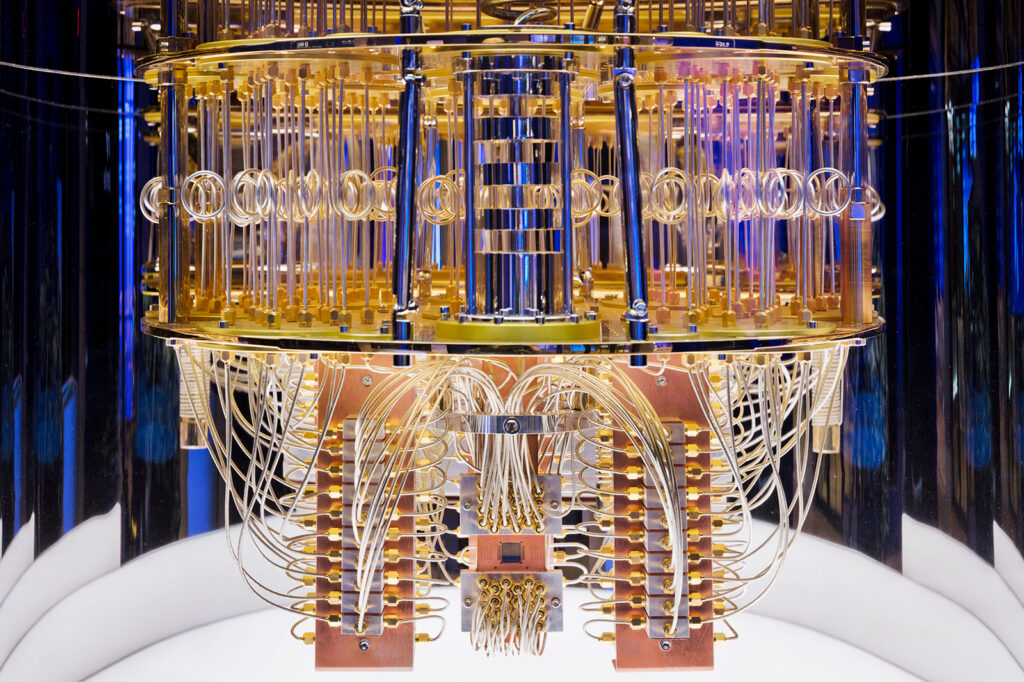
SAN FRANCISCO, July 8 — Tucked inside refrigerators that hover near absolute zero, a new kind of computer is slowly taking shape. It doesn’t run on the familiar bits that power your laptop or smartphone. Instead, it uses qubits.
Think of a regular computer bit as a light switch: it’s either on or off, a 1 or a 0. A qubit, by contrast, can be both at once.
That’s superposition, a direct consequence of quantum mechanics. The practical upshot? A quantum computer can explore many possible solutions to a problem simultaneously, rather than checking them one by one.
That’s only half the story. Qubits can also be entangled — a link so strong that measuring one qubit instantly affects its partner, no matter how far apart they are.
In plain terms, entanglement lets quantum computers perform calculations in parallel, coordinating information across the entire system at once. Quantum gates, the building blocks of quantum circuits, make this magic happen. The Hadamard gate puts a qubit into superposition.
The CNOT gate entangles two qubits. String enough of these operations together, and you get a quantum algorithm. The field already has two famous examples.
In 1994, mathematician Peter Shor published an algorithm that could, in theory, break widely used encryption by factoring large numbers exponentially faster than any classical computer. Two years later, Lov Grover published an algorithm that can search an unsorted database in roughly the square root of the time a classical computer would need.
Both algorithms exploit superposition and entanglement to outrun anything we have today. Here’s the catch: qubits are fragile. They lose their quantum properties in microseconds to milliseconds — that’s their coherence time.
Even a stray vibration or a passing electromagnetic wave can destroy the state they’re holding. To keep them stable, current quantum computers operate at about 15 millikelvins, a temperature colder than deep space.
That requires enormous dilution refrigerators and careful shielding. Error correction is the field’s central engineering challenge. Because qubits are so delicate, researchers have developed quantum error correction codes, such as the surface code.
The tradeoff is steep: it takes many physical qubits to form a single logical qubit that can perform a calculation reliably. At the moment, the most advanced quantum processors have a few hundred physical qubits. A useful, fault-tolerant quantum computer will likely need thousands, if not millions, of logical qubits — each built from many physical ones.
The practical upshot for ordinary readers? For now, quantum computers are not replacing your laptop.
They are experimental machines, housed in research labs and a handful of corporate data centers, tackling problems that classical computers find impossibly hard: simulating molecules for drug discovery, optimizing supply chains, cracking encryption. The algorithms — Shor’s, Grover’s, and newer ones — are proven on paper and in small demonstrations, but scaling them to useful size remains the grand challenge. What to watch next: the race to increase coherence time and the push to build better error-correcting codes.
If engineers can keep qubits stable long enough to run complex algorithms, the technology could transform industries. Until then, quantum computing remains a field of enormous promise — and enormous difficulty.
{“@context”: “https://schema.org”, “@type”: “NewsArticle”, “headline”: “Quantum Computing: Superposition, Entanglement, Qubits Explained”, “description”: “SAN FRANCISCO, July 8 — Tucked inside refrigerators that hover near absolute zero, a new kind of computer is slowly taking shape. It doesn’t run…”, “datePublished”: “2026-07-08T09:30:00+00:00”, “author”: {“@type”: “Person”, “name”: “Erika Johnson”}, “publisher”: {“@type”: “Organization”, “name”: “InfoPulse Today”, “url”: “https://newsfeed.infopulsetoday.com/”}}




