
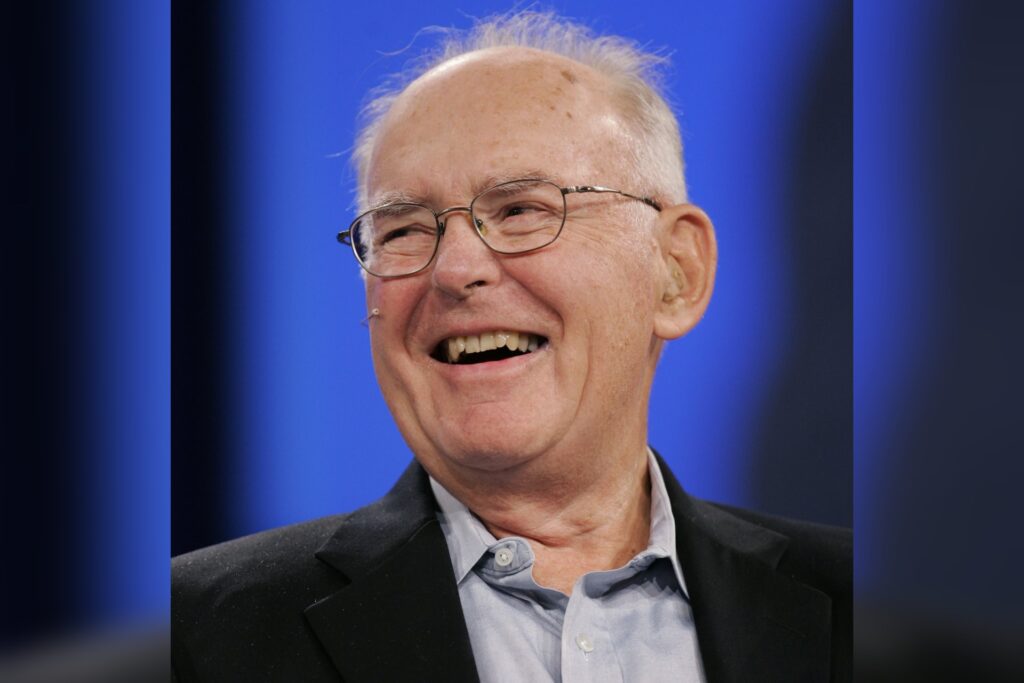
SAN FRANCISCO, July 13 — Gordon Moore, the chemist who co-founded Intel and whose name became synonymous with the relentless pace of technological progress, died in 2023 at the age of 94. His legacy, however, continues to shape the semiconductor industry and the very architecture of modern computing.
Born in San Francisco in 1929, Moore earned a Ph.D. in chemistry from Caltech in 1954. In 1965, while working at Fairchild Semiconductor, he published a paper that would become the foundational blueprint for the digital age. He predicted that the number of transistors on an integrated circuit would double every year — a forecast he later revised to every two years. This became known as Moore’s Law.
The technical reality behind the prediction was that it was less a law of physics and more a self-fulfilling industry roadmap. For decades, the entire semiconductor ecosystem — from fabrication plant design to chip architecture — aligned itself to that cadence. The detail that matters is that Moore’s Law wasn’t just an observation; it was a target that companies like Intel spent billions to hit.
In 1968, Moore co-founded Intel with Robert Noyce and Andrew Grove. Under the hood, the company’s early work on memory chips gave way to something far more consequential. As CEO from 1975 to 1987, and chairman from 1979 to 1997, Moore led Intel as it became the world’s largest chipmaker, driven by the x86 processor architecture that came to power the vast majority of personal computers.
The slowing of the curve
Around 2010, the exponential curve began to flatten. The physical limits of silicon — the fundamental material on which Moore’s Law was built — started to impose hard constraints. Transistor gates could only shrink so far before quantum effects and heat dissipation became insurmountable barriers. As ever, the physics caught up with the ambition.
Moore himself acknowledged the eventual limit. The prediction that had guided the industry for nearly half a century was never meant to be permanent. The shift has forced chipmakers to explore new architectures, from multi-core designs to novel materials, to maintain performance gains.
Beyond the chip
Moore’s influence extended far beyond the silicon wafer. In 2000, he and his wife Betty established the Gordon and Betty Moore Foundation, endowed with a $5 billion endowment. The foundation focuses on environmental conservation, scientific research, and patient care — a significant pivot from the world of transistors to the world of ecosystems and medicine.
He received the National Medal of Technology in 1990 and the IEEE Medal of Honor in 2008, recognitions of a career that defined an era. The wry observation that often accompanies his story is that the man whose name became a law never actually held a patent for a microprocessor. He was a chemist who saw the future in the dirt of silicon.
What to watch next: as the semiconductor industry grapples with the post-Moore’s-Law landscape, the question is not whether the doubling will continue, but what new paradigm will replace it. The answer will likely come from the same kind of fundamental scientific insight that Moore himself demonstrated in 1965.
Sources
{“@context”: “https://schema.org”, “@type”: “NewsArticle”, “headline”: “Gordon Moore: The Intel Co-Founder Whose 1965 Prediction, Moore’s”, “description”: “SAN FRANCISCO, July 13 — Gordon Moore, the chemist who co-founded Intel and whose name became synonymous with the relentless pace of technological progress, died…”, “datePublished”: “2026-07-13T09:30:00+00:00”, “author”: {“@type”: “Person”, “name”: “Sebastian Smith”}, “publisher”: {“@type”: “Organization”, “name”: “InfoPulse Today”, “url”: “https://newsfeed.2bme.xyz/”}, “citation”: [{“@type”: “CreativeWork”, “url”: “https://en.wikipedia.org/wiki/Gordon_Moore”}]}




