
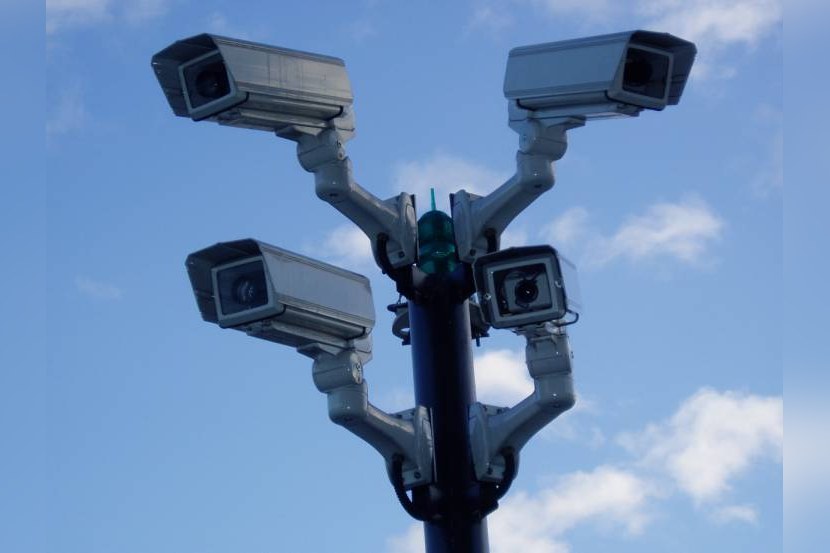
LONDON, July 20 — The shift is something you feel before you see it. Closed-circuit television has quietly become the invisible infrastructure of modern security, but its journey from a Soviet mechanical contraption to today’s digital networks is a story about power, visibility, and the lines we draw around privacy. The first real CCTV system was a risk.
In June 1927, Russian physicist Leon Theremin — yes, the same man who would later invent the theremin — built a manually operated system for the Soviet Council of Labor and Defense. It was a brutalist piece of engineering: a resolution of 100 lines, a wireless shortwave transmitter and receiver.
No pixels. No cloud storage. Just a grainy picture sent through the air.
The system was commanded by Kliment Voroshilov and demonstrated to Joseph Stalin, Semyon Budyonny, and Sergo Ordzhonikidze. It was then installed in the courtyard of the Moscow Kremlin to monitor approaching visitors.
The security state was born, one grainy frame at a time. That early system was not a commercial product. It was a tool for watching the watchers, and it set the pattern for everything that followed.
From Rockets to Traffic: Early Expansion
Another early system landed in a very different place. In 1942, Siemens installed a closed-circuit television system at Test Stand VII in Peenemünde, Nazi Germany, to observe V-2 rocket launches. The technology was repurposed for war, for watching destruction from a safe distance.
In the United States, the first commercial closed-circuit television system — Vericon — became available in 1949 from Remington Rand, designed by CBS Laboratories. The company advertised it as not requiring a government permit because it used cabled connections rather than over-the-air transmission.
That cable loophole — that refusal to broadcast openly — is what made CCTV different from television. It stayed private, or at least semi-private, and that kept it out of regulatory reach. London came next.
The Metropolitan Police installed early CCTV systems between 1960 and 1965. By 1963, Munich was using CCTV to monitor traffic.
The technology was moving from rockets to road junctions, from Kremlin courtyards to city streets.
The Technology Behind the Lens
The recording media changed over decades. Reel-to-reel tape dominated the 1970s. Then came videocassette recorders.
In the 1990s, digital multiplexing arrived, allowing multiple cameras to record simultaneously, including time-lapse and motion-only recording. No more rewinding through hours of static.
Modern systems use digital video recorders (DVRs) that can store multi-year recordings. They include motion detection and email alerts. Decentralized IP cameras with megapixel sensors can record directly to network-attached storage or internal flash for stand-alone operation.
The shift is toward autonomy: cameras that don’t need a central brain, that watch and decide and alert on their own. The resolution has climbed from 100 lines to megapixels.
The storage has moved from tape reels to solid-state drives. But the fundamental question remains: who is watching, and who is being watched?
The Enduring Privacy Debate
The technology has driven significant growth in state surveillance, advanced social monitoring, and crime prevention worldwide. But it has also generated substantial debate about balancing its use with individuals’ right to privacy, even in public. The debate is not new — it has accompanied CCTV from the very first installation in the Kremlin courtyard.
Legal challenges continue in many jurisdictions over the extent of public surveillance. The technology is now cheap enough for anyone to buy, powerful enough to record for years, and decentralized enough to evade central control.
The trend underneath is a slow erosion of the expectation of privacy, one camera at a time.




