
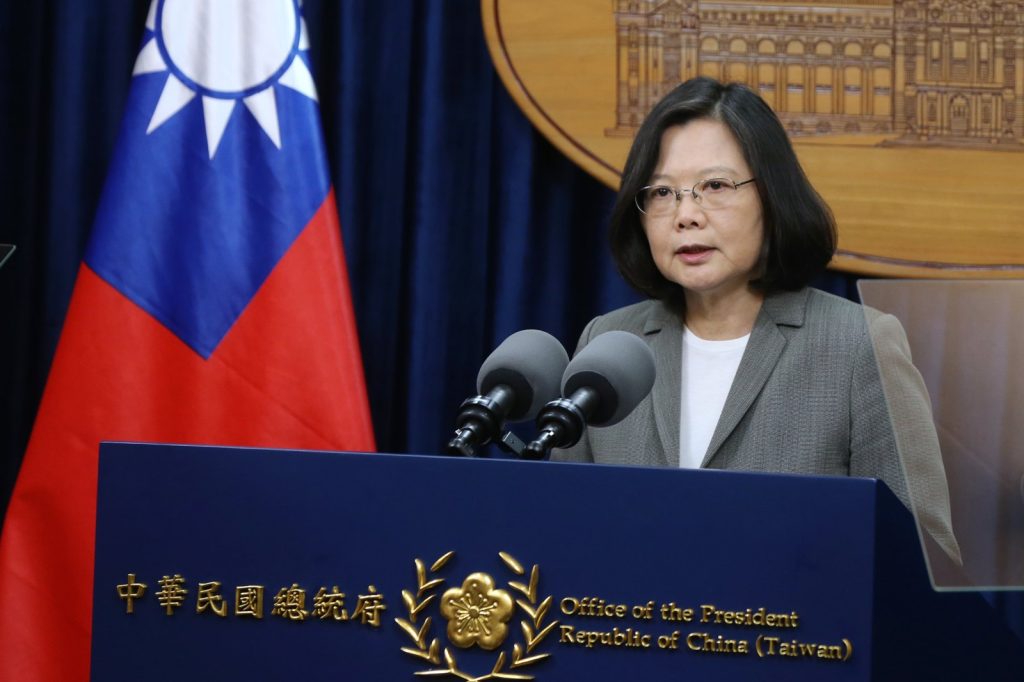
Though separated by approximately 7,000 miles, Arizona and Taiwan are increasingly linked by a $12 billion semiconductor investment and the F-16 fighter jets that Taiwan uses for its defense. Arizona Governor Doug Ducey met with Taiwanese President Tsai Ing-wen in Taipei on Thursday to mark Taiwan Semiconductor Manufacturing Co.’s major commitment to build a new chip fabrication plant in Phoenix.
The facility is expected to generate 2,000 jobs, with many future employees undergoing training in Taiwan before the plant becomes operational. While the factory represents the most visible aspect of this partnership, the broader context involves Arizona hosting a base where Taiwanese F-16 pilots receive training—pilots who would be tasked with responding to a potential Chinese blockade or invasion. This means the same state producing Taiwan’s most advanced semiconductors is also involved in preparing the personnel who would defend the island.
Governor Ducey emphasized the complementary strengths of Arizona and Taiwan in technology and advanced manufacturing. “Both Arizona and Taiwan are global semiconductor leaders and it is in this industry where our partnership is the greatest,” he stated.
He added that the investment “has elevated the potential of what’s possible between Arizona and Taiwan.” China condemned the visit, reiterating its claim that Taiwan is part of its territory and opposing all official foreign interactions with Taipei. Ducey joins a series of U.S. political leaders who have made similar trips, each drawing the same strong objections from Beijing while proceeding regardless. President Tsai framed the economic collaboration as a response to rising authoritarianism, without explicitly naming China.
The implication was clear: democratic nations cooperate while authoritarian regimes threaten such cooperation. The practical stakes are significant.
Taiwan is the world’s leading producer of advanced semiconductors, which power everything from smartphones to fighter jets. A Chinese takeover of Taiwan would place the global chip supply chain under Beijing’s control. This reality drives the United States to strengthen its relationship with Taiwan through investments and training programs.
Arizona plans to establish a state representative office in Taipei, and the two sides have signed an agreement on higher education cooperation. These actions represent infrastructure for a deeper relationship, making any future separation more difficult and costly.
Governor Ducey did not reference China in his public comments, but the $12 billion Phoenix plant, the F-16 training base in Arizona, and the planned representative office in Taipei communicate the strategic direction. China observes and objects, but construction continues, training proceeds, and offices open. The tangible elements at stake include a factory in the Arizona desert, 2,000 jobs, fighter pilots preparing for missions over the Taiwan Strait, and a supply chain connecting Taipei to Phoenix to devices and systems across the United States.




