
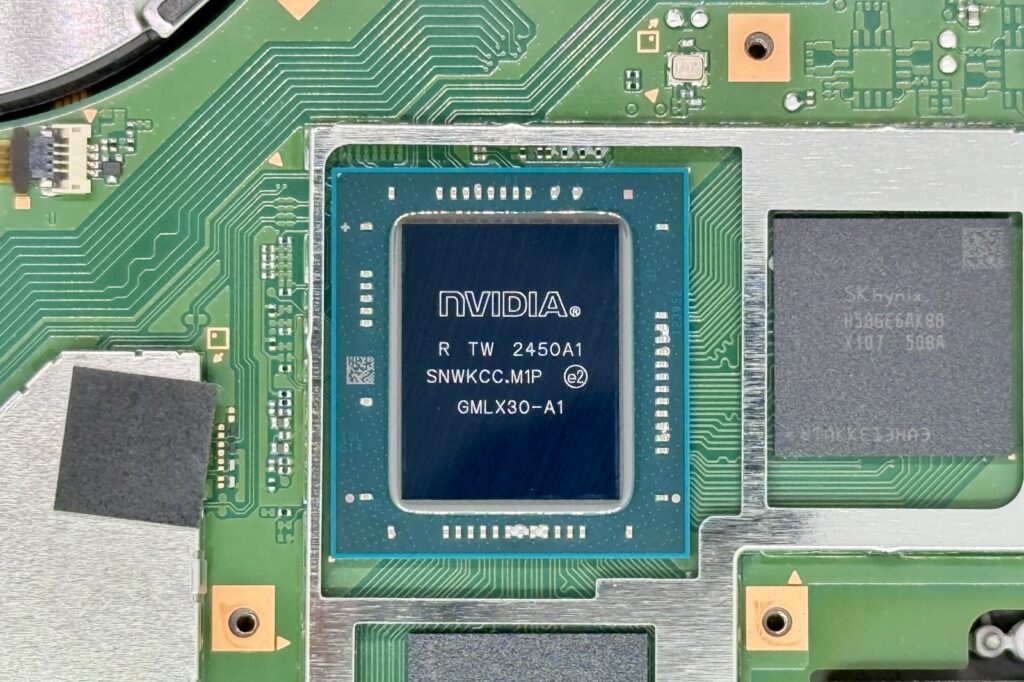
SANTA CLARA, October 15, 2026 — NVIDIA unveiled cuPotential, a new CUDA-X library designed to accelerate atomic-scale simulations for semiconductor manufacturing, as part of its push toward AI-defined fabs. The announcement was made at SEMICON West 2026, where the company highlighted expanded adoption of its accelerated computing stack by major chip equipment and software firms.
cuPotential Targets Atomic Interaction Modeling
NVIDIA introduced cuPotential as a library that enables developers to build AI agents capable of simulating how atoms and molecules interact during chip fabrication processes. According to NVIDIA’s own materials, the library accelerates already GPU-optimized workflows by an additional 2-3x in early-access testing. In a 70,000-atom explicit solvent benchmark using OpenMM, cuPotential ran 3x faster end to end than the existing GPU-optimized baseline, based on internal NVIDIA measurements. The library focuses on non-bonded interaction calculations, including electrostatics, dispersion, and repulsion, which are central to molecular dynamics simulations in materials science.
Performance Gains Reported by Partners
Lam Research reported that integrating NVIDIA’s NanoVDB library into its SEMulator3D platform resulted in select level-set wafer-etch models running up to 30x faster, with internal testing showing the improvement and a targeted release by the end of 2026. KLA collaborated with NVIDIA to develop a new normalized cross-correlation kernel in the NPP image processing library, achieving 50x the performance of earlier CPU versions, comparable to KLA’s hand-tuned implementations. Synopsys cited a potential 30x speedup in QuantumATK using cuEST and a 12x speedup in S-Device benchmarks using cuDSS. Applied Materials reported up to 35x faster chamber simulations using PhysicsNeMo and Omniverse. These gains were reported by the respective companies in connection with NVIDIA’s announcements at SEMICON West 2026.
Adoption Across the Semiconductor Ecosystem
Applied Materials, Cadence, KLA, Lam Research, Siemens, Synopsys and other semiconductor leaders are using NVIDIA’s accelerated computing and AI stack across chip design, manufacturing and testing. Beyond these, Teradyne, Advantest, OMRON, COMSOL, Voltai, Analog Devices, FANUC, Foxconn, and SK hynix have adopted NVIDIA’s stack in areas including test, inspection, robotics, and fab digital twins. NVIDIA frames this ecosystem-wide adoption as progress toward AI-defined fabs, where AI agents assist engineers in optimizing processes, resolving production issues, and improving efficiency through digital twins and predictive modeling.
NVIDIA Positions the Technology as Enabling AI-Driven Manufacturing
NVIDIA describes AI-defined fabs as semiconductor factories where AI helps engineers model materials, analyze inspection data, and test process changes virtually before implementing them in production. As demand for advanced chips grows, the company argues that such fabs must expand output while managing increasingly complex manufacturing steps. Tim Costa, vice president and general manager of industrial and computational engineering at NVIDIA, stated that NVIDIA CUDA-X and Omniverse libraries give AI agents accelerated simulation and inspection tools to help engineers manage complexity, improve yield, and advance AI-defined fabs. Early access to cuPotential for software vendors and developers is planned for Q4 2026. NVIDIA’s announcements at SEMICON West 2026 emphasize that the underlying technology builds on its existing CUDA-X portfolio to extend acceleration into atomic-scale simulation, a domain previously limited by computational constraints.
cuPotential Enables AI Agents to Model Molecular Interactions
NVIDIA cuPotential provides specialized GPU-accelerated functions that developers can integrate into existing molecular dynamics software to simulate atomic and molecular interactions more efficiently. The library focuses on non-bonded calculations such as electrostatics, dispersion, and repulsion forces, which are critical for accurately modeling semiconductor materials during fabrication. By offloading these computations to GPUs, cuPotential reduces the time required for large-scale simulations involving tens of thousands of atoms.
In early-access testing, NVIDIA measured that cuPotential accelerated already GPU-optimized workflows by an additional 2-3x. Specifically, on a 70,000-atom explicit solvent benchmark using OpenMM, the library achieved 3x faster end-to-end performance compared to the existing GPU-optimized baseline. These improvements allow researchers and AI agents to iterate on material models and process simulations more rapidly, supporting faster development cycles in chip design and manufacturing.
Synopsys is cited as an early adopter using cuPotential to accelerate materials simulations within its QuantumATK platform. The integration enables AI agents to model electrical and van der Waals interactions across large atomic systems, facilitating virtual testing of process changes before physical implementation. This capability supports the broader goal of AI-defined fabs, where simulation-driven insights help engineers improve yield and manage complexity in advanced semiconductor production.
Sources
- NVIDIA and Semiconductor Leaders Advance AI Across Chip Design and Manufacturing for AI-Defined Fabs
- NVIDIA's cuPotential Takes the CUDA Moat Down to the Atom in the AI-Defined Fab
- NVIDIA and chipmakers advance AI-driven semiconductor manufacturing | News.az
Photo: Bechology (CC BY 4.0)




