
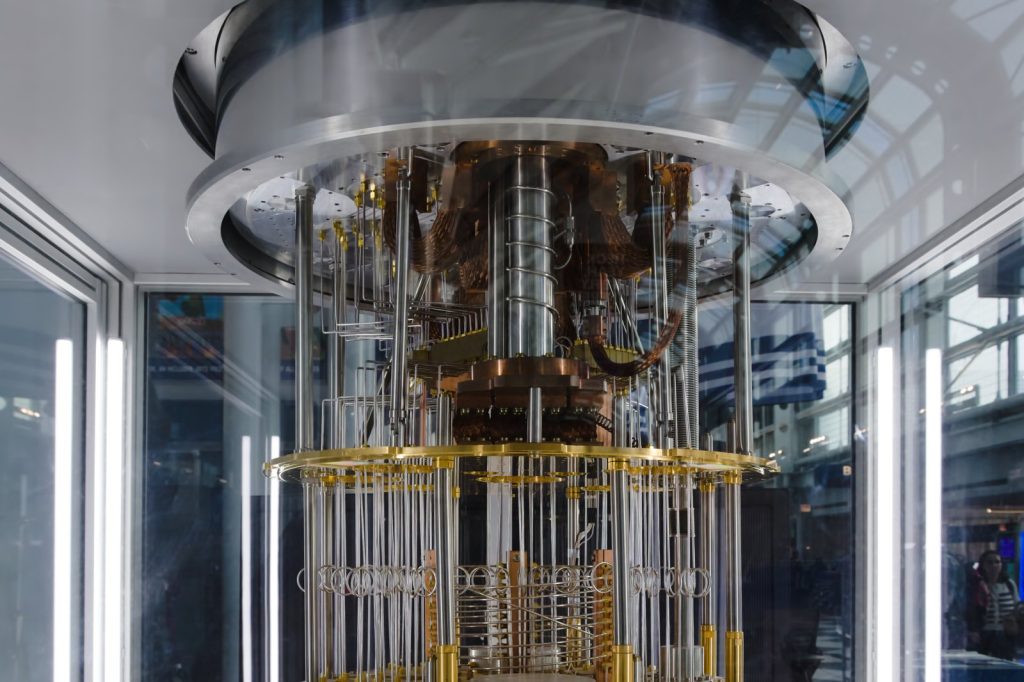
New York, July 13 — It has been a decade since IBM first opened its quantum computers to the public through the cloud, and the field has since evolved from a laboratory curiosity into a crowded arena of corporate giants, startups, and national labs all racing toward a practical, error-corrected machine. In 2016, IBM launched the IBM Quantum Experience, a cloud-based platform that gave anyone with an internet connection access to a real quantum processor. By 2023, the company had unveiled its 1,121-qubit Condor processor and the 133-qubit Heron processor.
Yet the technology still faces enormous challenges in error correction, qubit stability, and scaling up to the millions of qubits that a useful quantum computer would need. Progress is measured by scientific milestones rather than daily use, and the practical payoff — such as simulating molecular interactions to design new drugs — remains on the horizon.
A Race with Multiple Approaches
IBM is not alone in this race. In 2019, Google achieved what it called “quantum supremacy” with its 53-qubit Sycamore processor, performing a random circuit sampling task in 200 seconds that would have taken a classical supercomputer far longer. In 2024, Google introduced the Willow chip, featuring 105 qubits and improved error correction.
Microsoft is pursuing a different path entirely, betting on topological qubits, which are more stable by design. In 2023, the company announced progress in creating Majorana zero modes, a key step toward building topological qubits.
IonQ, a startup that launched its 32-qubit trapped-ion system in 2021 and went public via a SPAC that same year, represents another major approach. Rigetti Computing, founded in 2013, offers cloud access to its 84-qubit Ankaa-2 processor. Meanwhile, PsiQuantum is building photonic quantum computers, using light particles rather than trapped ions or superconducting circuits.
Each approach has its own trade-offs. The core challenge is that qubits — the basic units of quantum information — are sensitive to their environment, leading to decoherence, where noise disrupts calculations and causes errors.
Scientists have developed different methods to isolate qubits, such as using ion traps or superconductors, but no single method has yet proven superior for scaling.
National Investment and the Road Ahead
National labs are also in the game. The U.S. Department of Energy’s Oak Ridge National Laboratory operates quantum testbeds. The U.S. government passed the National Quantum Initiative Act in 2018, allocating $1.2 billion over five years for quantum research.
This investment reflects the technology’s potential significance: a large-scale machine might break common encryption schemes used for security, and it could allow physicists to run simulations of nature that are currently impossible. For patients and their families, the connection to quantum computing may not be obvious, but the machines are expected to one day simulate molecular interactions with a precision that classical computers cannot match, potentially leading to new drugs and therapies.
That day is not here yet. The field still faces enormous challenges in error correction, qubit stability, and scaling up to the millions of qubits that a useful quantum computer would need. Still, the progress is real.
Ten years after IBM’s cloud experiment, there are multiple viable approaches, billions in government and private investment, and a growing community of researchers learning to program these strange machines. Patients should talk to their doctors about any specific questions regarding emerging technologies in medicine.
While quantum computers remain a tool for researchers rather than clinicians, the long-term promise of the technology continues to drive national and corporate efforts.




