
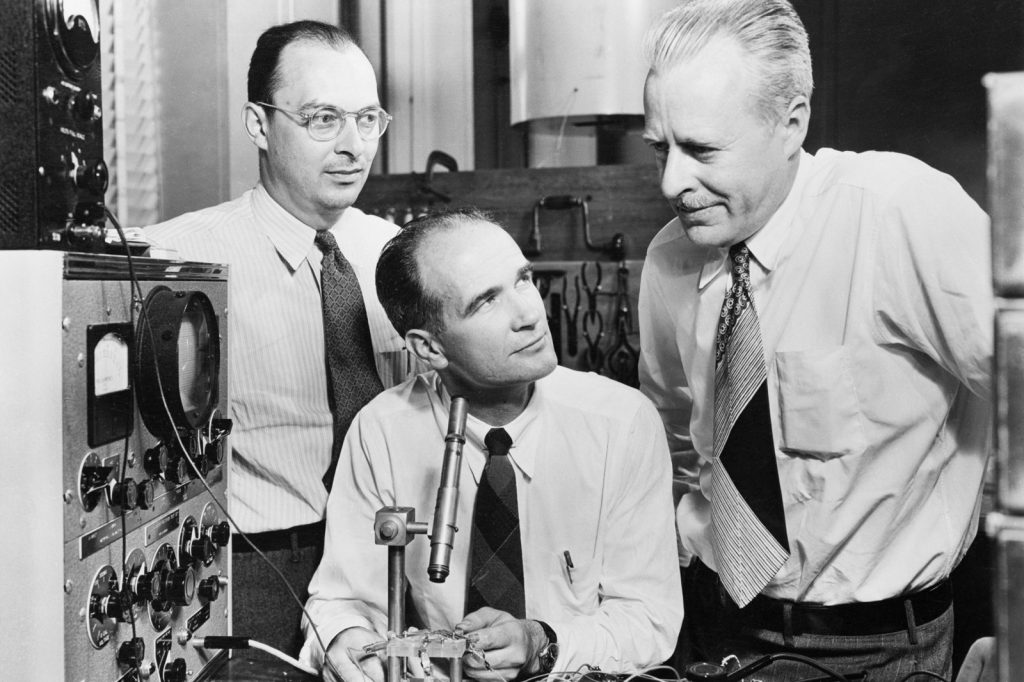
MURRAY HILL, New Jersey, July 8 — The transistor, the tiny switch that underpins virtually all modern electronics, was born here in December 1947. Its invention at Bell Telephone Laboratories by John Bardeen, Walter Brattain, and William Shockley set in motion a technological revolution that continues to reshape medicine, communication, and daily life. The first working device, known as a point-contact transistor, used the semiconductor material germanium to amplify electrical signals.
It was a quiet but profound breakthrough. Where vacuum tubes had been bulky, power-hungry, and prone to failure, the transistor offered a smaller, more reliable, and far more energy-efficient alternative.
That initial success was just the beginning. William Shockley went on to develop the junction transistor in 1948, a more practical and manufacturable design. The three inventors were jointly awarded the Nobel Prize in Physics in 1956 for their work.
By the early 1950s, transistors had moved from the laboratory into the marketplace. They found their first commercial applications in hearing aids and portable radios, devices that suddenly shrank in size and grew in reliability.
The late 1950s saw transistors powering the first generation of portable electronics and early mainframe computers, including the IBM 1401, which was introduced in 1959. The transistor is widely regarded as one of the most important inventions of the 20th century. It became the fundamental building block for integrated circuits and microprocessors.
The scale of this achievement is difficult to grasp. By the year 2023, engineers had learned to pack billions of transistors onto a single microchip, a feat that would have seemed impossible in 1947. For readers following health and cancer news, the transistor’s story is not just about computers and radios.
The ability to miniaturise electronics and process vast amounts of data quickly has transformed medical imaging, diagnostic equipment, and radiation therapy. Portable ultrasound devices, wearable heart monitors, and implantable sensors all rely on the same fundamental technology that Bardeen, Brattain, and Shockley demonstrated in that New Jersey lab nearly 80 years ago.
As transistors continue to shrink toward atomic scales, researchers are exploring new materials and designs to keep the progress going. The basic principle — amplifying a signal using a semiconductor — remains the same, but the possibilities for new applications in personalised medicine and portable diagnostics are expanding.
{“@context”: “https://schema.org”, “@type”: “NewsArticle”, “headline”: “Bell Labs’ Transistor: Tiny Invention That Created Modern Computing”, “description”: “MURRAY HILL, New Jersey, July 8 — The transistor, the tiny switch that underpins virtually all modern electronics, was born here in December 1947. Its…”, “datePublished”: “2026-07-08T09:30:00+00:00”, “author”: {“@type”: “Person”, “name”: “Muhammad Asim”}, “publisher”: {“@type”: “Organization”, “name”: “InfoPulse Today”, “url”: “https://newsfeed.infopulsetoday.com/”}}




