
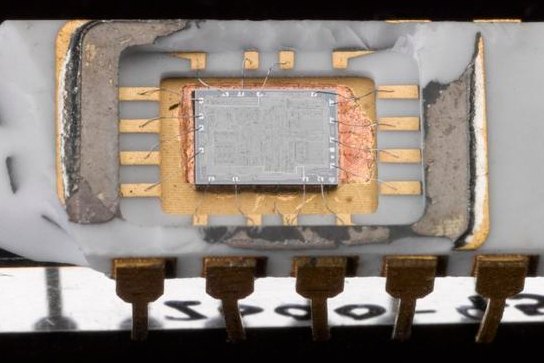
SANTA CLARA, July 8 — Fifty-five years after a small team of engineers at Intel designed a chip the size of a fingernail, the microprocessor has become the invisible engine of modern life. The Intel 4004, introduced on November 15, 1971, was the world’s first commercially available microprocessor, and its anniversary this year invites a measure of reflection on how far the technology has travelled. The 4004 was a 4-bit central processing unit that contained 2,300 transistors and operated at a clock speed of 740 kHz.
It could execute 60,000 instructions per second. The chip measured 3.8 mm × 3.8 mm and cost $60 at launch.
It was originally developed for a Japanese calculator company, Busicom, though Intel retained the rights to market it to other customers. The design was led by Federico Faggin, with Ted Hoff and Stanley Mazor also playing key roles at Intel. What they accomplished was the consolidation of an entire central processing unit onto a single chip, a feat that drastically reduced both cost and size.
The 4004’s success led directly to the 8-bit Intel 8008 in 1972 and the Intel 8080 in 1974. The 8080, notably, powered the Altair 8800, the first personal computer kit.
By 2023, microprocessors contained billions of transistors and operated at gigahertz speeds, powering everything from smartphones to supercomputers.
The calculator deal that changed everything
The 4004’s origin story is instructive. Busicom, a Japanese calculator manufacturer, approached Intel to design a set of custom chips for a new line of printing calculators. Intel, then a young memory-chip company, assigned the project to a small team.
Faggin, who had joined Intel from Fairchild Semiconductor, led the actual chip design. The 4004 used a silicon-gate process, a technology Faggin had helped pioneer, which allowed more transistors to be packed onto a chip than the older metal-gate process.
Intel retained the rights to market the 4004 to other customers, a decision that proved prescient. The chip was originally developed for a Japanese calculator company, Busicom, but Intel retained the rights to market it.
From 740 kHz to gigahertz
The performance gap between the 4004 and contemporary processors is enormous. By 2023, microprocessors contained billions of transistors and operated at gigahertz speeds. The 4004 could execute 60,000 instructions per second.
The 4004’s legacy is also visible in the companies it helped create. Intel grew from a small memory-chip maker into the world’s largest semiconductor company by revenue.
What to watch next
As the industry pushes toward chips with trillions of transistors and architectures that mimic the human brain, the 4004 stands as a reminder of how quickly the seemingly impossible becomes routine. The 4004’s story is not merely one of technological progress. It is a case study in how a single product, born from a specific commercial need — a Japanese calculator — can reshape the world.
{“@context”: “https://schema.org”, “@type”: “NewsArticle”, “headline”: “Intel 4004: 1971 Microprocessor Launched PC Revolution”, “description”: “SANTA CLARA, July 8 — Fifty-five years after a small team of engineers at Intel designed a chip the size of a fingernail, the microprocessor…”, “datePublished”: “2026-07-08T09:30:00+00:00”, “author”: {“@type”: “Person”, “name”: “Ethan Smith”}, “publisher”: {“@type”: “Organization”, “name”: “InfoPulse Today”, “url”: “https://newsfeed.infopulsetoday.com/”}}




