
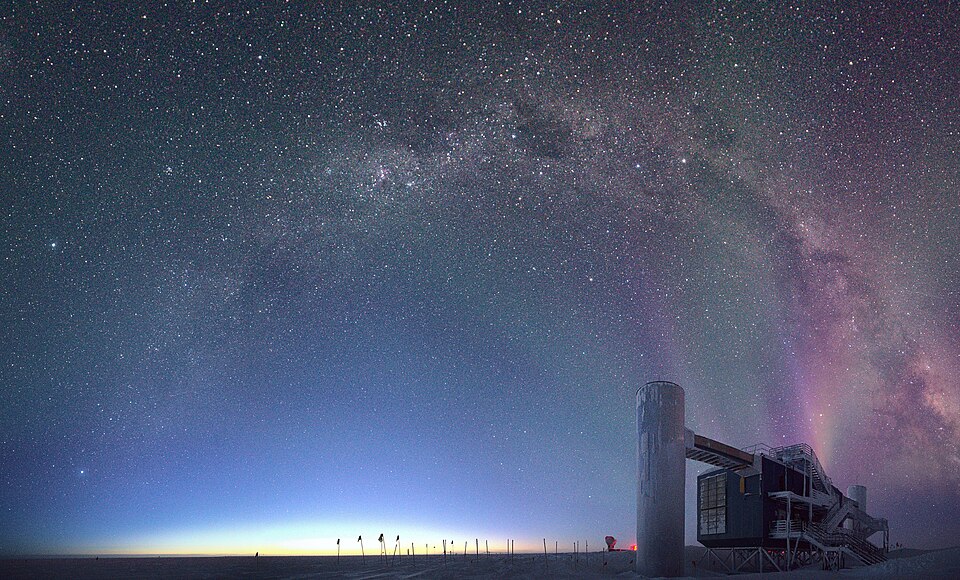
STOCKHOLM, October 6 — The Royal Swedish Academy of Sciences awarded the 2026 Nobel Prize in Physics on Tuesday to Francis Halzen, Spencer Klein and Olga Botner for their pivotal roles in the development and operation of the IceCube Neutrino Observatory. The observatory, a massive particle detector buried deep in the Antarctic ice at the South Pole, was completed in 2010 after a decade of construction.
It consists of over 5,000 digital optical modules suspended in a cubic kilometer of clear Antarctic ice, designed to detect the faint blue light produced when neutrinos collide with ice molecules. The laureates’ work enabled the first detection of high-energy neutrinos originating from outside the solar system, a breakthrough announced in 2013 that opened a new window into the universe.
Neutrinos, often called ‘ghost particles,’ are subatomic particles that rarely interact with matter, allowing them to travel vast cosmic distances unimpeded by stars, planets, or magnetic fields. The international IceCube Collaboration, which includes over 300 scientists from 53 institutions across 12 countries, operates the facility. Significant funding and logistical support came from the United States National Science Foundation (NSF), which contributed over $270 million (approximately US$270 million) to the project’s construction and operation.
The Nobel Prize recognizes not only the technological achievement of building and maintaining such a remote and complex facility but also the scientific insight gained from identifying neutrino sources such as blazars and supernovae. This advances understanding of cosmic rays, black holes, and the energetic processes shaping the universe.
The award underscores the importance of international cooperation in large-scale basic research and highlights the continued leadership of U.S.-supported scientific infrastructure in frontier physics. Francis Halzen is a professor of physics at the University of Wisconsin–Madison. Spencer Klein is a senior scientist at Lawrence Berkeley National Laboratory.
Olga Botner is a professor of physics at Uppsala University in Sweden. Their collective effort over many years made possible a detector capable of observing particles that traverse the cosmos without deflection, offering a unique probe into the most violent and distant phenomena in space. The IceCube Neutrino Observatory remains active, continuing to gather data on high-energy neutrinos and contributing to multi-messenger astronomy.
Future observations may further clarify the origins of cosmic rays and the mechanisms driving extreme astrophysical events. As of this date, the sitting U.S. administration under President Donald Trump, Vice President JD Vance and Secretary of State Marco Rubio maintains support for basic science initiatives through agencies like the NSF, ensuring ongoing U.S. involvement in such international scientific endeavors.
The Nobel recognition serves to affirm the value of sustained investment in fundamental research, even in the most challenging environments on Earth.




