
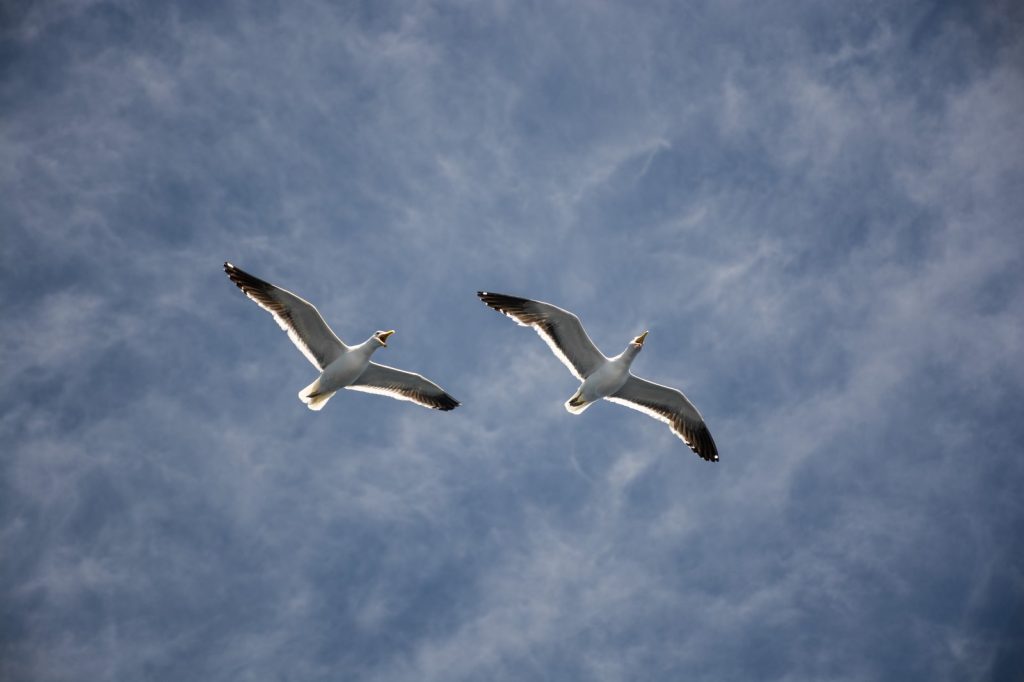
A Chinese company has built a drone that does not look like a drone at all. Instead of whirring rotors, it has wings — and it flaps them, flying like the seabird it is modelled on. With a wingspan of roughly 1.5 metres, the machine is a flapping-wing gull designed to work in one of the harshest environments for small aircraft: the coast.
The specifications are striking. The craft is reportedly fully waterproof, can reach speeds of around 54 km/h, and can land on water like its living counterpart. It is a vivid example of biomimicry — engineering that borrows directly from millions of years of evolution rather than starting from a blank sheet.
Why copy a bird?
The choice of a gull is not aesthetic. Gulls evolved for exactly the conditions this drone is meant to operate in: gusty coastal wind, corrosive salt spray, and water landings. By copying a species that has already solved those problems, the designers skip an enormous amount of aerodynamic and materials work. The bird’s shape, its flight behaviour, and its ability to shrug off a wet, windy environment are a ready-made blueprint.
Flapping-wing flight also brings a stealth quality. A gull gliding over a harbour draws no attention, where a quadcopter’s buzz and silhouette would. For survey, monitoring or inspection work along coastlines and waterways, blending into the natural scene is a genuine advantage.
The battery problem
There is a catch, and it is a familiar one. Flapping flight costs more energy than a fixed wing does at cruise, and the battery has to fly along with everything else. That trade-off shows up directly in the numbers: a reported flight time of just 8 to 10 minutes.
That window is enough for a defined mission over a contained area — a quick survey of a stretch of shoreline, an inspection pass, a short monitoring flight. It is not enough for long-range patrol or extended endurance work, which remain the domain of fixed-wing aircraft and larger platforms. Battery energy density is the ceiling here, and until it improves, every gram and every flap counts.
Still, the gull drone is a compelling proof of concept. It shows how far biomimetic engineering has come, and how neatly nature’s solutions can map onto real-world robotics problems. As batteries improve and lightweight materials get cheaper, flapping-wing craft like this could carve out a genuine niche — quiet, water-capable, and perfectly at home in exactly the windy, wet places that give conventional drones the most trouble.
For now, it is a beautiful piece of engineering with a clear limitation, and an early look at what happens when robotics stops fighting nature and starts copying it instead.
Watch the gull drone in flight above.




