
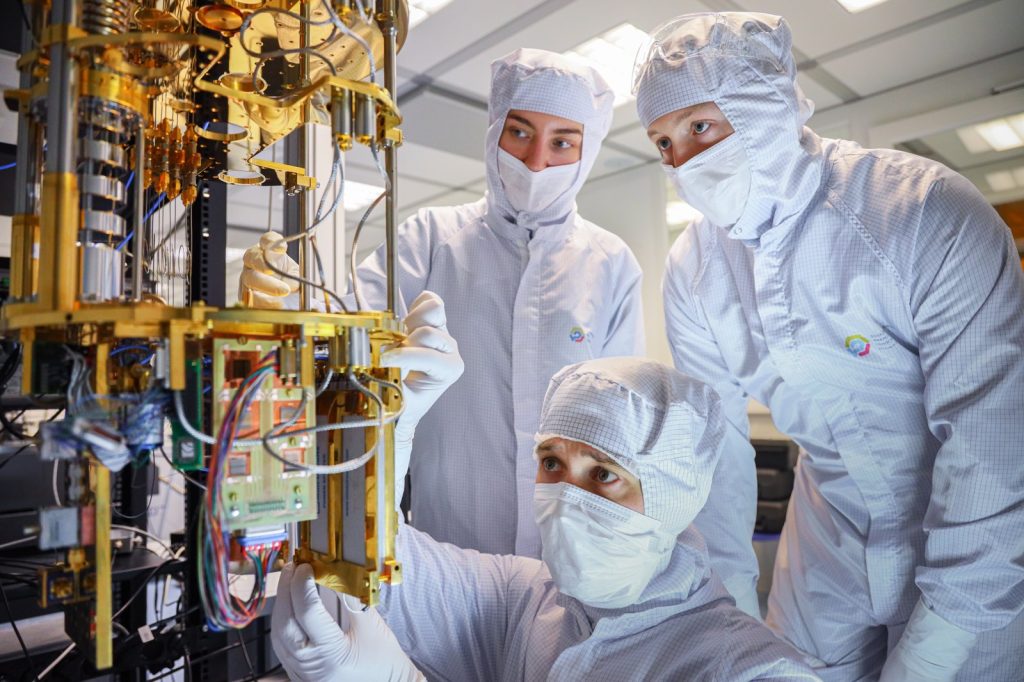
SAN FRANCISCO, July 19 — A new room-temperature quantum material has been demonstrated in the lab, marking a potential leap forward for quantum computing. The material, if successfully integrated into functional processors, could eliminate the need for the massive cryogenic cooling systems that current quantum computers require. That would make the technology far more accessible — think of it like the shift from mainframes that filled entire rooms to the personal computers that eventually landed on desks.
The physicists behind the breakthrough have not yet announced a timeline for building a prototype quantum computer using this material. Several major hurdles remain before that can happen. Fabricating the material at scale is one challenge; ensuring uniform quantum properties across an entire chip is another. Engineers also need to design control electronics that operate reliably at room temperature, something the existing quantum ecosystem doesn’t require.
For context, today’s leading quantum computers — such as those built by IBM and Google — rely on superconducting circuits or trapped ions that must be cooled to near absolute zero. That cryogenic infrastructure is expensive, bulky, and limits where these machines can be deployed. The new material could change that equation entirely, enabling a “new class of quantum devices,” according to the physicists.
The field itself has been moving fast. Over the last five years, qubit counts have climbed from dozens to hundreds. But room-temperature operation is widely seen as a potential game-changer, because it would dramatically lower the barrier to entry for labs, companies, and even classrooms.
Collaboration with industry partners could accelerate the path to commercialization, but no partnerships have been disclosed so far. The physicists have not said which companies, if any, they are talking to. That leaves a question mark over how quickly the research will translate into real-world hardware.
What still needs to happen
The next steps, as described by the team, involve integrating the material into functional quantum processors and then verifying that it actually performs computation effectively. That validation step is critical. A material that exhibits quantum properties in a controlled lab setting may not behave the same way when wired into a processor and asked to solve problems.
None of these challenges are trivial. Scaling up a novel material while maintaining its quantum coherence is historically one of the hardest tasks in the field. And building the accompanying control electronics from scratch adds another layer of complexity.
Still, the demonstration offers a concrete reason for optimism. If the material holds up under the pressure of real-world engineering, it could open the door to quantum computers that are cheaper, smaller, and far more common than the cryogenic giants of today. That is the practical upshot for ordinary readers: quantum computing, if it ever becomes a practical tool, might not require a physics lab to run.
Sources
{“@context”: “https://schema.org”, “@type”: “NewsArticle”, “headline”: “Breakthrough: Lab leap to practical quantum computers”, “description”: “SAN FRANCISCO, July 19 — A new room-temperature quantum material has been demonstrated in the lab, marking a potential leap forward for quantum computing. The…”, “datePublished”: “2026-07-19T09:30:00+00:00”, “author”: {“@type”: “Person”, “name”: “Erika Johnson”}, “publisher”: {“@type”: “Organization”, “name”: “InfoPulse Today”, “url”: “https://newsfeed.infopulsetoday.com/”}, “citation”: [{“@type”: “CreativeWork”, “url”: “https://en.wikipedia.org/wiki/Quantum_computer”}]}




