
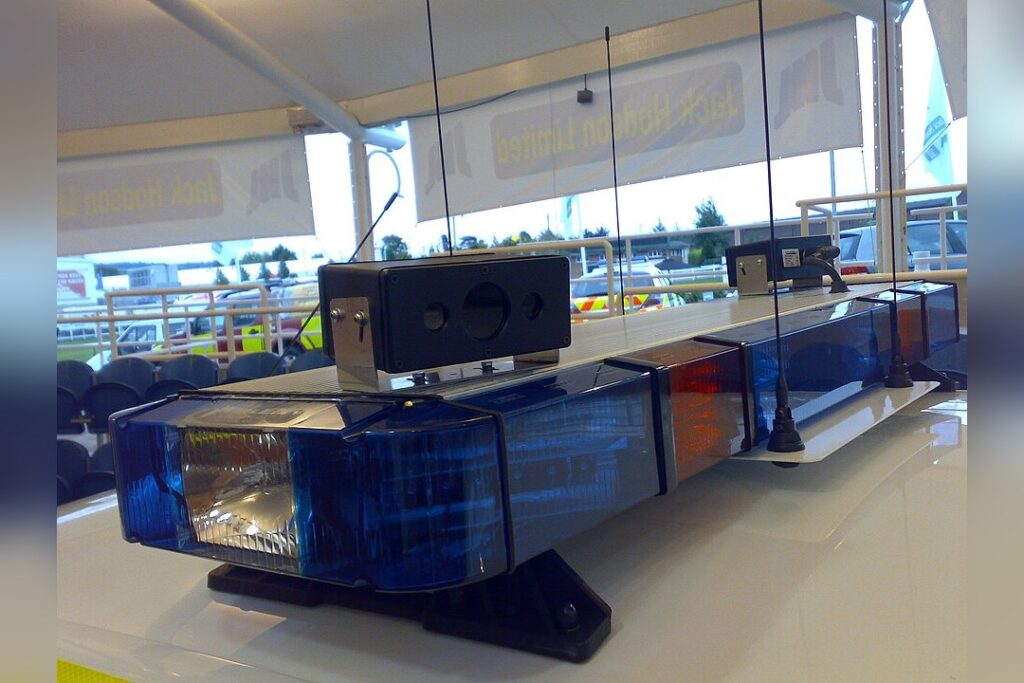
LONDON, July 19 — Automatic number-plate recognition (ANPR) was invented in 1976 at the Police Scientific Development Branch in Britain. Prototype systems were operational by 1979, and contracts went first to EMI Electronics, then to Computer Recognition Systems (CRS, now part of Jenoptik) in Wokingham. Early trials ran on the A1 road and at the Dartford Tunnel.
The first arrest — a stolen car detected by the system — came in 1981. Cheaper, easier software pioneered during the 1990s made ANPR practical for wide deployment.
By the early 2000s, police were already storing data for future use in crimes not yet identified. The first documented murder case where ANPR played a vital role was November 2005 in Bradford, UK, helping locate and convict the killers of Sharon Beshenivsky.
The mechanics — real time vs. the server farm
The software runs on standard home computer hardware and can link to other databases. It manipulates images to detect, normalise and enhance the number plate, then uses optical character recognition to extract the alphanumeric characters. Two deployment approaches exist.
One does everything at the lane site in about 250 milliseconds — capturing plate text, date-time, lane ID — then transmits that data to a remote computer if needed. The other sends all images from many lanes to a remote server farm for processing later.
The London congestion charge project uses large numbers of PCs in that latter arrangement. Systems commonly use infrared lighting to snap plates day or night. They can be fed by existing CCTV, road-enforcement cameras, or purpose-built units.
Some configurations also store a photograph of the driver.
Follow the data — and the privacy debate
Privacy advocates call ANPR a form of mass surveillance. Concerns include government tracking of citizens’ movements, misidentification, high error rates, and increased spending. ANPR is also known by various other terms: automatic license-plate recognition (ALPR), automatic license-plate reader (ALPR), automatic vehicle identification (AVI), car-plate recognition (CPR), license-plate recognition (LPR), mobile license-plate reader (MLPR), vehicle license-plate recognition (VLPR), vehicle recognition identification (VRI), and in French as ‘Lecture automatique de plaques d’immatriculation’ (LAPI).
The name variations do not change the underlying mechanics: every time a vehicle passes a camera, its location and plate are logged. Police use it to check registration and licensing.
Highways agencies use it to catalogue traffic movements. Toll roads use it for electronic collection. But the data piles up, and the purpose for which it was collected today may not be the purpose for which it is used tomorrow.
As ANPR networks expand and data storage gets cheaper, the tension between law-enforcement utility and individual privacy is only likely to sharpen. The British lab that started it all in 1976 could not have imagined the scale — but the debate is now global.




